The FDE Engineer's Perspective: Why Enterprise Agent Projects Die the Moment They Go Live

Enterprise AI projects keep failing because companies lack FDEs who can bridge technology and real business complexity.
This article, based on an FDE-focused Agent tutorial series, examines why enterprise AI projects so often fail at deployment. It identifies three root causes — models can't access private data, AI value is hard to quantify, and business and security teams are misaligned — then traces a financial reimbursement Agent case from requirements to failed rollout, showing how hidden business rules (city-tier expense caps, time-based ride policies, handwritten annotations) are the real killers that demos never surface but real deployments cannot survive.
Why 99% of Agent Tutorials Leave You Unable to Ship Anything Real
Most Agent tutorials on the market share two persistent flaws. First, they get the order backwards — they open with a pile of jargon (tool calling, task planning, memory mechanisms, the ReAct framework) before the reader has built any mental model at all. Second, they sell a "learn Agent in ten minutes" fantasy. Students run the code, clone someone else's finished product, and walk away without understanding the underlying principles, without knowing how to tune anything, and without any idea how to adapt it to a real business context. Change the scenario, and the whole thing falls apart.
The core argument of this tutorial series is straightforward: a genuine hands-on introduction to Agent development must start with the logic before touching the project. Ditch the hollow jargon and the empty speed-runs. Use plain-language examples to truly internalize Agent core principles, build a complete mental framework first, then work up to real projects step by step — until you can independently handle the full pipeline from requirements analysis and solution design all the way to deployment.
That logic points directly to one of the hottest roles right now: the FDE (Forward Deployed Engineer). An FDE isn't just someone who calls models. They're the critical link that actually gets large language models working inside traditional enterprises — driving down costs and lifting output in measurable ways.
Three Root Causes Behind the "Ships and Dies" Pattern in Enterprise AI
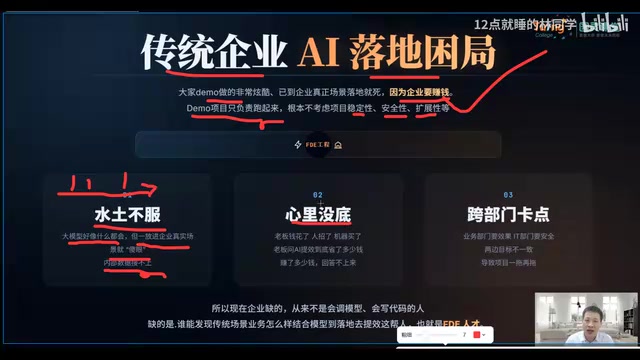
This tutorial series hammers on one brutal truth: over the past few years, a huge number of traditional enterprise AI projects produced demos that looked increasingly impressive — and then died the moment they actually went live. Three root causes explain why.
First, the model "won't take orders." No matter how capable a large model seems, the instant you drop it into a real business environment — finance, legal, power utilities — it can't connect to the company's private data, and it immediately becomes useless. Models are trained on publicly available internet data. The proprietary rules and internal data inside an enterprise are completely invisible to them.
Second, value can't be quantified. Eight or nine out of ten executives want to embrace large models. They spend heavily on talent, hardware, and compute. But the moment the CEO asks "exactly how much has this project improved our efficiency, cut our costs, or generated in revenue?", the team goes quiet. Companies need to make money — not ship demos.
Third, business requirements and security review operate in separate worlds. The business side wants results. The security side wants compliance. Their standards conflict, and projects get stuck in the middle with no way forward.
The conclusion is blunt: companies have never been short of people who can call a model. What they lack is talent that knows how to use large models to drive genuine digital transformation — real cost reduction and real efficiency gains. That's the soil from which the FDE role grew.
Who Should Consider Transitioning Into FDE
This tutorial series is explicit: FDE is an excellent transition target for engineers coming from traditional technical backgrounds. Whether you're in traditional architecture, Java development, front-end, Python, or you're a senior engineer looking for a new direction — this role is accessible.
Its value lies in bridging large model technology with real enterprise scenarios. The series draws on multiple real-world project types the team has actually delivered as teaching cases, including: intelligent logistics systems (inventory queries and warehouse data updates for logistics companies with complex nodes and high labor costs); smart medical record management platforms for large hospitals (using multimodal models plus RAG to replace the massive volume of repetitive case documentation physicians deal with); intelligent work order dispatch for traditional industries (a standard use case in real estate, agriculture, and manufacturing); intelligent customer service for e-commerce (covering high-variability, multimodal retrieval relevance scenarios); and a project deployed by a publicly listed Chinese beverage company through a major e-commerce platform.
These cases span logistics, healthcare, e-commerce, manufacturing, and finance. What they share is that all of them involve the combined demands of enterprise-grade stability, security, scalability, and maintainability — not a single-feature demo.
The FDE role was first systematically defined and promoted by Palantir. Unlike traditional software engineers, FDEs are embedded directly in the client's operational environment, responsible for deeply integrating a technology product with the company's actual workflows. In the large model era, the role has taken on new meaning: it's no longer just about model integration and system connectivity — it also requires cross-functional capabilities including requirements discovery, business process analysis, and ROI modeling. In China, some companies call this role a "Solutions Engineer" or "AI Deployment Engineer," but the core logic is identical: acting as a translator between technical capability and business value. Compensation for these roles typically exceeds that of pure development positions, because the expectation is that the engineer can independently drive a project from inception to delivery — not just own one technical module.
Case Study: How a Financial Expense Reimbursement Agent Fell Apart

The tutorial uses a real "multimodal financial reimbursement project" as its central case study, tracing exactly how a project without FDE involvement unravels step by step.
Step one: the request. The CFO says, "I want a system that automatically reviews invoices." That sounds simple. Nearly every failed project starts with a sentence just like it.
Step two: the requirements document. The product manager takes the request and writes it up — the blueprint for the building. The problem: if the PM lacks the skills or doesn't go on-site to do proper discovery, what gets written is an incomplete document.
Step three: technical review and development. Engineers review the document and start building. But many developers just write code — they don't understand the business, they don't probe the requirements, they take the document and "artistically write software" without doing any risk or architecture assessment.

Step four: the PoC demo. Engineers build a demonstration version first — like a model apartment before construction begins — for the executive to review. The executive says, "That's exactly what I want," and the project is formally kicked off.
Step five: full rollout into live business operations. This is where everything breaks.
PoC (Proof of Concept) is a standard preliminary phase in enterprise software projects, designed to validate technical feasibility at minimum cost. In AI projects, the PoC phase typically uses hand-picked clean data, manually constructed ideal inputs, and simplified business logic — which is why success rates are high and demos look great. The problem is that PoC "success" is easily misread by decision-makers as proof that the project is viable, leading them to skip proper assessment of real data quality, edge case coverage, and internal rule integration — and push straight into full-scale development. This gap between PoC and full rollout, with no adequate "risk bridge" in between, is one of the most common structural reasons AI projects fail. It's precisely why FDEs need to be involved at the review stage to force identification of risk points before they become catastrophic.
Go-Live, Immediate Collapse: Hidden Business Rules Are the Real Killer
Financial workflows demand extreme data accuracy — a single wrong digit on an invoice can cause serious losses. The problems that emerge in real business environments go far beyond anything a demo would surface:
- Invoice formats are a mess: paper and electronic invoices mixed together; photos with glare, missing fields, duplicate invoices the system can't detect; OCR producing constant errors.
- Massive volumes of hidden rules: travel reimbursement has city-tier standards (different hotel caps for Tier 1 vs. Tier 2 cities); ride-hailing has time-based rules (e.g., rides after 9 PM are not reimbursable; rides before 9 PM are). No matter how capable a large model is, it has no idea these rules exist — they are proprietary to the company and have never appeared in any public data.
- Handwritten annotations: expense forms may include handwritten notes. The automated Agent system fails on these non-standard submissions, and the entire workflow breaks down.
This is the "high-frequency disaster" of enterprise deployment — the demo phase never encounters these problems, but in a real environment, any single one of them is enough to kill the project.
RAG (Retrieval-Augmented Generation) is the dominant technical solution for the core problem of large models being unable to access enterprise private data. The basic principle: before the model generates a response, relevant document chunks are retrieved from the company's internal knowledge base and injected into the model's prompt as context, allowing the model to answer based on private data without needing to be retrained. But RAG is not a universal solution — for structured business rules like "ride-hailing is only reimbursable before 9 PM," pure semantic retrieval is often unreliable. A rules engine or structured database is far better suited to managing and validating that kind of logic. This means real enterprise Agent systems typically need to combine RAG, structured rule repositories, multimodal OCR, and other techniques — not rely on any single approach.
Closing Thought: The Core FDE Skill Is "Making the Logic Actually Work"
The central message of this tutorial series is worth remembering for anyone trying to ship real AI systems: what you learn from a tutorial is entry-level at best. Everyone you're competing with has learned the same thing. A running demo is not a deployable enterprise product. Enterprise deployment demands stability, security, scalability, and maintainability — and the ability to quantify business value in concrete terms.
The real capability of an FDE is not fluency with API calls. It's going deep into the business environment, surfacing the hidden rules, designing an architecture that can withstand real-world data, and building something that actually makes the company money. For technical professionals looking for a high-value transition in the large model era, this is a direction genuinely worth paying attention to.
Note: This article is based on content from a Bilibili tutorial series. The project cases and technical claims described reflect a single source. Actual teaching quality and project details should be verified against the full course.
Related articles

A Single Prompt Triggers a Global PHP Security Storm: Is AI a Savior or a Hidden Risk?
A single AI prompt triggered a global PHP security crisis affecting Wikipedia and the Internet Archive. This article reviews the incident, analyzes the OpenAI-Amazon controversy, and explores the security paradox of lowered vulnerability discovery barriers in the AI era and developer response strategies.

When AI Is Taken Away: How Reliance on Shortcuts Undermines Your Problem-Solving Resilience
A study of 1,222 people found that after using AI to answer questions, once AI was removed, people gave up on more problems than a control group that never used AI. The article analyzes the impact of AI reliance on learning resilience and metacognition, and explores design implications for AI learning tools.

Carta and NewView Partner to Let Startup Employees Cash Out Equity Early
Carta and NewView Capital partner to simplify startup tender offers, helping employees sell equity early. Analysis of the mechanism, liquidity pain points, and impact.