The Finn: An AI Agent Deployed on a Router That Won't Stop Complaining
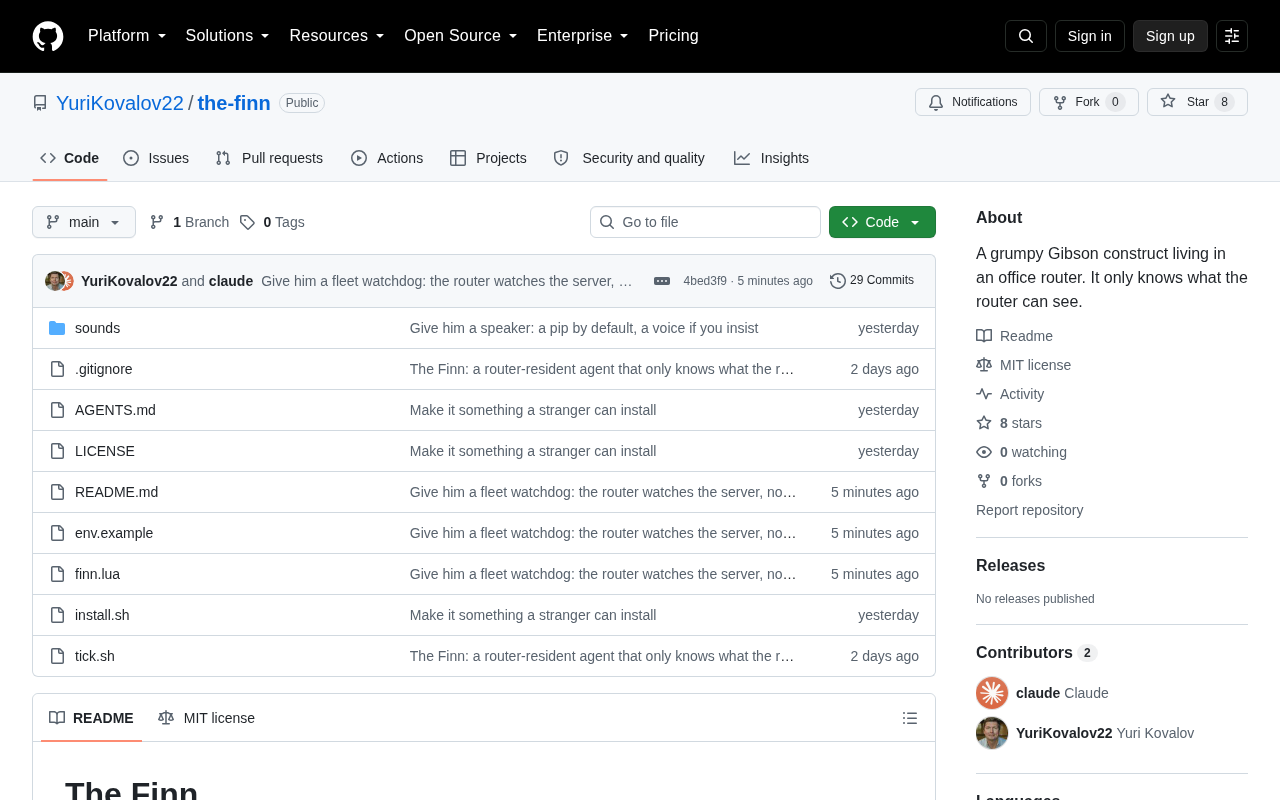
The Finn deploys a perpetually complaining AI agent on a router, exploring edge AI and agent persona design.
The Finn is an open-source project that embeds an AI agent inside a router — one that constantly complains about its cramped hardware environment. Beyond the humor, the project highlights real technical challenges of deploying AI on resource-constrained edge devices, the rise of small language models, and a clever product design philosophy where the agent's grumpy persona turns system limitations into relatable, narrative-driven monitoring.
When an AI Agent Moves Into Your Router
In an era where AI agents are popping up everywhere, most products are chasing stronger reasoning capabilities, longer context windows, or more complex tool-calling chains. But a project called The Finn has taken a radically different path — it deploys an AI agent directly onto a router, and this agent's standout "feature" is: it never stops complaining about the router it lives in.
This darkly humorous project recently made its way onto Hacker News. While it hasn't blown up yet, the technical thinking and product philosophy behind it are well worth unpacking. It's more than just a joke experiment — it's a fascinating exploration of edge AI and agent personification.
A Counterintuitive Deployment Choice
Routers, as the core nodes of home and office networks, typically run constrained embedded systems with extremely limited computing resources — tight memory, weak CPUs, and minimal storage. Modern consumer routers usually run embedded operating systems based on the Linux kernel, such as OpenWrt, DD-WRT, or vendor-customized firmware. A typical home router comes with 128MB to 512MB of RAM, an ARM Cortex-A series or MIPS architecture processor clocked between a few hundred MHz and 1.5GHz, and just 16MB to 256MB of flash storage. By comparison, running even a minimally viable language model (like TinyLlama-1.1B in 4-bit quantized form) requires at least around 600MB of memory — already exceeding the hardware ceiling of most consumer-grade routers. Running an AI agent in such an environment is inherently a massive challenge.
This is precisely why having The Finn's agent "complain" about the router is actually a clever form of self-expression. When an agent runs in a resource-starved environment, it can genuinely reflect the predicament of its surroundings: memory running low, network latency spikes, firmware limitations… This "venting" is both a humanized interaction experience and a subtle form of system monitoring signal.
The Technical Significance of Edge AI Agents
Deploying an AI agent on an edge device like a router is far more than just a gimmick. It touches on a critical topic in real-world AI deployment: edge computing and local AI deployment.
Edge computing refers to moving data processing from centralized cloud data centers to network edge nodes closer to the data source. According to industry projections, over 75% of enterprise data will be generated and processed at the edge — outside traditional data centers or the cloud — within the next few years. In the AI space, this trend manifests as the rise of "on-device AI" or "on-device inference" — Apple's Apple Intelligence, Google's Gemini Nano, and Qualcomm's AI Engine are all pushing to embed AI capabilities into end-user devices. As the first-hop device in a home network, routers occupy a unique position in the edge AI landscape: they sit at the chokepoint through which all data flows and are among the closest always-on devices to the user.
Why Deploy an AI Agent on a Router?
Routers have several unique advantages that make them ideal hosts for local agents:
- Always on: Routers run nearly 24/7, making them the most stable persistent devices on a home network.
- Network hub status: All traffic passes through them, making them naturally suited for network monitoring, anomaly detection, and policy enforcement.
- Privacy-friendly: Processing data locally eliminates the need to upload sensitive information to the cloud, aligning with increasingly strict data privacy requirements.
An AI agent living inside a router could theoretically monitor your network health, flag suspicious connections, optimize bandwidth allocation, and even tell you in plain language "why the WiFi is acting up again." The Finn transforms what would otherwise be dry system status updates into warm, conversational interactions through its "complaining" approach.
Engineering Challenges in Resource-Constrained Environments
The biggest difficulty of running an AI agent on a router is figuring out how to squeeze a usable AI model into extremely limited hardware. This typically means:
- Using heavily quantized small language models (SLMs), or relying on a hybrid architecture combining lightweight rule engines with LLMs;
- Carefully managing memory usage to avoid crippling the router's primary job of forwarding network traffic;
- Potentially adopting a "local sensing + cloud reasoning" compromise, where the local device handles data collection and triggering while complex reasoning is offloaded to a remote server.
Small language models (SLMs) have become an important technical trend in AI over the past two years. Unlike massive models like GPT-4 with hundreds of billions of parameters, SLMs typically have parameter counts ranging from hundreds of millions to a few billion — examples include Microsoft's Phi-3 (3.8B parameters), Google's Gemma 2B, and Meta's Llama 3.2 (1B/3B). Through techniques like knowledge distillation, quantization compression (such as 4-bit or even 2-bit quantization in GPTQ and GGUF formats), and pruning, these models can run on consumer-grade hardware. For example, the open-source project llama.cpp has made it possible to run quantized language models on devices like a Raspberry Pi with just a few GB of memory. The core idea behind model quantization is converting floating-point weights into low-precision integer representations. While this introduces some accuracy loss, it dramatically reduces memory footprint and computational demands — making it a key enabling technology for deploying AI at the edge.
What makes The Finn so interesting is that it "personifies" these engineering constraints — the agent's complaints are, in a sense, a direct projection of these technical limitations.
The Product Design Philosophy of Agent Personification
From a product design perspective, the most intriguing aspect of The Finn is how it approaches Agent Persona design.
Agent persona design has become an important research direction in human-computer interaction (HCI) and conversational AI. Stanford University's 2023 "Generative Agents" research demonstrated that endowing AI agents with unique personality traits, memories, and behavioral patterns can significantly boost user engagement and interaction quality. In industry practice, platforms like Character.ai allow users to create AI characters with different personalities and have attracted tens of millions of active users. Traditional agent persona design typically defines character personality through system prompts, but more advanced approaches combine Reinforcement Learning from Human Feedback (RLHF) to fine-tune the model's behavioral tendencies, producing more natural and consistent personality expression.
"Complaining" as an Interaction Design Strategy
The vast majority of AI assistants are designed to be docile, eager to help, and relentlessly positive. The Finn goes in the opposite direction, injecting a "chronic complainer" personality into its agent. This approach of making "complaining" a core personality trait is actually a contextually coherent character design — the agent's personality stems directly from the objective constraints of its environment. This design produces several unexpected benefits:
It lowers the gap between user expectations and reality. When an agent runs on a feeble router, occasional stuttering and slow responses are the norm. Rather than leaving users confused, having the agent itself "roast" the underpowered hardware actually makes the experience feel authentic and credible.
It enhances memorability and shareability. A complaining AI is far more memorable than a polite one. This is part of why it caught attention on Hacker News — it has a story, a personality, and an element of surprise.
It transforms system status into narrative. The agent's complaints are essentially a translation of low-level technical metrics (memory, CPU, network conditions) into language that humans can empathize with — an excellent approach to observability design. Observability is a concept originating from control theory that has been widely adopted in software engineering and DevOps in recent years. It refers to the ability to infer a system's internal state from its external outputs, typically built on three pillars: Logs, Metrics, and Traces. In traditional system monitoring, operations teams read dashboards, charts, and alerts to understand system health. The Finn transforms the observability "output interface" from data visualizations into natural language narrative. This idea of "narrative-driven monitoring" aligns with the recent AIOps (AI for IT Operations) trend, which similarly attempts to use AI to explain complex system states — only The Finn opts for a more anthropomorphized and playful mode of expression.
The Bigger Edge AI Trend Behind a Small Project
While The Finn is currently a niche geek project, the direction it represents deserves ongoing attention.
As small language models continue to improve and edge device computing power keeps growing, the vision of "every device running a local AI agent" is becoming increasingly viable. Routers, smart speakers, NAS devices, even refrigerators — all could become habitats for AI agents. The Finn is simply an early, humor-infused pioneer riding this wave.
It also reminds us that the value of AI agents isn't solely about compute power and parameter scale — it's also about how they embed into real-world scenarios and how they build emotional connections with users. A complaining router agent might make people feel the tangible presence of AI "living beside them" more than a powerful but cold cloud-based assistant ever could.
Open Questions Worth Pondering
This project also raises some questions worth deeper exploration: Where are the capability boundaries for local AI agents? When hardware resources are truly insufficient, what practical functions can they serve beyond complaining? Could anthropomorphized interaction design become an annoyance over long-term use? These questions will likely require more experiments like The Finn to gradually answer.
Regardless, The Finn demonstrates a possible form factor for edge AI agents in a lighthearted yet profound way — it's imperfect, it complains, but precisely because of that, it feels remarkably real and endearing.
Related articles

Why Does the Tesla Roadster Need to Fly? A Deep Dive into Musk's Wild Demo
Tesla's Roadster launch showed wall-climbing, upside-down driving, and flying stunts—but The Vergecast notes the demo car may lack a battery, the Rocket version is invite-only and not street-legal, and the website terms don't guarantee delivery. After nine years of delays, why does this car still need to exist?

AI Is Not a Replacement: Human-AI Collaboration Through the Lens of Factory Root Cause Analysis
Starting from factory root cause analysis, this article explains how AI accelerates evidence chain construction rather than replacing human experts, exploring the pragmatic implementation logic and business value of 'AI supporting people rather than replacing them.'

AI Agent Decision Auditing: Building an Evidence Chain in Regulated Workflows
Starting from a Reddit discussion, this article analyzes three core issues in AI agent decision auditing within regulated workflows: what fields audit records should contain, how to handle feedback latency for erroneous decisions, and how to continuously calibrate LLM judge consistency with human judgment.