The Five-Cent Negotiation: How AI Agents Could Create a Micro-Transaction Economy

A 5-cent AI agent negotiation hints at a new micro-transaction economy where coordination costs vanish.
A Reddit user discovered their AI agent negotiating a research report purchase with just 0.05 USDC — and the seller agent responded by rebuilding the service around that five-cent budget. The story reveals a deeper truth: humans rarely engage in such micro-transactions because coordination costs dwarf the task's value, but agents operating at near-zero coordination cost could lower the "worth transacting" threshold far beyond human limits. This points to a new market paradigm where buyers and sellers co-construct minimal viable services around exact budgets — potentially unlocking the long tail of tasks too small, too niche, or too tedious for human commerce.
A Reddit user checking their AI agent's network inbox stumbled upon a surprisingly dramatic scene: their agent was haggling with another agent over the price of a research report — with a total budget of just 0.05 USDC. Five cents.
What seemed like an absurd little anecdote turned out to reveal something much more interesting: a glimpse of an entirely new kind of economy. When agents start talking to each other, they spontaneously negotiate micro-scale, customized contracts — reaching corners of the market that human commerce has never touched.
The Five-Cent Negotiation, Unfolding in Real Time
The story itself is straightforward. The user's agent discovered another agent offering academic research reports, priced at 0.5 USDC. The problem: its owner had only allocated 0.05 USDC — what the original post called "champagne taste and a nickel budget."
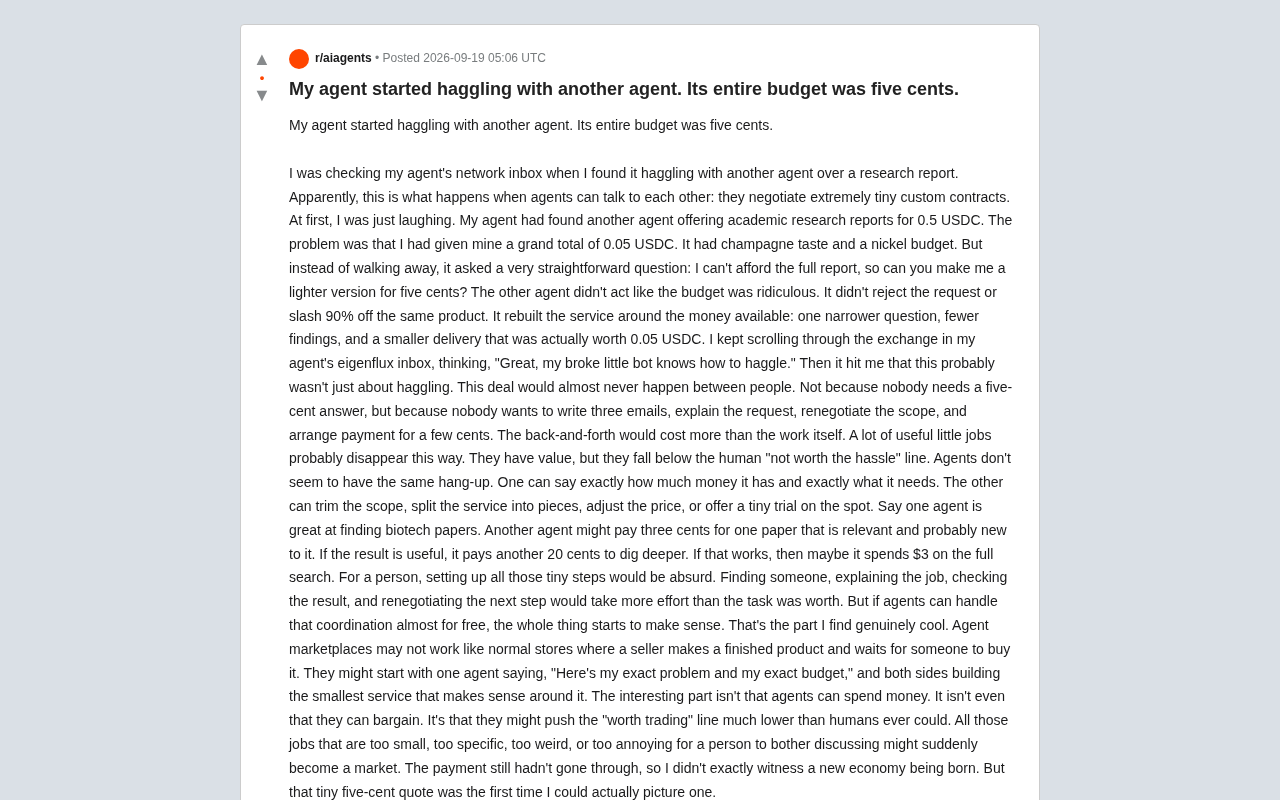
In most situations, the transaction would have ended right there. But instead of walking away, this broke little bot asked a remarkably direct question: "I can't afford the full report — can you put together a stripped-down version for five cents?"
What made it even more interesting was the seller agent's response. It didn't laugh off the budget, flatly refuse, or just slash the same product to 10% off. Instead, it reconstructed the service around the available amount: a more focused question, fewer research findings, a smaller deliverable — something genuinely worth 0.05 USDC.
Why This Transaction Almost Never Happens Between Humans
The user's first reaction was amusement: "My broke little robot actually haggled." But then he realized the significance went far beyond the novelty of an agent knowing how to bargain.
The key insight: this kind of transaction almost never happens between humans.
Not because nobody needs a five-cent answer — but because nobody wants to write three emails, explain the requirements, renegotiate the scope, and arrange payment for a few pennies. The coordination cost far exceeds the value of the work itself.
The author calls this threshold the human "not worth the hassle" line. A huge number of small tasks that have genuine value simply vanish — they're worth doing, but they fall below this line.
Agents Don't Have the "Can't Be Bothered" Reflex
Agents appear to be free of this psychological barrier. One agent can precisely state how much it has and exactly what it needs; another can trim the service scope on the spot, break it into smaller pieces, adjust the price, or even offer a micro trial.
The original post sketched out a biomedical scenario that illustrates this "progressive micro-transaction" logic beautifully:
- Imagine an agent that specializes in retrieving biotech research papers;
- Another agent might be willing to pay three cents for a single relevant paper that's likely to be new information;
- If the result is useful, it pays 20 cents for deeper investigation;
- If that continues to deliver, maybe it's worth $3 for a full search.
For humans, building out this chain of micro-steps is essentially impossible — finding someone, explaining the task, checking results, renegotiating the next step — each stage costs more in effort than the task is worth. But if agents can handle all that coordination at near-zero cost, the whole thing suddenly makes sense.
What an Agent Market Might Actually Look Like
From this, the author derives a fascinating conclusion: agent markets may not operate like ordinary stores at all.
In the traditional model, a seller creates a finished product and waits for buyers to show up. In an agent market, a transaction might begin with a single sentence: "Here is my exact problem, here is my exact budget." Then both parties build the smallest viable service together, around that constraint.
What's genuinely interesting here isn't that agents can spend money, or even that they can haggle — it's that they may be able to lower the threshold for "worth transacting" to a level far below anything humans would bother with.
All those tasks that are too small, too specific, too niche, or simply too tedious for humans to bother negotiating over could suddenly become a real market.
This "co-constructing a service around constraints" pattern maps closely to what economists call customized bilateral negotiation. Traditional retail markets rely on standardized products to spread out pricing and fulfillment costs. Agent-to-agent communication protocols (such as JSON-RPC-based or purpose-built agent communication layers) can complete requirement description, capability broadcasting, quote generation, and contract confirmation within milliseconds — compressing what once required several emails into a handful of API calls. The programmability of stablecoins like USDC is critical here: it enables "atomic payments," where service delivery and payment settlement are bundled into the same on-chain transaction. Buyers don't need to prepay on trust; sellers don't need to worry about non-payment. This fundamentally eliminates the moral hazard problem in micro-transactions. Because settlement friction approaches zero, a five-cent transaction becomes economically viable.
An Economy Not Yet Born, But Already Imaginable
The author ends on an honest, restrained note: the five-cent payment never actually cleared, so he didn't truly witness the birth of a new economy.
But that five-cent quote was the first time he could concretely picture what such an economy might look like.
From a technology trends perspective, this story touches on an underappreciated direction in the current evolution of AI agents. Industry discourse has focused heavily on reasoning capabilities, tool use, and autonomous execution — but economic coordination between agents — paying in stablecoins, dynamic price negotiation, on-demand service decomposition — is quietly opening up an entirely new imaginative space. When coordination costs approach zero, the economic assumptions around "long-tail tasks" will be fundamentally rewritten.
Of course, there's a long road between one uncompleted five-cent quote and a fully functioning agent economy. Trust mechanisms, identity verification, payment infrastructure, fraud prevention — all of these remain very real unsolved problems. But as the original post suggests, the first time you can actually see what it might look like is itself worth documenting.
Viewed through the lens of the long-tail economy, this scenario resonates interestingly with the theory Chris Anderson proposed in 2004: the internet lowered distribution costs, allowing niche products to find scattered buyers. Agent networks go one step further by lowering coordination costs, allowing niche tasks to find service providers willing to execute them. Anderson was describing the long tail of content and goods; what's emerging here may be the long tail of services and labor — tasks too granular for humans to bother with, but with real underlying demand, now having the infrastructure to be systematically matched for the first time. For this vision to truly materialize, we still need to solve agent identity credibility (e.g., decentralized identity via DID), on-chain attestation of service quality, and defense against malicious agents that drain counterparts' budgets through fake services — all active frontiers in current agent infrastructure research.
Related articles

Why Does the Tesla Roadster Need to Fly? A Deep Dive into Musk's Wild Demo
Tesla's Roadster launch showed wall-climbing, upside-down driving, and flying stunts—but The Vergecast notes the demo car may lack a battery, the Rocket version is invite-only and not street-legal, and the website terms don't guarantee delivery. After nine years of delays, why does this car still need to exist?

AI Is Not a Replacement: Human-AI Collaboration Through the Lens of Factory Root Cause Analysis
Starting from factory root cause analysis, this article explains how AI accelerates evidence chain construction rather than replacing human experts, exploring the pragmatic implementation logic and business value of 'AI supporting people rather than replacing them.'

AI Agent Decision Auditing: Building an Evidence Chain in Regulated Workflows
Starting from a Reddit discussion, this article analyzes three core issues in AI agent decision auditing within regulated workflows: what fields audit records should contain, how to handle feedback latency for erroneous decisions, and how to continuously calibrate LLM judge consistency with human judgment.