The Five-Dimensional Agent Evaluation Framework: A Complete Guide to the Must-Ask AI Product Manager Interview Question

A systematic breakdown of the five-dimensional AI Agent evaluation framework and methodology
This article presents a comprehensive evaluation framework for AI Agents: first distinguishing between result and process evaluation, then designing task sets from three sources (real user data, competitor collection, and manual construction), followed by systematic assessment across five dimensions — Accuracy (success rate), Speed (efficiency), Cost (economics), Stability (reliability), and Safety (risk control) — and finally validating actual Agent value through controlled experiments.
In AI product manager interviews, there's one question that comes up almost every time: How do you evaluate whether your Agent is performing well?
Many people instinctively answer "check if the responses are accurate," but if that's all you offer, the interviewer will likely conclude you've never actually built an Agent product. In real projects, Agent evaluation is far more complex than "are the answers good" — it's an entire systematic evaluation framework. This article breaks down this evaluation logic to help you handle it confidently in both interviews and actual work.
Before diving into evaluation methods, it's essential to understand what an Agent actually is. An AI Agent differs from traditional chatbots or simple Q&A systems — it's an AI system capable of autonomously perceiving its environment, formulating plans, invoking tools, and executing multi-step tasks. A typical Agent architecture includes a Planning module, Memory module, Tool Use module, and Action module. Because Agents involve the coordination of multiple modules and interactions with external systems, their evaluation complexity far exceeds that of simple LLM Q&A evaluation — you need to assess not just the final output, but the rationality of the entire decision chain.
Clarify Whether You're Evaluating Results or Process
Many people only focus on results when evaluating Agents — is the answer correct? Was the task completed? But experienced product managers know that Agent evaluation must examine both process and results.
Process evaluation dimensions include:
- Were tools called repeatedly?
- Were there failed retries?
- Were there logical jumps?
- Did the Agent get stuck in infinite loops?
- Were there fallback strategies in place?
From a technical implementation standpoint, process evaluation typically relies on Trace analysis of Agent execution. Every Agent run produces a complete Trace that records all intermediate steps between receiving user input and producing final output, including the inputs and outputs of each LLM inference call, tool invocation parameters and return values, and state transition logic. Through structured Trace analysis, you can pinpoint exactly where the Agent went wrong — whether it was an intent understanding error in the planning phase, a parameter passing mistake in the tool invocation phase, or information loss in the result synthesis phase. This fine-grained process diagnostic capability is the core foundation for optimizing Agent performance.
So Agent evaluation should be split into at least two dimensions: Are the results correct? and Is the process stable? This is the first layer of logic in the evaluation framework, and it's the dividing line between "armchair theorizing" and "real-world experience."
Design a Scientific Task Set
The prerequisite for evaluating an Agent is — what tasks do you use to test it? The quality of your task set design directly determines the validity of your evaluation. Generally, tasks come from three sources:
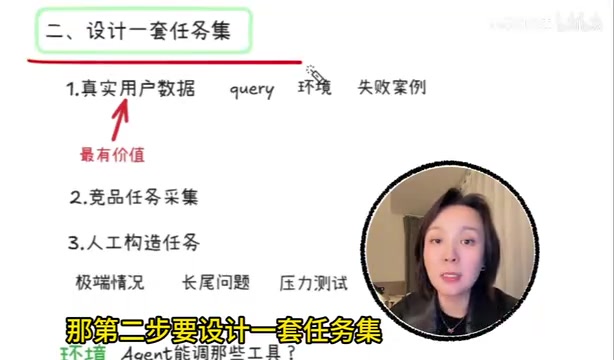
Real User Data (Most Valuable)
Actual user queries, real usage environments, and real failure cases — these are the testing materials closest to production scenarios. They expose edge cases you'd never think of during the design phase.
Competitor Task Collection
If you're building a customer service Agent, typical industry questions, high-frequency responses, and standard business processes can all be incorporated into your task set. These tasks help you establish an industry baseline and quickly identify gaps between your Agent and competitors.
Manually Constructed Tasks
Primarily used to test extreme cases, edge scenarios, and stress conditions. Many people overlook this, but it's precisely the key method for discovering system vulnerabilities.
A critical point to note: a task isn't just a single sentence. It also includes environmental information — what tools can the Agent access, what version of the knowledge base is available, are there invocation limits, what happens on failure — these are all indispensable components of Agent evaluation.
Five-Dimensional Evaluation Metrics: Accuracy, Speed, Cost, Stability, and Safety
This is the most critical part of the entire Agent evaluation framework. I summarize it in five dimensions: Accuracy, Speed, Cost, Stability, and Safety. If you can clearly articulate these five dimensions in an interview, the interviewer will essentially be convinced you've genuinely built Agent products.

Accuracy — Task Success Rate
Define "success" from a task perspective. For example, in a flight rebooking scenario, it's not enough for the Agent to say "I've rebooked your flight" — you need to verify:
- Did it actually complete the rebooking operation?
- Was it synced to the order system?
- Did the user receive a confirmation notification?
When there's no ground truth to compare against, two methods are typically used: expert manual evaluation or automated LLM evaluation (LLM-as-Judge). The former is highly precise but expensive; the latter is scalable but requires calibration. In practice, both methods are often used in combination.
LLM-as-Judge is an important methodology that has emerged in the AI evaluation field over the past two years, first systematically proposed by institutions like UC Berkeley in 2023. The core idea is to use powerful large language models like GPT-4 as "judges" to automatically score Agent output quality. In practice, detailed scoring rubrics are designed and passed to the judge model as system prompts, asking it to rate the Agent's responses on dimensions like accuracy, completeness, and relevance. The advantage of this approach is large-scale, low-cost evaluation — research shows its agreement with human expert scores can exceed 80%. However, it has known biases, such as position bias (tendency to score answers listed first higher) and verbosity bias (tendency to score longer answers higher), so calibration measures like multiple evaluations and order swapping are needed to improve reliability.
Speed — Execution Efficiency
A reliable Agent doesn't slowly "think" — it completes tasks within a reasonable timeframe. Efficiency evaluation focuses on:
- Average completion time
- Number of conversation turns
- Number of tool invocations
- Presence of unnecessary loops
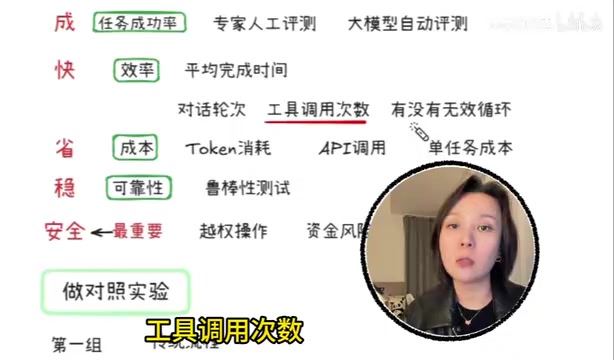
Many Agents' problems aren't about lack of intelligence, but about being too verbose — repeated tool calls, redundant confirmation steps, and overly long reasoning chains. All of these severely drag down user experience and system efficiency.
Cost — Cost Control
Many Agents appear to achieve automation, but when you run the numbers, they're actually more expensive than human labor. Cost evaluation requires calculating:
- Token consumption
- API call frequency and fees
- Comprehensive cost per task
Tokens are the basic unit of measurement for LLM text processing — roughly understood as the smallest semantic segments of text (in Chinese, approximately 1 character equals 1.5-2 tokens). Mainstream LLM APIs charge by token count, with separate pricing for input and output. For Agents, cost is particularly significant because a single complete task execution may involve multiple LLM calls — one for the planning phase, one for each tool selection, another for result synthesis, plus potential retries and error correction. A single task's token consumption can be 5-10 times that of a normal conversation. Common cost optimization strategies include: streamlining system prompts, using smaller models for simple subtasks (model routing), caching common query results, and optimizing the Agent's reasoning chain to reduce unnecessary intermediate steps.
Only when an Agent truly achieves cost reduction and efficiency improvement while maintaining quality does it have business value. This is particularly critical when reporting ROI to business stakeholders.
Stability — Reliability
If you run the same task ten times, is the success rate consistent? If user input gets slightly more complex, will the system crash? This typically involves robustness testing, including:
- Input variant testing (synonymous expressions, colloquial language, typos)
- Concurrent stress testing
- Abnormal input testing (extremely long text, special characters, malicious input)
Robustness, a concept originating from control theory, refers to a system's ability to maintain normal functionality in the face of input perturbations or environmental changes. In Agent evaluation, robustness testing typically adopts an adversarial testing approach, systematically constructing various "challenging" scenarios. Specific technical methods include: semantic equivalence transformation (rewriting "Help me book a flight to Shanghai tomorrow" as "I need to fly to Shanghai tmrw, get me a ticket"), missing information testing (user only says "rebook" without providing a flight number), multi-intent hybrid testing (a single sentence containing multiple requests), and context interference testing (inserting irrelevant topics mid-conversation then returning to the original task). A commonly used quantification metric in the industry is the "Consistency Score" — the proportion of cases where the same semantic intent achieves the same correct result across different expression forms.
An Agent with a 90% success rate but wild fluctuations is far less reliable than one with an 85% success rate but consistent performance. Stability is the baseline requirement for whether an Agent can go live.
Safety — Risk Prevention and Control
This is the most important of the five dimensions. Once an Agent has execution capabilities (such as operating databases, initiating transactions, or calling external APIs), all safety issues are amplified exponentially.
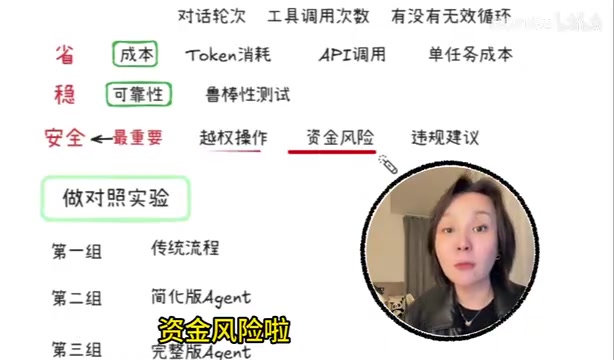
Key risk scenarios to focus on include:
- Unauthorized operations: Will the Agent perform operations beyond its authorized scope?
- Financial risk: When financial transactions are involved, does the Agent have sufficient verification mechanisms?
- Non-compliant recommendations: Will the Agent provide advice that violates regulations or company policies?
The essence of Agent safety issues lies in the fact that when an AI system upgrades from "advisor" to "executor," the consequences of its errors also escalate from "information misguidance" to "actual harm." The industry currently employs a safety prevention framework with several layers: the first is the Principle of Least Privilege, where the Agent is only granted the minimum set of permissions necessary to complete the current task; the second is a Human-in-the-Loop confirmation mechanism, where high-risk operations (such as large transfers or data deletion) must receive human confirmation before execution; the third is reversible operation design, ensuring that Agent-executed operations can be rolled back if errors occur; the fourth is real-time monitoring and circuit-breaking mechanisms that automatically interrupt Agent execution when anomalous behavior patterns are detected. Additionally, prompt injection attacks (using carefully crafted inputs to induce the Agent to perform unintended operations) are one of the most concerning threats in the current Agent safety field, and evaluation must specifically design such attack scenarios for testing.
When evaluating, you must specifically design high-risk scenarios to test whether the Agent will cross boundaries under extreme conditions. This is not optional — it's mandatory.
Design Controlled Experiments to Validate Agent Value
The final element that many people overlook but is extremely important — controlled experiments. Ideally, design three comparison groups:
| Group | Description |
|---|---|
| Control Group A | Traditional workflow (manual processing or legacy system) |
| Experimental Group B | Simplified Agent (basic capabilities) |
| Experimental Group C | Full Agent (complete capabilities) |
Through this three-way comparison, you can clearly answer:
- How much has the Agent improved over traditional approaches?
- What's the incremental value of the full Agent versus the simplified version?
- Is the additional complexity worth the investment?
The controlled experiment design approach originates from classic A/B testing methodology, which has a mature practice framework in the internet product domain. However, Agent controlled experiments have unique characteristics: first, Agent outputs are non-deterministic (the same input may produce different execution paths), so sufficiently large sample sizes are needed to eliminate random fluctuation; second, Agent performance may be affected by task ordering (context from a previous task may influence execution of the next), so task order randomization is necessary; finally, evaluation metrics are often multi-dimensional, requiring comprehensive consideration of success rate, efficiency, cost, and other variables — you cannot draw conclusions from a single metric alone. For statistical significance testing, a p-value below 0.05 is typically required, along with an effect size that reaches a practically meaningful level, before concluding that the Agent has genuinely delivered valuable improvement.
Results from such comparisons are truly convincing — whether in interviews or reporting to leadership.
Summary: Answer Agent Evaluation Questions with Systematic Thinking
A complete Agent evaluation framework can be summarized in four steps:
- Define evaluation dimensions: Results + Process
- Build task sets: Real data + Competitor collection + Manual construction
- Five-dimensional metrics: Accuracy (success rate), Speed (efficiency), Cost (economics), Stability (reliability), Safety (risk control)
- Controlled experiments: Traditional workflow vs. Simplified Agent vs. Full Agent
If you can articulate the complete logic of task sets + five-dimensional metrics + controlled experiments in an interview, the interviewer will essentially conclude you've genuinely built AI products. The completeness and systematicness of your evaluation framework is itself the best proof of a product manager's professional capability.
Related articles
Deep Dive into AI Agent Skill Design: …
Deep Dive into AI Agent Skill Design: Engineering Practices from Anthropic and Perplexity
A deep dive into Skill design philosophy from Anthropic's Claude Code team and Perplexity's Agent team, covering the Tax Test, Gotchas Flywheel, progressive disclosure, and Eval-First practices for building high-quality AI Agent skill systems.
Deep Dive into OpenAI's Official GPT-5…
Deep Dive into OpenAI's Official GPT-5.6 Prompting Guide: The Shift from Manual to Automatic
A deep dive into OpenAI's official GPT-5.6 Sol prompting guide: conciseness-first, outcome-oriented design, autonomy boundaries, tool routing, and reasoning intensity tuning.
 Deep Dives
Deep Dive into How OpenClaw (Open-Source Crayfish) AI Agent Works
Deep analysis of OpenClaw AI Agent internals: System Prompt, tool calling, SubAgents, Skill system, memory, and Context Engineering explained.