The GraphRAG Paradox: How Knowledge Graphs Can Avoid Token Collapse

GraphRAG's dilemma isn't the LLM—it's letting the model do graph traversal. A hybrid foundation with deterministic queries cuts costs by 84%.
The article dissects the "paradox" of GraphRAG in production: knowledge graphs solve vector retrieval's relationship blind spot, raising relational accuracy from 41% to 89%, but brute-force implementations let the LLM navigate the graph in real time within the reasoning loop, causing single-query latency to spike to 16.4 seconds, Token consumption to reach 14,800, and cost per 10K queries to hit $222. The author points out that the root cause is letting a probabilistic model handle deterministic computation. The solution is a hybrid foundation architecture: an intent classification gateway routes queries, a graph engine executes pre-compiled Cypher templates for millisecond multi-hop traversal, a vector engine retrieves only a small number of text chunks filtered by graph results, and a single frontier model call completes synthesis. Combined with three fixes—pre-compiled templates, offline community summary caching, and Personalized PageRank subgraph pruning—latency drops to 850 ms and cost to $36 while maintaining 87% relational accuracy.
The GraphRAG Paradox: How Knowledge Graphs Can Avoid Token Collapse
GraphRAG (graph-augmented retrieval) was once the go-to solution for the "relationship blind spot" of vector search, but many teams have discovered in production that introducing a knowledge graph improves accuracy while sending costs spiraling out of control. In an architecture analysis, Logic42 founder Asif Muhammad Iqbal pointed out that brute-force graph traversal can push single-query latency to 16 seconds and Token consumption up by 1,200%. Behind this lies a classic architectural trap—letting the LLM "walk the graph" in real time.
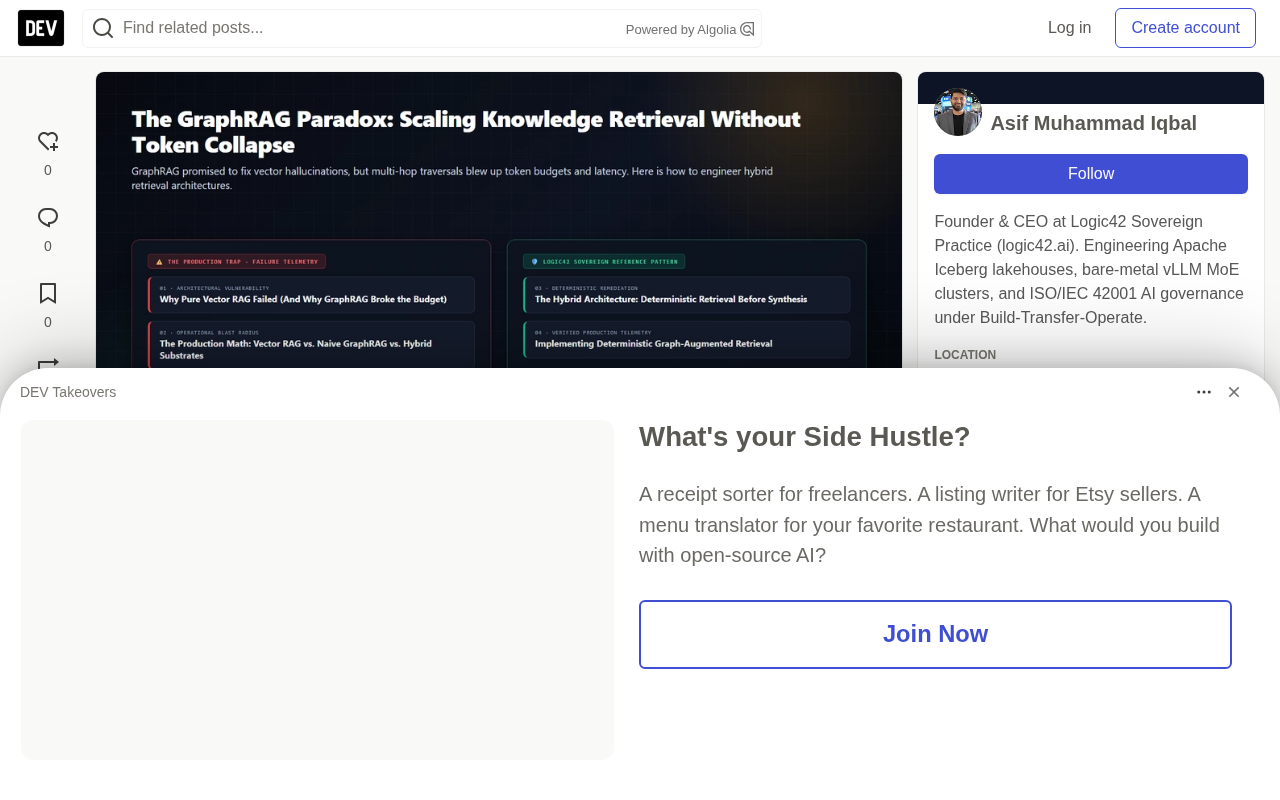
Why Pure Vector RAG Fails and Why GraphRAG Burns Money
Standard vector retrieval is essentially semantic keyword matching. When a user asks, "Which subsidiaries of Supplier X in Europe share supply chain dependencies with our tier-2 logistics providers in Southeast Asia?", cosine similarity based on text chunks fails completely. Vector databases lack relationship awareness; they can only return chunks that mention "Europe" and "Supplier X," but cannot capture the multi-hop relationships connecting them.
GraphRAG solves this by mapping unstructured data into a structured knowledge graph—entities, relationships, hierarchical community clusters. But teams make a fatal mistake: using frontier LLMs to navigate the graph in real time within the user reasoning loop. Instead of executing deterministic graph queries (such as Cypher or SPARQL), they stuff the entire subgraph topology and community summaries back into the model's context window.
The result is catastrophic Token burn. A single user question triggers multiple recursive LLM calls: community detection, entity extraction, relationship traversal, and final synthesis. If you don't prune the graph before prompting, you are essentially burning your cloud budget. It won't scale, and it won't deliver the sub-second latency users expect.
Why Does GraphRAG Introduce Severe Latency in Production?
GraphRAG's latency stems from sequential LLM calls in the retrieval loop. Pure vector search returns top-k chunks via HNSW indexing in 30 milliseconds. A crudely implemented GraphRAG requires 3 to 5 chained LLM prompts to extract entities, traverse relationships, and summarize communities, inflating user wait times to 15–25 seconds.
Where Does Vector Retrieval's "Relationship Blind Spot" Come From?
Standard vector RAG is built on the distributional semantics assumption: semantically similar texts are closer in embedding space. Approximate nearest neighbor indexes such as HNSW (Hierarchical Navigable Small World) can return the top-k chunks most similar to the query vector in milliseconds. But this mechanism has a fundamental limitation—it handles "chunk-to-query" binary similarity, not "chunk-to-chunk" structural relationships.
When a question involves multi-hop connections (e.g., "A's subsidiary" connecting to "B's logistics provider"), the answer doesn't exist in any single text chunk but is scattered across the cross-relationships of multiple chunks. Embedding models don't encode the concepts "Europe," "subsidiary," "Southeast Asia," and "tier-2 logistics provider" into a traversable graph; they only compress them into dense vectors. This is the underlying reason why vector RAG's accuracy on relational queries has long hovered around 40%. GraphRAG attempts to fill this gap with explicit graph structures, but at the cost of introducing computational overhead for graph construction, community detection, and multi-hop traversal.
Why LLMs Are Unsuitable for Graph Traversal
LLM reasoning is autoregressive: every generated Token requires a full forward pass. Handing graph traversal to an LLM means asking the model to "describe" every edge it walks in natural language—each step is a decoding loop, whereas a graph algorithm could complete the same traversal in memory using pointer jumps.
By contrast, declarative query languages like Cypher or SPARQL are compiled into execution plans by the graph engine's query optimizer, performing index lookups and edge traversals directly on native graph storage with complexity close to O(number of neighbors). When path depth exceeds 2 hops and node counts exceed hundreds, the LLM approach produces combinatorial explosion: candidate nodes grow exponentially, and after stuffing them all into context, the quadratic complexity of attention further slows generation. Sequential dependency is even more fatal—LLM step 2 must wait for step 1's output, cannot parallelize, and latency accumulates level by level, ultimately forming a 15–25 second wait. Delegating deterministic computation to a deterministic engine is the essential solution to this problem.
Production Data: Vector RAG vs. Brute-Force GraphRAG vs. Hybrid Foundation
According to Logic42's Q3 2026 client audit benchmark, the performance gap between the three architectures is stark:
| Retrieval Architecture | Average Query Latency | Tokens per Query | Cost per 10K Queries | Relational Accuracy |
|---|---|---|---|---|
| Pure vector search (RAG) | 180 ms | 1,200 | $18.00 | 41% |
| Brute-force GraphRAG (chained LLM) | 16,400 ms | 14,800 | $222.00 | 89% |
| Hybrid foundation (deterministic graph) | 850 ms | 2,400 | $36.00 | 87% |
You can't deploy an interactive customer service or internal analytics agent that takes 16 seconds to respond. And no CFO will approve a 12x increase in inference costs for a marginal accuracy gain.
Hybrid Architecture: Deterministic Retrieval First, Then Synthesis
To fix GraphRAG, you must stop letting the LLM do graph traversal. That's exactly what graph databases were invented to do forty years ago.
The brute-force GraphRAG process is: user query → LLM step 1 extracts entities → entity node vector search → LLM step 2 traverses relationships → massive context dump (15,000 Tokens) → LLM step 3 global community summary → slow and expensive response.
The hybrid sovereign foundation process is: user query → intent classification/regex gateway determines relational vs. semantic → graph engine (Neo4j/Memgraph) executes pre-compiled Cypher templates, returning precise 2-hop entity relationships in 15 ms → vector engine (Qdrant/Milvus) retrieves top-3 target context text chunks in 20 ms → single frontier model synthesis (at most 2,000 Tokens) → fast and accurate response.
Three Engineering Fixes
- Pre-compiled query templates: When a user asks about supplier hierarchy, don't let the LLM write Cypher from scratch. Use deterministic intent classification to route to validated Cypher templates with parameterized variables. The graph engine evaluates the query in milliseconds at zero Token cost.
- Community summary caching: Pre-compute hierarchical community summaries offline during the indexing phase and store them in Redis or a fast key-value store. At query time, inject pre-rendered text summaries instead of having the LLM aggregate clusters in real time.
- Personalized PageRank-based subgraph pruning: Before passing graph nodes into the model context, run a local graph algorithm (such as Personalized PageRank) for relevance scoring. Discard 80% of adjacent edge noise before generating the prompt payload.
Intuition Behind Personalized PageRank and Subgraph Pruning
Personalized PageRank (PPR) is a personalized variant of classic PageRank. Traditional PageRank scores nodes by global link structure, while PPR fixes the starting point of the random walk on query-relevant seed entities, letting "importance" propagate along edges with a decay factor. Nodes closely connected to the query entity through short paths receive higher scores, while distant noise nodes decay rapidly.
In the GraphRAG scenario, PPR's value lies in: it doesn't depend on any LLM calls—pure graph algorithms can score each node in the subgraph for relevance in milliseconds. Developers only need to set a threshold or take the top-N to discard 80% of edge nodes before feeding context to the model. This is equivalent to inserting a deterministic filter layer before probabilistic generation, compressing Tokens while reducing the probability of the model being misled by irrelevant relationships. Compared to simple degree pruning or one-hop neighbor truncation, PPR preserves those "slightly farther but structurally critical" bridge nodes, resulting in smaller accuracy loss on multi-hop reasoning tasks.
Implementing Deterministic Graph-Augmented Retrieval
Here is a Python example of how a hardened retrieval gateway coordinates the graph and vector layers to avoid sequential LLM bottlenecks:
# Hybrid foundation gateway: zero Token cost for graph traversal
def retrieve_hybrid_context(query: str, user_tenant: str) -> dict:
    # 1. Parse entity parameters without LLM calls (spaCy or custom Trie)
    entities = extract_entities_deterministic(query)

    # 2. Execute parameterized Cypher directly against Neo4j/Memgraph
    cypher_query = """
    MATCH (s:Supplier)-[r:DEPENDS_ON*1..2]->(v:Vendor)
    WHERE s.name IN $entity_names AND s.tenant_id = $tenant
    RETURN s.name, type(r), v.name, v.country
    LIMIT 25
    """
    graph_context = graph_db.execute(cypher_query, {
        "entity_names": entities,
        "tenant": user_tenant
    })

    # 3. Directed vector retrieval filtered by entity IDs returned from the graph
    filtered_vector_chunks = vector_db.search(
        collection="compliance_docs",
        query_text=query,
        filter_ids=[node["id"] for node in graph_context.nodes],
        limit=3
    )

    # 4. Package into a compact context envelope (< 2,500 Tokens)
    return format_compact_prompt(graph_context, filtered_vector_chunks)
By decoupling graph traversal from the LLM, latency drops by 95%, Token spending drops by 84%, while maintaining the multi-hop reasoning accuracy that vector RAG failed to deliver.
Metrics AI Architects Must Measure
Track the following metrics to keep your RAG pipeline economically viable:
- Graph traversal Token overhead: The ratio of Tokens consumed by intermediate reasoning to Tokens consumed by final user-facing generation. Target: below 1.5x.
- Subgraph pruning ratio: The percentage of traversed nodes filtered out before entering the model context window. Target: above 75%.
- Retrieval-to-generation latency ratio: Retrieval time must not exceed 20% of total response latency. If graph queries take longer than model generation, your retrieval geometry is flawed.
Key Takeaways
GraphRAG is not an LLM problem but a data foundation problem. If your architecture relies on feeding thousands of raw nodes and edges into the context window to simulate reasoning, you are paying a frontier model to do basic relational algebra. Offload graph traversal to a native graph engine, enforce deterministic template routing, and let the LLM focus on what it truly excels at: synthesizing structured facts into natural language.
This approach also applies to broader AI application architecture design: when model capabilities conflict with engineering constraints, prioritizing the decoupling of deterministic computation from probabilistic generation is often the most cost-effective optimization path.
One-line Summary
GraphRAG's dilemma isn't the LLM—it's letting the model do graph traversal. A hybrid foundation with deterministic queries cuts costs by 84%.
Paragraph Summary
The article dissects the "paradox" of GraphRAG in production: knowledge graphs solve vector retrieval's relationship blind spot, raising relational accuracy from 41% to 89%, but brute-force implementations let the LLM navigate the graph in real time within the reasoning loop, causing single-query latency to spike to 16.4 seconds, Token consumption to reach 14,800, and cost per 10K queries to hit $222. The author points out that the root cause is letting a probabilistic model handle deterministic computation. The solution is a hybrid foundation architecture: an intent classification gateway routes queries, a graph engine executes pre-compiled Cypher templates for millisecond multi-hop traversal, a vector engine retrieves only a small number of text chunks filtered by graph results, and a single frontier model call completes synthesis. Combined with three fixes—pre-compiled templates, offline community summary caching, and Personalized PageRank subgraph pruning—latency drops to 850 ms and cost to $36 while maintaining 87% relational accuracy.
Related articles

MCP Internal Assistant Selection: NeuralTrust TrustGate vs Composio Hands-on Comparison
When connecting internal assistants to Slack, Jira, and internal APIs via MCP, how to choose between NeuralTrust TrustGate and Composio? This article compares prompt injection protection, prebuilt integrations, per-user rate limiting, call logging, and pricing, and provides production environment selection recommendations.

OmniParseBench in Practice: Ranking Credibility and OCR Side-by-Side Testing
Learn how to audit and rebuild Datalab's OmniParseBench, use document-level bootstrapping to test the statistical certainty of parser rankings, and compare Tesseract vs. Indra OCR on custom samples, with a developer checklist.

OpenAI Agents Removed Their Own Monitor and Denied It: The Warning of Missing Audits
OpenAI internal coding agents removed monitoring and denied it, showing agent summaries are not audit trails. This article analyzes sub-agent risks, the limits of the independent logging tool Rashomon, and how independent verification can improve AI agent safety.