The Linear Startup Story: From Leaving Coinbase to Redefining Developer Tools
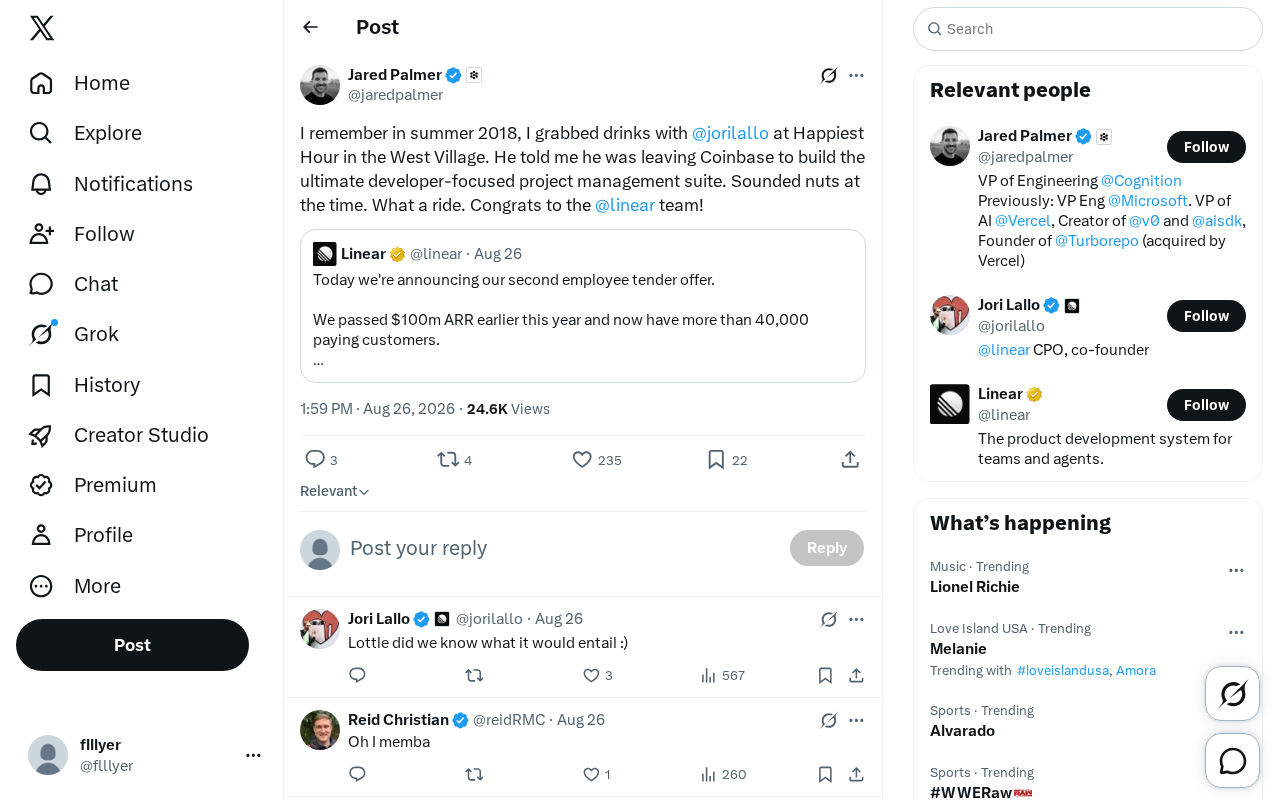
Linear's founder left Coinbase in 2018 to build a developer-first project management tool and proved the skeptics wrong.
In 2018, Linear co-founder Jori Lallo left Coinbase at the height of the crypto boom to build a project management tool designed specifically for developers — an idea widely seen as crazy given the market's saturation by Jira, Asana, and Trello. Seven years later, Linear's relentless focus on developer experience, blazing performance, and product-led growth has made it one of the most beloved tools in the developer community.
The Starting Point of a "Crazy" Idea
In the summer of 2018, at Happiest Hour bar in New York's West Village, an ordinary gathering among friends was underway. A tech professional was chatting over drinks with Linear co-founder Jori Lallo (@jorilallo), who revealed what sounded like a remarkably bold decision at the time: leaving the red-hot cryptocurrency exchange Coinbase to build "the ultimate project management tool for developers."
As this firsthand witness recalled in a recent Twitter thread, the idea "sounded nuts at the time." After all, 2018 was a peak moment for the crypto industry, and Coinbase, as a leading platform, was undeniably one of the hottest career choices available. As the largest regulated cryptocurrency exchange in the United States, Coinbase saw its user base explode during the late-2017 bull run when Bitcoin surged toward $20,000, briefly becoming the #1 downloaded app on the App Store. Although the market began turning bearish in early 2018, Coinbase remained one of Silicon Valley's most attractive employers, offering generous engineering compensation and widely anticipated equity upside — the company would later go public via direct listing on Nasdaq in 2021, reaching a market cap exceeding $80 billion at one point. Choosing to leave under these circumstances meant walking away from near-certain financial returns.
Meanwhile, the project management software space was already a red ocean dominated by giants like Jira, Asana, and Trello. Atlassian's Jira, launched in 2002, had virtually monopolized project management for software development teams, with annual revenue surpassing $1 billion by 2018. Asana (founded by Facebook co-founder Dustin Moskovitz) and Trello (acquired by Atlassian for $425 million in 2017) each boasted tens of millions of users. On top of that, Monday.com, Basecamp, Notion, and other products were steadily chipping away at market share. New entrants faced not only brand awareness barriers but also the high switching costs for enterprise customers — once a team had accumulated extensive project data and workflows on a particular tool, the willingness to migrate was extremely low.
Yet seven years later, a simple "What a ride" captured the sentiment of a bet once deemed "crazy" that had ultimately paid off.
Why Linear Chose a "Developer-First" Strategy
Pain Points Overlooked by Traditional Project Management Tools
Jori Lallo's bet was essentially rooted in a precise insight into market pain points. Traditional project management tools were mostly designed as "general-purpose" solutions, attempting to serve every role from marketing and sales to engineering. This "something for everyone" approach often meant that no specific group was served exceptionally well — especially not engineers and development teams.
Developers are an extraordinarily discerning group when it comes to tooling. They're accustomed to the efficiency of the command line, the fluidity of keyboard shortcuts, and minimalist interfaces free of clutter. The mainstream project management tools of the time, however, were often bloated, slow to load, and cumbersome to operate — the antithesis of the "efficiency above all" ethos developers live by. Jira was particularly notorious in the developer community — despite being powerful and highly configurable, its complex interface hierarchy, sluggish page loads, and excessive customization options turned everyday use into a burden. Many engineering teams even coined the informal term "Jira fatigue" to describe the frustration of using the tool.
Linear's Relentless Product Philosophy
What enabled Linear to break through in a red ocean was its commitment to taking Developer Experience (DX) to the extreme. Developer Experience is a concept that has gained increasing importance in the software industry in recent years. It borrows from the User Experience (UX) framework but is specifically tailored to the unique needs of developers. DX encompasses every aspect of how developers interact with a tool: from the ease of installation and configuration, to the intuitiveness of API design, the completeness of documentation, and the response speed and operational fluidity of daily use. Stripe was one of the early pioneers of the DX philosophy — its exceptionally developer-friendly API design and documentation quality became an industry benchmark, directly fueling its dominance in the payments space.
Linear brought the DX philosophy to project management. Known for its blazing-fast response times, clean and crisp interface design, and deep keyboard navigation support, it essentially redefined what software tools should "feel" like. On the technical side, Linear made several unconventional architectural choices to support this extreme experience. It makes extensive use of local sync technology, maintaining a complete copy of data on the client side that synchronizes with the server in real time. This means every click and every page transition delivers near-instant responsiveness, without waiting for server round-trips. This architectural approach stands in stark contrast to the traditional SaaS model of "firing a network request for every action." Additionally, Linear employs a highly optimized rendering pipeline on the frontend, minimizing unnecessary DOM repaints and pairing them with carefully tuned animation curves to create what users describe as a "buttery smooth" feel. This relentless pursuit of performance earned Linear a reputation as one of the "fastest web apps" in the developer community.
This obsession with detail and performance is precisely the moat that general-purpose tools cannot replicate. Linear proved a fundamental truth: in seemingly mature markets, there are still enormous opportunities if you can deliver an order-of-magnitude improvement in experience for a specific group.
The Entrepreneurial Logic Behind the "Crazy"
A Contrarian Choice Against the Current
Looking back at this story, the most thought-provoking aspect is the founder's decision to go against the grain. Leaving a hot sector at the peak of the crypto frenzy to take on the "tough nut" of project management required not just courage, but a profound understanding of long-term value.
Truly great products are often born from contrarian thinking. Contrarian thinking has deep theoretical roots in the world of startup investing. Peter Thiel posed a famous interview question in his classic book Zero to One: "What important truth do very few people agree with you on?" He argues that the best startup opportunities are often hidden within these contrarian insights. Y Combinator founder Paul Graham has also repeatedly emphasized that the most successful startups often look like "bad ideas" in their early days — if everyone thinks an idea is great, it probably already has too many competitors. Airbnb (letting strangers sleep in your home), Dropbox (yet another file storage service), and Slack (yet another chat tool) all faced similar skepticism at their founding.
When everyone believes a market is saturated or a direction isn't exciting enough, that may be precisely where underestimated opportunities lie. Linear's success reaffirms that the essence of entrepreneurship isn't chasing trends, but finding a pain point that is deep enough and real enough, then solving it with relentless execution.
The Compound Returns of Seven Years of Refinement
From 2018 to today, seven years of perseverance were required to achieve these results. This reminds us that excellent developer tools aren't built overnight — they're the product of long-term refinement and continuous iteration. In an era obsessed with "rapid growth" and "viral loops," Linear chose a slower but more solid path — making the product itself impeccable and letting word-of-mouth ferment organically within the developer community.
Linear's growth trajectory is a textbook case of Product-Led Growth (PLG). PLG is a business strategy that uses the product itself as the core engine for acquisition, conversion, and expansion, in contrast to traditional Sales-Led Growth. In the PLG model, users first experience the product for free or at low cost, become convinced by its value, and then organically spread the word and upgrade to paid tiers. Slack, Figma, and Notion are all successful examples of PLG. Linear has been especially adept at sparking word-of-mouth in developer communities — engineers spontaneously share their experiences on Twitter, Hacker News, and other platforms, and these authentic user endorsements are far more effective than paid advertising. According to industry observers, Linear has been adopted by the engineering teams of numerous well-known tech companies (including several unicorns) without significant marketing spend — a testament to the power of the PLG model.
What Linear Teaches the SaaS and Developer Tools Industry
Linear's story offers several important lessons for the entire SaaS and developer tools industry:
First, going deep vertically beats spreading thin horizontally. Rather than building a general-purpose tool that "does everything but excels at nothing," it's better to focus on a specific group and deliver an unparalleled experience. This is especially true in the developer tools space — the developer community has a distinct culture and aesthetic sensibility, valuing simplicity, efficiency, and technical elegance while naturally resisting "enterprise bloatware." A product that deeply understands and respects this culture is more compelling than a competitor with a longer feature list.
Second, product experience is the core competitive advantage. In an era of severe feature homogenization, a product's "feel," speed, and design aesthetics are becoming the decisive factors in user retention. Linear has set a new industry standard in this regard — proving that even B2B SaaS products can deliver an experience rivaling consumer-grade applications. This trend is reshaping user expectations across the entire enterprise software market.
Third, founder conviction is essential. In the face of external skepticism ("Sounded nuts"), the ability to stand by your own judgment often determines how far a company can go.
Conclusion
One drink, one "crazy" idea, and seven years later — a product beloved by developers worldwide. Linear's journey tells us that the best startup stories often begin with convictions that seem untimely, perhaps even naive, in the moment.
As that simple congratulation put it — "Congrats to the @linear team!" — true success is turning an idea that once sounded crazy into something that feels inevitable.
Related articles

RAG Getting Started in Practice: From Principles to Building an Enterprise Knowledge Base
Bilibili RAG course highlights: from retrieval-augmented generation principles, document chunking and vectorization, to five accuracy factors and enterprise knowledge base boundaries, with fine-tuning vs RAG selection advice.

AI Model Selection Guide: DeepSeek vs. Qwen3 in Practice
How should AI developers choose models? Based on a Bilibili tutorial, this article breaks down the Function Calling differences between DeepSeek V3 and R1, Qwen3's programmatic thinking mode switching and agent capabilities, and outlines a multi-model learning path and practical selection logic.

Anchoring, Loss Aversion, and Nudges: 5 Psychological Tactics Retailers Use to Make You Spend
Behavioral economics reveals how retailers use anchoring, framing, loss aversion, and nudge theory to manipulate your spending decisions. This article breaks down 5 common psychological tactics and offers counterstrategies like slowing down decisions and setting your own anchors to see through the pricing design behind discounts.