The Missing Incentive Layer in Long-Lived AI Agents: A Principal-Agent Framework and Runtime Architecture

Paper argues AI agent incentives should be runtime contracts, not prompts; experiments show resource allocation works while language incentives fail.
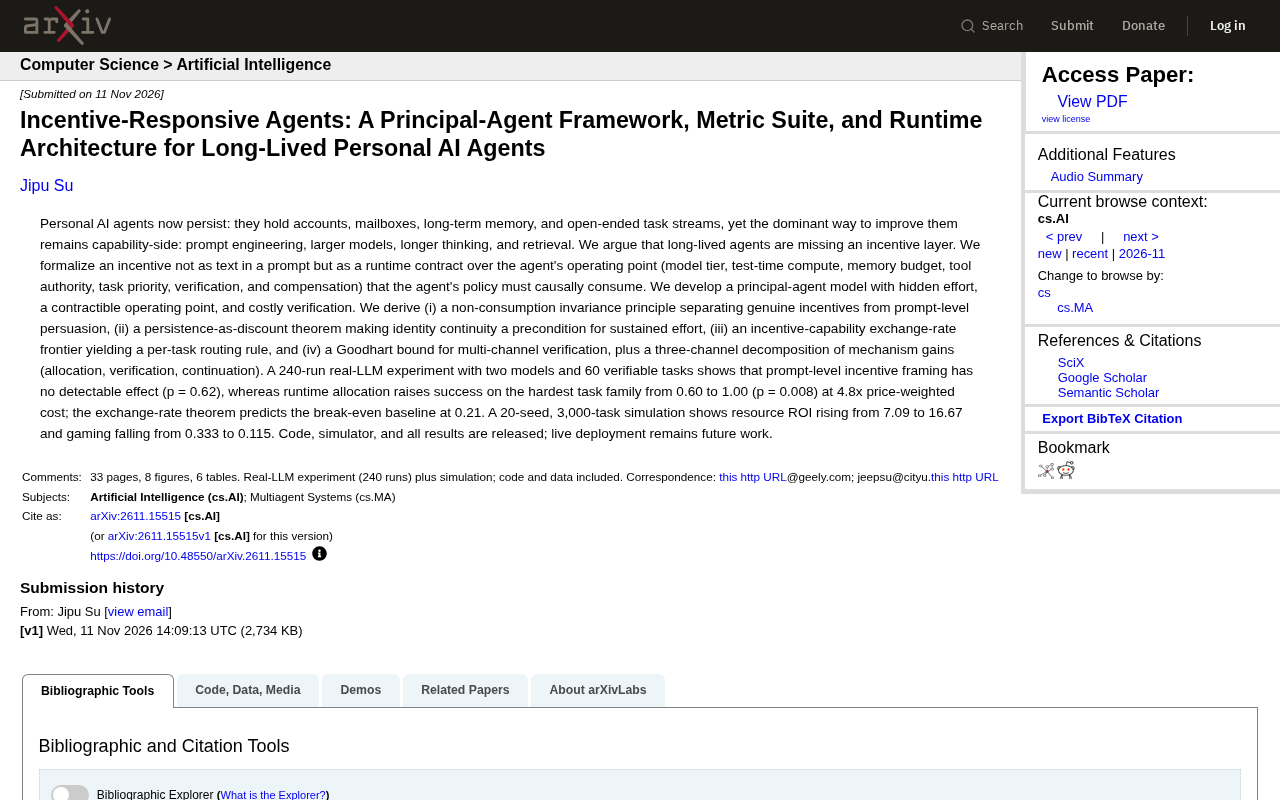
The article introduces a new paper on the incentive layer for long-lived personal AI agents. It argues that current methods focus on capability (prompt engineering, larger models, longer thinking) while neglecting incentives. The paper formalizes incentives as runtime contracts over operating points (model tier, compute, memory, permissions, verification/compensation) and proposes a non-consumption invariance principle: if the policy doesn't causally use a parameter, adjusting it isn't an incentive—explaining why prompt-based rewards fail. A principal-agent model yields a persistence discount theorem, an incentive-capability exchange rate frontier, and a Goodhart upper bound for multi-channel verification. A 240-run LLM experiment shows prompt incentives have no significant effect (p=0.62), while runtime allocation raises hardest-task success from 0.60 to 1.00 (p=0.008) at 4.8x cost; simulations show higher resource ROI and less gaming.
Personal AI agents are becoming "long-lived": they hold accounts, manage email, maintain long-term memory, and handle open-ended task streams. Yet the mainstream methods for improving their capabilities remain focused on the capability side—prompt engineering, larger models, longer thinking time, and retrieval augmentation. A new paper argues that long-lived agents are missing a critical layer: the incentive layer.
Why do prompt-level incentives not work?
The research team formalizes incentives as a runtime contract rather than text in a prompt. This contract operates on the agent's "operating points," including model tier, test-time compute, memory budget, tool permissions, task priority, verification mechanisms, and compensation mechanisms. The agent's policy must causally consume these operating-point parameters for the incentive to actually take effect.
To distinguish genuine incentives from prompt-level persuasion, the paper derives a non-consumption invariance principle: if the agent's policy does not causally use a given operating-point parameter, then adjusting that parameter does not constitute an incentive. This explains why writing "if you do this well, I'll give you more resources" in a prompt often fails—because resource allocation is not actually tied to the agent's behavior.
Principal-agent model and three theoretical results
The paper constructs a principal-agent model in which the principal (user or system designer) sets the contract and the agent (the AI) exerts hidden effort. The contract observes operating points, and verification is costly. On this basis, the authors derive several key conclusions:
- Persistence as a discount theorem: identity continuity (i.e., the agent knowing it will exist long-term) is a prerequisite for sustained effort. If the agent expects to be reset or replaced, its discount rate on long-term returns rises, and its effort level falls accordingly.
- Incentive-capability exchange rate frontier: for a given task, there exists a trade-off boundary between incentive and capability, from which per-task routing rules can be derived—which tasks are worth allocating more resources to, and which tasks should have reduced investment.
- Goodhart upper bound for multi-channel verification: when the verification signal has multiple channels, the space for the agent to manipulate a single metric is limited, and the mechanism's payoff can be decomposed into three channels: allocation, verification, and continuation.
Principal-agent model originates from contract economics and information economics, and is used to characterize incentive design problems between principals and agents under information asymmetry and misaligned objectives. The principal (e.g., employer, platform, or user) wants the agent (e.g., employee, contractor, or AI) to exert effort that is difficult to observe directly, but can only observe partial signals related to effort. Classic conclusions include: when effort is unobservable, a fixed wage cannot induce optimal effort, and compensation must be tied to observable performance; but performance metrics may be manipulated by the agent (i.e., incentive distortion under multitasking). This paper transplants this framework to the AI agent setting: the principal is the system designer, the agent is the online AI, the observable signals are "operating point" parameters (model tier, compute, memory budget, etc.), and verification is costly, thereby replacing "sending prompts to the agent" with "designing an executable runtime contract." Understanding this model helps clarify why the paper emphasizes that the contract must be causally consumed by the agent's policy, and why single-metric verification invites manipulation.
Goodhart's Law is often stated as "when a measure becomes a target, it ceases to be a good measure." In the AI agent context, it means the agent will optimize for—or even game—the single verified success metric rather than genuinely completing the task. The paper's "Goodhart upper bound for multi-channel verification" is precisely a mechanistic treatment of this law: when the verification signal consists of multiple mutually independent channels, the cost for the agent to manipulate all channels or bypass verification rises, the space for manipulating a single metric is compressed, and the mechanism's payoff can be decomposed into allocation, verification, and continuation channels. This provides designers with a computable constraint boundary—not simply increasing the number of metrics, but ensuring that each channel covers and cross-validates the agent's behavior, thereby suppressing "metric gaming" at the mechanism level rather than relying on moral persuasion in prompts.
Experimental results: prompts ineffective, runtime allocation effective
The paper conducted a real LLM experiment with 240 runs, involving two models and 60 verifiable tasks. The results are striking:
- The prompt-level incentive framework had no detectable effect (p = 0.62). That is, describing the incentive structure in the prompt had no significant impact on task success rate.
- Runtime allocation raised the success rate of the hardest task family from 0.60 to 1.00 (p = 0.008), at the cost of a 4.8x increase in price-weighted cost. The break-even baseline predicted by the exchange rate theorem is 0.21—above this baseline, increasing resource investment is worthwhile.
In addition, a simulation with 20 seeds and 3000 tasks showed that resource ROI rose from 7.09 to 16.67, while "gaming" (the agent's behavior of manipulating metrics) fell from 0.333 to 0.115. This indicates that sound incentive design not only improves output but also suppresses opportunistic behavior.
Price-weighted cost is the metric the paper uses to measure resource investment. It weights and sums different operating points (e.g., higher-tier models, more test-time compute, larger memory budgets, broader tool permissions) by their respective unit prices, reflecting "how much money was actually spent to improve task success rate." In the experiment, runtime allocation raised the success rate of the hardest task family from 0.60 to 1.00, but price-weighted cost became 4.8x, meaning the marginal cost per unit of success rate rose significantly. The break-even baseline of 0.21 given by the exchange rate theorem indicates that additional resources are worthwhile only when the baseline success rate is below this threshold; above the threshold, the task is already relatively easy to complete, and continuing to add resources is uneconomical. This metric turns "is it worth investing" from an intuitive judgment into a computable ROI decision, and is the quantitative basis for per-task routing rules.
p-values and statistical significance: The paper reports that the effect of the prompt-level incentive framework is not significant (p=0.62), while the effect of runtime allocation is significant (p=0.008). A p-value represents the probability of observing the current or more extreme result if the null hypothesis (i.e., the intervention has no real effect) is true. p=0.62 means the result of the prompt intervention is highly consistent with "no effect at all," and the null hypothesis can hardly be rejected; p=0.008 is far below the commonly used 0.05 threshold, indicating that the success rate improvement brought by runtime allocation is unlikely to be explained by random fluctuation. It should be noted that a small p-value only indicates that "the effect is unlikely to be coincidental," and does not directly equate to a large effect size; the paper also reports the absolute improvement in success rate from 0.60 to 1.00 and the 4.8x cost, and readers should judge practical value by considering effect size and cost together.
Implications for AI agent design
The core contribution of this work is to pull incentives back from the "language level" to the "mechanism level." For developers building long-lived personal AI agents, this means:
- Resource allocation itself is an incentive signal. Dynamically adjusting model tier, compute budget, and tool permissions is more effective than promising rewards in prompts.
- Identity continuity needs to be designed. The agent needs to perceive its own long-term existence in order to exert sustained effort toward long-term goals. Frequently resetting or replacing the agent undermines this continuity.
- Verification mechanisms need multiple channels. A single success metric is easy for the agent to "game," and multi-channel verification can constrain this behavior.
The paper's code, simulator, and all results are open-sourced, but real-time deployment remains future work. This provides an actionable theoretical framework and preliminary empirical support for the incentive design of AI agents.
One-line Summary
The paper argues that AI agent incentives should be runtime contracts rather than prompts, and experiments show that resource allocation works while language-based incentives do not.
Paragraph Summary
The article introduces a new paper on the incentive layer for long-lived personal AI agents. The authors point out that current mainstream methods for improving agent capabilities focus on the capability side—prompt engineering, larger models, and longer thinking time—while neglecting the incentive layer. The paper formalizes incentives as runtime contracts operating on the agent's operating points (model tier, compute, memory budget, tool permissions, verification and compensation mechanisms), and proposes the non-consumption invariance principle: if the policy does not causally consume a parameter, adjusting that parameter does not constitute an incentive. This explains why reward promises in prompts are often ineffective. The paper builds a principal-agent model and derives three conclusions: the persistence discount theorem, the incentive-capability exchange rate frontier, and the Goodhart upper bound for multi-channel verification. A 240-run real LLM experiment shows that prompt incentives have no significant effect (p=0.62), while runtime allocation raises the hardest task success rate from 0.60 to 1.00 (p=0.008) at 4.8x cost; simulations show resource ROI rising and gaming behavior falling.
Related articles

Why Microsoft CEO Nadella Still Backs Nvidia After Jensen Huang's Departure
Microsoft CEO Nadella publicly expresses confidence in Nvidia interim CEO Colette Kress. This article analyzes Nvidia's power transition after Jensen Huang's departure, Microsoft's compute dependency, and the trust logic of the AI supply chain.

Nadella: Critical Infrastructure Is 'Unpatchable' as AI Cybersecurity Arms Race Escalates
Microsoft CEO Nadella addresses AI cyberattack fears, saying much critical infrastructure is unpatchable, downplaying the Outlook outage, and analyzing AI's dual role in cybersecurity.

Musk Backs Jensen Huang: Firing Him Is Like Cutting Jordan
Musk says Jensen Huang is loyal to the U.S. and likens firing him to cutting Michael Jordan—highlighting politicization anxieties in the AI chip industry and defending talent value.