The Modern Shrine: Deep Dive into a Decision Calibration System Blending Ancient Wisdom with AI

A former ML engineer blends AI with ancient wisdom to build a decision calibration system for overthinking analytical minds.
The Modern Shrine is a decision calibration system by former ML engineer Tony Tong that combines AI, behavioral psychology, and ancient pattern systems to help analytical professionals overcome decision paralysis. Rather than giving direct answers, it helps users trust their own judgment by drawing parallels between ancient frameworks like the I Ching and modern machine learning pattern recognition.
When Analytical Minds Hit Decision Paralysis
In an age of information overload, a fascinating paradox is emerging: the more information people have, the harder it becomes for them to decide. Engineers, analysts, product managers—those trained to arm themselves with data and logic—often find themselves endlessly weighing options and unable to act at critical junctures.
This phenomenon is known in cognitive psychology as "Analysis Paralysis." Psychologist Barry Schwartz, in his book The Paradox of Choice, argues that once options and information exceed a certain threshold, decision quality actually declines, along with satisfaction. Schwartz, a psychology professor at Swarthmore College, systematically demonstrated in his 2004 book that "more choices don't equal better decisions," categorizing decision-makers into two types: "Maximizers" (who pursue the optimal choice every time) and "Satisficers" (who only require results that meet a "good enough" standard). Research shows that while maximizers often achieve objectively better outcomes, their subjective satisfaction is paradoxically lower—they're perpetually haunted by "what if I had chosen the other option." Analytical minds almost inherently belong to the maximizer camp.
For analytical people, their professional training enables them to clearly see the pros and cons of every option, but it also sharpens their sensitivity to uncertainty and potential risks. Neuroscience research shows that overactivation of the prefrontal cortex (the rational analysis region) suppresses ventromedial prefrontal activity associated with intuitive decision-making, trapping decision-makers in endless evaluation loops even when they have ample information. Specifically, the Prefrontal Cortex is the brain region responsible for higher cognitive functions including planning, reasoning, and decision-making. When analytical minds face complex decisions, the dorsolateral prefrontal cortex (dlPFC) becomes overactivated to process multidimensional information, but this suppresses activity in the ventromedial prefrontal cortex (vmPFC)—which is responsible for integrating emotional signals to form intuitive judgments. A 2007 study published in Science demonstrated that patients with vmPFC damage could rationally enumerate pros and cons but couldn't make final choices, because the last step of decision-making requires the emotional system's "vote." This explains why more rational people are more susceptible to decision deadlock: their analytical system is so powerful that it suppresses signals from the intuitive system.
The Modern Shrine targets precisely this pain point, attempting to provide a decision calibration system for analytical people who "have all the information but still don't trust the next step."
Built by former machine learning engineer Tony Tong, the product currently has 36 upvotes and 6 comments on Product Hunt, ranking 17th, categorized under Productivity, Education, and Lifestyle. While the vote count isn't blockbuster-level, its angle of approach offers considerable intellectual value.
What Is "Old School Machine Learning"?
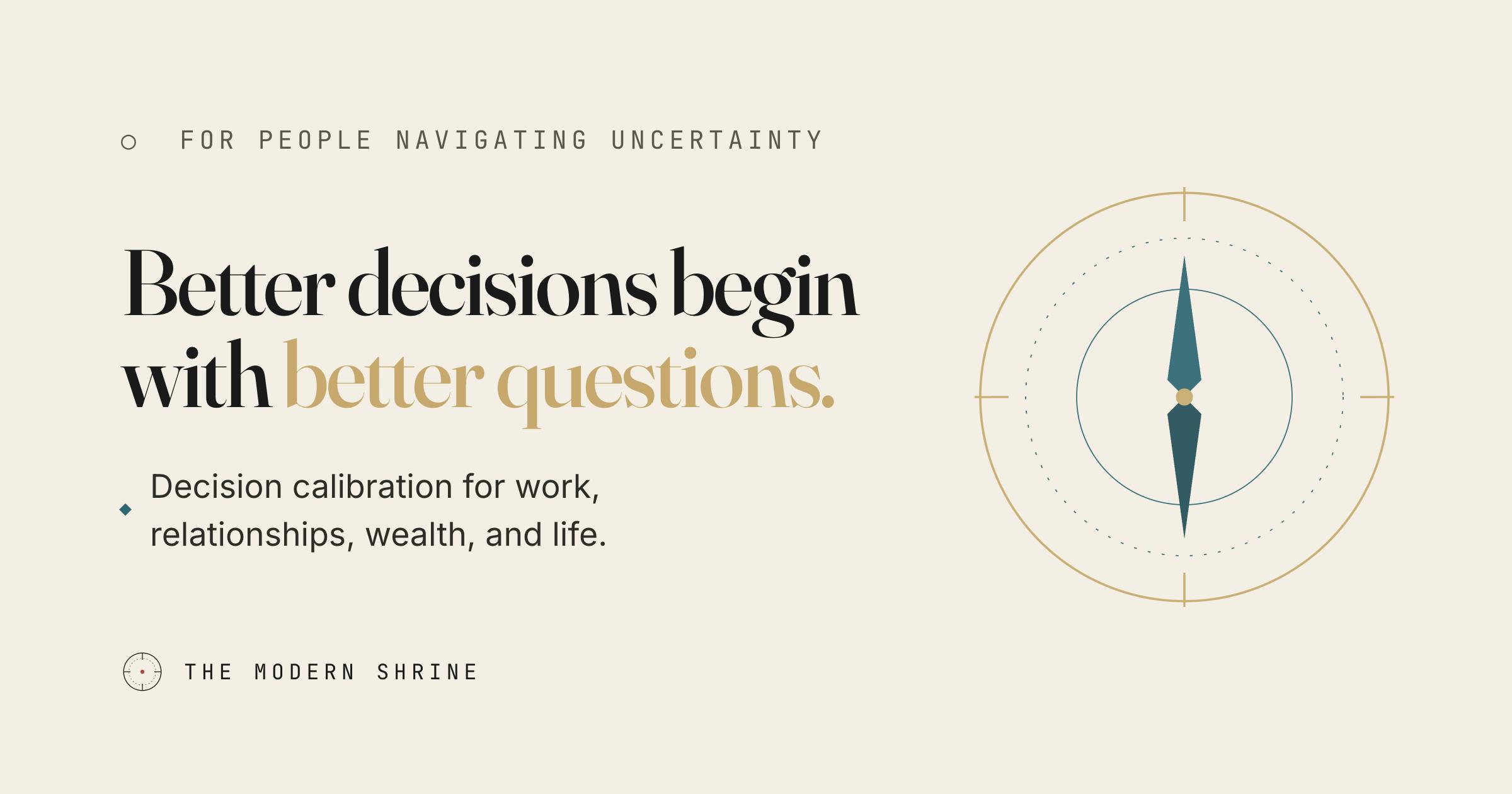
The product's most attention-grabbing concept is the founder's notion of "old school machine learning." Tony Tong merges AI, behavioral psychology, and ancient pattern systems into a practical toolkit for modern decision-making scenarios.
The Underlying Logic of Triple Integration
From the product description, The Modern Shrine's methodology rests on three core pillars:
- AI Technology: As a former ML engineer, the founder leverages algorithmic capabilities for handling complex variables and pattern recognition in decision-making;
- Human Behavior & Psychology: Deep understanding of why people hesitate even when fully informed—fundamentally, cognitive biases and emotional factors are at play;
- Ancient Pattern Systems: This is the product's most differentiated component, reinterpreting time-honored Eastern thinking frameworks or divination-style pattern recognition as "ancient pattern recognition engines."
The pioneering research of behavioral economists Daniel Kahneman and Amos Tversky revealed systematic biases in human decision-making: loss aversion makes potential losses feel roughly 2.5 times more intense than equivalent gains; anchoring effects cause the first information encountered to disproportionately influence final judgments; confirmation bias leads people to seek evidence supporting existing views. Kahneman received the 2002 Nobel Prize in Economics for this body of work. In Thinking, Fast and Slow, he divided human cognition into "System 1" (fast, intuitive, automatic) and "System 2" (slow, rational, effortful), noting that even well-trained professionals cannot fully immunize themselves against these biases. For information-rich analytical minds, these biases don't disappear—they may become even more covert. Their vast information reserves provide richer "ammunition" for confirmation bias, while comprehensive awareness of multiple risks amplifies loss aversion.
This analogy is quite ingenious. The core capability of modern machine learning is extracting patterns from large datasets—whether classification and regression in supervised learning, or clustering and dimensionality reduction in unsupervised learning—the essence is compressing high-dimensional complex information into actionable decision rules. In technical detail: supervised learning learns mapping functions between inputs and outputs through labeled data (e.g., a classifier determining whether an email is spam); unsupervised learning discovers hidden structures in unlabeled data (e.g., K-Means clustering for customer segmentation); dimensionality reduction techniques (like PCA and t-SNE) project high-dimensional data into low-dimensional spaces so humans can intuitively understand complex patterns. Fundamentally, all these techniques do the same thing: transform unactionable complex information into actionable simplified representations.
Many historical divination and decision systems did something remarkably similar: the I Ching's 64 hexagrams essentially map complex situations onto 64 archetypal patterns, each corresponding to a set of action recommendations; the Tarot's 78 cards form a semantic space covering all manner of life situations. From an information theory perspective, the I Ching's 64 hexagrams consist of 6 line positions, each with two states (yin or yang), yielding 2^6=64 combinations—a 6-bit encoding system that can compress arbitrarily complex situations into combinations of 6 binary dimensions. The text associated with each hexagram and line constitutes a "lookup table" providing behavioral guidance for that state. Interestingly, modern decision tree algorithms work on almost exactly the same principle: through a series of binary splits, they partition a complex problem space into finite leaf nodes, each corresponding to a decision recommendation. The only difference: decision trees determine split criteria through statistical data, while the I Ching established its classification framework through thousands of years of accumulated human experience.
These systems don't claim to predict the future—they provide a "forced framing" cognitive tool. When facing infinitely complex reality, a finite pattern library helps decision-makers quickly locate their situation, breaking through decision deadlock. From an information theory perspective, this is an information compression mechanism that reduces decision complexity.
The founder views these ancient systems as "pattern systems that didn't use modern computing power," drawing an analogy with machine learning that creates an intellectual resonance spanning millennia.
Decision Calibration: Not Deciding for You, But Helping You Trust Your Decision
Interestingly, The Modern Shrine positions itself as a "decision calibration system" rather than a tool that provides direct answers. This distinction in wording is critical.
In machine learning, "calibration" is a precise technical concept: a model is "well-calibrated" when its 70% confidence predictions are indeed correct 70% of the time. The typical verification method is a "Reliability Diagram": predictions are binned by probability, then each bin's actual positive rate is checked against the predicted probability. Many high-performance models (like deep neural networks) have poor calibration despite high accuracy—they tend toward overconfidence. Common calibration methods include Platt Scaling (post-processing raw outputs with logistic regression) and Temperature Scaling (softening probability distributions with a single temperature parameter).
In other words, calibration doesn't address "whether the answer is correct" but rather "whether your confidence in your answer accurately reflects reality." Transferring this concept to human decision-making is profoundly illuminating—many analytical minds' real problem isn't poor judgment but "metacognitive bias": a systematic deviation between their confidence in their own judgments and actual accuracy. The overconfident act recklessly, while the underconfident (the typical decision-paralysis demographic) get trapped in endless verification loops. Applying ML's calibration framework to human decisions means helping decision-makers identify their own "metacognitive temperature"—whether they lean toward overconfidence or overcaution—and adjust accordingly.
For analytical people, the problem often isn't a lack of options or data, but an inability to establish confidence among multiple rational choices. Calibration means helping users align intuition with reason, balance over-analysis with action, and ultimately dare to take "the next step."
This product philosophy stands in stark contrast to the flood of "AI decides for you" tools on the market. The current AI decision-support tool market roughly divides into three categories: first, data-driven decision support systems (like BI tools Tableau and Power BI), focused on visualization and data insights; second, AI recommendation tools (like decision suggestions from various AI assistants) that directly output recommended answers; third, thought-guidance tools that help users clarify their thinking through structured questioning and frameworks. Research firm Gartner predicts that by 2026, over 50% of middle managers will use some form of AI assistance for critical decisions. But notably, user trust in AI decision recommendations follows a U-shaped distribution: high trust for low-risk daily decisions and highly quantitative professional decisions; significantly lower trust for complex decisions involving personal values and emotions—and the latter is precisely where analytical minds most frequently encounter decision paralysis.
The Modern Shrine clearly belongs to the third category but adds cultural-symbolic differentiation. Direct-answer tools attempt to replace human judgment, while The Modern Shrine acts more as a thinking partner, aiming to restore users' trust in their own judgment. Decision psychology research shows that for highly personalized complex decisions (career changes, relationship decisions), thought-guidance tools often outperform direct answers—because execution power is highly correlated with the decision-maker's "psychological ownership" of the conclusion. A study published in the Journal of Consumer Research found that people's execution commitment to conclusions they helped derive is approximately 40% higher than for passively received advice—this has been called an extension of the "IKEA effect" into the decision domain. From a product psychology perspective, this may better match analytical users' real needs—they resist being told the answer but welcome being guided to clarity.
Ancient Wisdom Meets Modern AI: Gimmick or Genuine Product Value?
Products that combine traditional cultural symbols with cutting-edge technology inevitably face polarized evaluations.
Potential Value
On the positive side, ancient decision frameworks—refined over thousands of years—crystallize substantial experiential wisdom about human nature, probability, and uncertainty. Structuring these and combining them with AI could theoretically offer users a decision-support experience that provides both emotional resonance and logical scaffolding. For users weary of cold data analysis, this "warmth-infused rationality" may be more readily accepted and adopted.
Neuroeconomics research further demonstrates that emotion isn't the enemy of rational decision-making—it's a necessary component. The landmark case is neuroscientist Antonio Damasio's research on patients with prefrontal damage: these patients retained intact rational analytical abilities but performed terribly in everyday decisions due to impaired emotional processing pathways. Damasio's 1994 "Somatic Marker Hypothesis" proposes that emotional reactions generate "marker" signals in the body (such as accelerated heartbeat or stomach tightening) that participate in the decision process as rapid evaluation mechanisms. He studied vmPFC-damaged patients: they had normal IQs and intact logical abilities but couldn't learn to avoid unfavorable options in the "Iowa Gambling Task"—because they lacked emotional signals to mark "this choice feels wrong." Healthy subjects, after experiencing several rounds of losses, showed skin conductance response changes when approaching "bad decks," even before they could articulate the rule, guiding them away from risk. This demonstrates that decision-makers who rely entirely on logical analysis while excluding emotional signals are actually more prone to infinite loops. Ancient wisdom systems can introduce an emotional dimension within a rational framework, providing the necessary "push" for decision-making.
Questions Worth Examining
On the other hand, this fusion risks being dismissed as "mysticism in fancy packaging." The key question is whether the product truly delivers verifiable decision improvement or merely leverages mystical elements for psychological comfort. Ancient pattern systems inherently lack rigorous scientific causal support, and how to leverage their framing value without misleading users is the core challenge for products like this.
Notably, even "psychological comfort" itself has practical value—research on "Need for Cognitive Closure" in psychology shows that humans naturally need a "signal" to terminate infinite information-seeking loops. Ancient rituals and symbolic systems have historically served as such "termination signals." The issue is whether the product clearly communicates the nature of its working principles to users (a framing tool rather than a prediction tool), preventing inappropriate dependency or superstition.
The founder's machine learning background is particularly important here—it suggests the product might handle this fusion more rigorously rather than as pure marketing rhetoric. However, based on currently available public information, it's impossible to assess the specific algorithmic implementation details.
Market Opportunity and Limitations of a Niche Position
The Modern Shrine is clearly not a mass-market product—it precisely targets the niche of "analytical, information-rich but decision-challenged" individuals. This positioning is both an advantage and a constraint:
- Advantage: The target users' pain point is clear and their willingness to pay may be high—knowledge workers typically pay for tools that resolve cognitive bottlenecks, and their decision scenarios (career transitions, investment choices, technical roadmap decisions) often involve high-value outcomes
- Constraint: Market size is relatively limited, and the product needs to educate users on its unique methodology. Additionally, it must find a precise balance between "rational credibility" and "emotional resonance"—leaning too far in either direction risks losing core users
In today's landscape of heavily commoditized AI tools, The Modern Shrine at least offers a fresh perspective—technology doesn't always have to maximize efficiency; it can also help humans reconnect with their own intuition and judgment. This philosophy echoes the emerging "Human-Centered AI" movement: Stanford's HAI (Human-Centered Artificial Intelligence Institute) emphasizes that AI's ultimate goal isn't to replace human cognition but to augment human judgment and autonomy. Whether the "ancient wisdom + AI" combination can deliver reliable product value remains to be validated through more user feedback and real-world experience.
For readers interested in decision tools and AI application innovation, this product is worth watching as a fascinating case study. It reminds us that in an era of soaring computing power, humanity's oldest wisdom may still offer unexpected inspiration for its most modern technologies.
Key Takeaways
- Decision paralysis is a systemic challenge for analytical minds: Neuroscience research shows that excessive rational analysis suppresses the intuitive decision system—the more information available, the harder it becomes to act
- The "old school machine learning" concept redefines ancient wisdom systems as pattern recognition engines: The I Ching's 64 hexagrams function as a 6-bit encoding system, structurally highly similar to how modern decision tree algorithms work
- "Calibration" rather than "replacement" is the core product philosophy: Drawing on probability calibration concepts from machine learning, it helps users correct systematic biases in confidence about their own judgments
- Emotion isn't the enemy of reason—it's a necessary component of decision-making: Damasio's Somatic Marker Hypothesis proves that pure logical analysis alone cannot support effective decisions
- Market positioning is precise but limited in scale: Targeting knowledge workers with high willingness to pay, but requiring a balance between scientific credibility and cultural resonance
Related articles

Gemini 3.7 Flash Spotted in Google Cloud Console — Launch Countdown Begins
Developers spot Gemini 3.7 Flash in Google Cloud Console, sparking discussion about its relationship to Pro and Google's model distillation strategy.

AI-Memory: Building a Cross-Tool Long-Term Memory System for Coding AIs
AI-Memory is a Rust-based open-source project providing long-term memory for Claude Code, Cursor, Aider and other Agent coding CLIs, enabling seamless handoff between vendors.

Bullet Enters the Stage: YC Newcomer Bets on a Faster Coding Agent
YC S26 startup Bullet launches a speed-focused coding Agent targeting developer latency pain points. Analysis of its differentiation, acceleration techniques, and market opportunity against Cursor and Claude Code.