The Mystery of China's High ML Paper Output: Quality and Ecosystem Debates Behind the Numbers

Reddit discussion reveals China's high ML research output: shocking paper counts and numerous co-authors raise questions about quality and fairness.
Based on a Reddit discussion, this article examines the high-output phenomenon in China's machine learning research ecosystem: publishing 100-200 papers during undergraduate or graduate studies is not uncommon, collaboration teams often reach dozens, research is heavily concentrated in LLM and multimodal areas, with enormous experimental volume but less mathematical derivation. The author uses LLM detection tools to find suspicious passages, yet these papers are still accepted at top conferences like ICLR and AAAI. The post also speculates about relatively closed academic publishing and hiring networks that may involve reciprocal mechanisms. The article notes that this phenomenon involves multiple factors including academic evaluation systems, conference review mechanisms, and interpersonal networks; sheer quantitative growth does not equal quality improvement, and more transparency and cross-cultural dialogue are needed to understand it.
Introduction
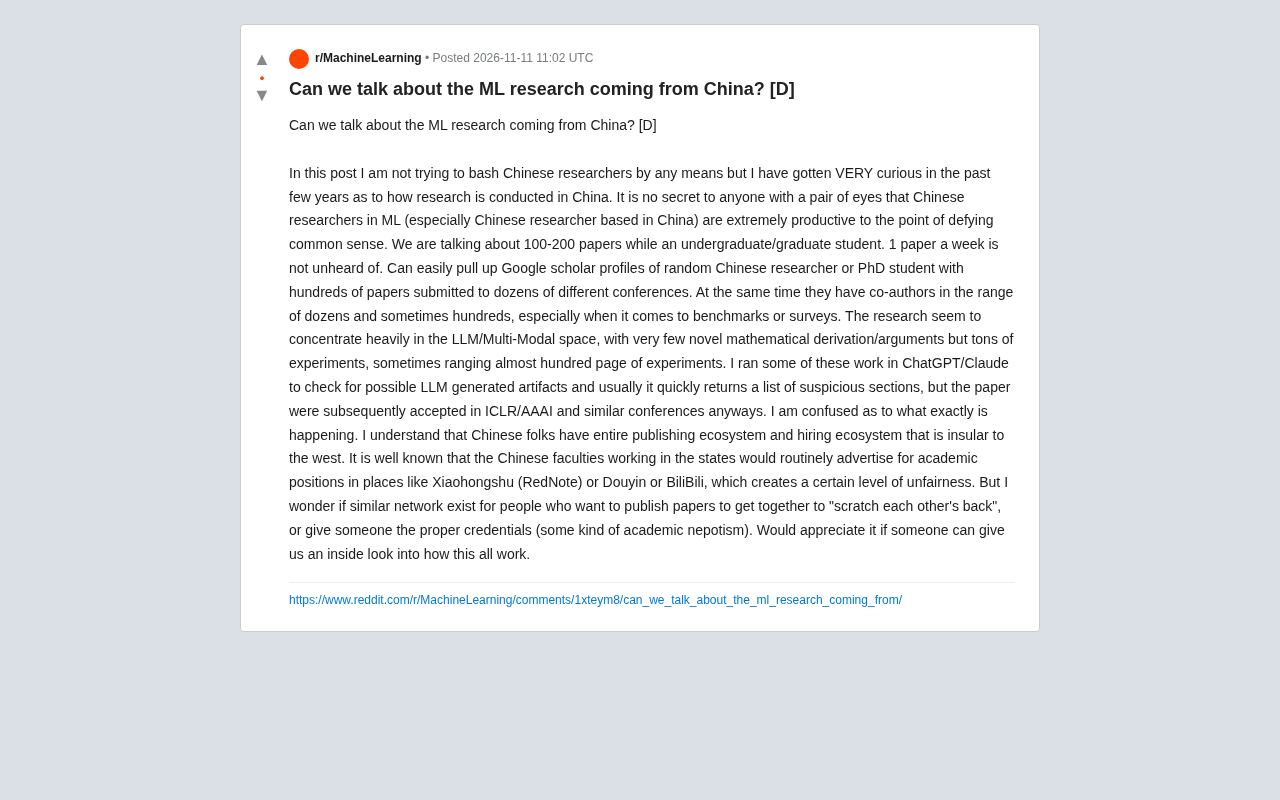
A recent discussion on Reddit has drawn widespread attention to China's machine learning research ecosystem. The author of the post is not trying to disparage Chinese researchers, but rather is puzzled by the "defy common sense" high output of Chinese researchers—especially those based in China—in the ML field: publishing 100-200 papers during undergraduate or graduate studies, with one paper per week not being uncommon, and virtually any Chinese researcher or PhD student on Google Scholar having hundreds of papers submitted to dozens of conferences. At the same time, co-author lists often run to dozens or even hundreds of people, especially in benchmark or survey papers. Research is highly concentrated in LLM/multimodal areas, with less novel mathematical derivation but enormous experimental volume—sometimes the experimental section approaches a hundred pages. The author uses ChatGPT/Claude to check these works and often quickly gets back lists of suspicious sections, yet the papers are still accepted at conferences like ICLR/AAAI. What exactly is going on behind this?
The High-Output Phenomenon: Inflation of Quantity and Collaboration
The output rate of Chinese researchers in ML is astonishing. According to the post, publishing 100-200 papers during undergraduate or graduate studies is no fantasy, and cases of one paper per week are occasionally heard of. On Google Scholar, it is not uncommon to casually open the profile of a Chinese researcher or PhD student and find hundreds of papers directed at dozens of different conferences. Even more striking is the scale of collaboration: teams of dozens or even hundreds of co-authors are especially common in benchmark or survey papers. This "human wave tactic" style of collaboration stands in sharp contrast to the small-team, deep-collaboration model typical of Western academia.
Behind this high output may lie a complex academic evaluation system, graduation requirements, and resource allocation mechanisms. But does sheer quantitative growth mean a corresponding improvement in research quality? The author of the post is skeptical.
Google Scholar citations and paper counts: Google Scholar is a free academic search engine whose personal profiles aggregate a scholar's paper list, citation counts, h-index, and other metrics. Because it automatically crawls paper information from the web and does not strictly verify author identity or paper quality, paper counts are very直观 on profiles. In some academic evaluation systems, paper counts and citation numbers are simplified into quantitative indicators, which may incentivize researchers to pursue a "quantity-first" strategy.
h-index: The h-index means that a scholar has h papers each cited at least h times, used to measure the balance between output and impact. But the h-index may create an "inflated" impression for prolific authors with dispersed citations, especially when many papers are published in lower-threshold conferences or journals. Understanding these metrics helps analyze the incentive structure behind the high-output phenomenon.
Research Style: Imbalance Between Experiment-Driven Work and Mathematical Depth
The post points out that Chinese researchers' work is highly concentrated in the LLM and multimodal space, with extremely large experimental sections—sometimes approaching a hundred pages—but relatively lacking in novel mathematical derivation or argumentation. This "heavy on experiments, light on theory" style may be related to the current AI field's excessive emphasis on benchmarks and performance metrics. However, this tendency also raises concerns about research depth and innovation.
The author uses ChatGPT/Claude to detect possible LLM-generated traces in papers and can often quickly list a series of suspicious passages, yet these papers are still accepted at top conferences like ICLR and AAAI. This inevitably raises questions: Are there loopholes in the conference review mechanism? Or is the richness of experiments enough to mask the lack of theoretical depth?
LLM-generated trace detection: The article mentions using ChatGPT/Claude to detect possible LLM-generated passages in papers, which falls under "machine-generated text detection." Common methods include analyzing text perplexity, lexical diversity, syntactic patterns, and watermarking techniques. But such detection tools themselves have high false-positive rates and limited effectiveness on human-revised text. Therefore, detection results can only serve as reference and cannot be directly used as evidence of academic misconduct.
ICLR and AAAI: ICLR (International Conference on Learning Representations) is a top conference in deep learning, known for open review (OpenReview); AAAI is a comprehensive top conference in artificial intelligence. Both typically have acceptance rates around 20%-30%, with review processes emphasizing innovation, experimental sufficiency, and writing quality. Papers with large experimental volume but lacking theoretical contribution may still be accepted for being "engineering-heavy," reflecting the diverse standards and potential preferences of conference review.
Academic Ecosystem: Closed Networks and Potential Unfairness
The author understands that China has a publishing and hiring ecosystem relatively isolated from the West. One phenomenon that needs no explanation is that Chinese faculty working in the US often post academic job openings on Xiaohongshu, Douyin, or Bilibili, which to some extent creates unfairness. The author further speculates whether there are similar networks where people who want to publish papers "scratch each other's backs," or give someone appropriate credentials (a kind of academic nepotism).
Although this speculation lacks solid evidence, it reflects outside doubts about the transparency of China's academic ecosystem. The large number of collaborators and dense conference submissions may hint at a reciprocal mechanism based on interpersonal networks. However, this is not unique to China; similar phenomena exist in global academia, only the scale and form may differ.
Academic nepotism and reciprocal citation: The "scratching each other's backs" phenomenon speculated in the article is often called "reciprocal citation" or "citation cartels" in academia. Researchers boost citation metrics through mutual citation and co-authorship within small circles, or use interpersonal networks to gain review convenience. This phenomenon is not unique to China and has cases worldwide, but large-scale, systematic reciprocal networks harm academic fairness and innovation.
Job postings on Xiaohongshu, Douyin, Bilibili: These Chinese social platforms have become channels for some overseas Chinese faculty to post academic job openings. Because information dissemination is limited in scope and circle-based, it may lead to asymmetric distribution of job opportunities and exacerbate unfairness in access to academic resources. This reflects the importance of information transparency and channel diversification in the academic labor market.
Multi-Source Perspectives and Unresolved Mysteries
This discussion is mainly based on a single Reddit post and lacks cross-validation from other independent sources. The observations and speculations in the post represent the confusion of some researchers, but more empirical research is needed to reveal the real mechanisms behind China's high ML research output. For example, is high output related to specific evaluation metrics (such as linking paper counts to graduation)? Do conference reviews favor papers with large experimental volume? The answers to these questions require deeper investigation.
Collaboration inflation in benchmark and survey papers: Benchmark papers typically require building datasets, designing evaluation protocols, and running large numbers of experiments, while survey papers need to cover extensive literature, so the number of collaborators is naturally larger. But in some cases, co-author lists may include authors who contributed only minimally or provided resource support, leading to "guest authorship." This raises discussion about authorship contribution standards (such as ICMJE guidelines): when the number of collaborators reaches dozens, how can it be ensured that each author has made substantive contributions to the paper? This requires more transparent contribution statement mechanisms.
Conclusion
The high-output phenomenon of Chinese ML research is a complex topic involving multiple factors such as academic culture, evaluation systems, conference review, and interpersonal networks. Sheer quantitative growth should not be simply equated with quality improvement, nor should it be categorically denied. Understanding this phenomenon requires more transparency and cross-cultural dialogue, rather than simple speculation or prejudice.
(Note: This article is based on a Reddit discussion; the views represent only the original poster and discussants, not the position of this platform.)
Related articles

AI's New Species FDE in Practice: Core Responsibilities and Career Guide
An in-depth look at the three core responsibilities of the AI-era FDE (Forward Deployed Engineer), role boundaries with algorithm, backend, and product teams, and an interview and career preparation guide, illustrated with a real-world learning platform agent transformation case to help developers understand this key role in the last mile of AI deployment.
LangChain + MCP in Practice: Architecture Protocol and Agent Tool Integration
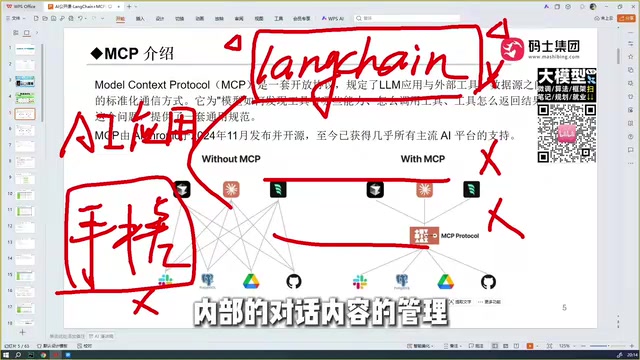
Starting from LangChain and Agent encapsulation, this article explains how the MCP protocol solves cross-model, cross-framework tool reuse, compares MCP with Function Calling, and outlines the LangChain stack and Agent development.

Codex in Practice: From Environment Setup to Skills and MCP Calls
Codex is OpenAI's AI coding assistant. This guide covers its positioning, how it compares to Claude Code, model configuration pitfalls, and practical Skills and MCP usage for beginners.