The ".name Grandfathered" Phenomenon After Domain Rule Changes
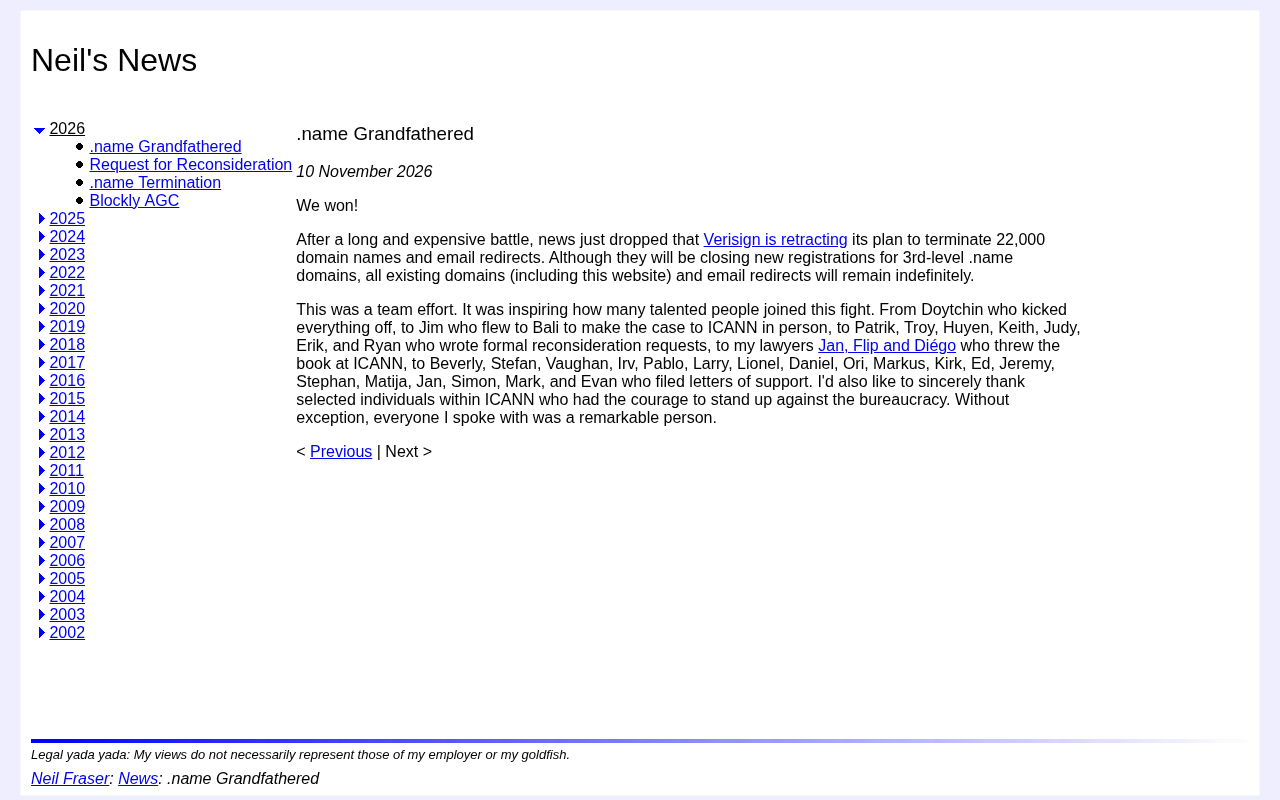
Using ".name Grandfathered" as an example, this analyzes the tension between new rules and old precedents in domain governance and the long-term impact of grandfather clauses.
This article uses technical author Neil Fraser's short post on ".name Grandfathered" and the Hacker News discussion as a starting point to explain the meaning of grandfather clauses in the domain system: exempting existing domains after new policies take effect to avoid service interruptions. It notes that this case draws community attention to rule transparency, fairness, and technical debt, and analyzes how grandfather clauses can create path dependence, leading registries to maintain a dual-track system long-term. For developers, historical domain status affects validation logic, security monitoring, and migration decisions. The community divergence is whether grandfather clauses are a necessary compromise for stability or whether exemption lists should be published and sunset clauses set.
How a Brief Technical Event Reflects the Long-Term Logic of Domain Governance
In the domain world, rule adjustments are not uncommon, but the emergence of "grandfathering" often means certain legacy assets receive special treatment, sparking ongoing discussion in the community. A recent short post by technical author Neil Fraser (which gained hundreds of points after being shared on Hacker News) points to a case called ".name Grandfathered." Although the original piece is extremely brief—just a title and a redirect link—combined with the extensive discussion in the HN comment section, we can unpack a recurring tension in domain governance: the friction between new rules and old precedents.
This article is not a complete technical analysis but rather a starting point. The content below synthesizes the discussion atmosphere linked from the original source and the direction of opinions in the HN comment section to help readers understand the general pattern of such events.
What Is a "Grandfather Clause" in Domains?
A grandfather clause is originally a legal term referring to allowing existing entities to continue operating under old rules after new rules take effect. In the domain name system, when a top-level domain (TLD) or registration policy changes, already-registered domains are often "exempted" from new restrictions; otherwise, existing users would face sudden service interruptions or compliance costs.
Take the .name TLD as an example. It was originally intended for personal name registration, but early registration policies were relatively lax. When the registry tightened rules (e.g., requiring domains to correspond to real names, limiting multiple domain holdings), those domains legally registered under the old rules were "grandfathered" and retained. This itself reflects stability, but it can also create inconsistency in rule enforcement: new users face strict restrictions while old users enjoy de facto privileges.
Top-Level Domain (TLD) and Registry
A top-level domain is the rightmost level in the Domain Name System (DNS) hierarchy, such as .com, .org, .name. It is coordinated by ICANN (Internet Corporation for Assigned Names and Numbers), but actual operations are usually delegated to a "registry." The registry is responsible for setting registration policies under that TLD, maintaining the domain database, and selling domains to the public through "registrars." Therefore, when the article mentions tightening registration policies for .name or the emergence of grandfather clauses, the decision-making body is the .name registry, not ICANN directly. Understanding this governance chain helps determine: the scope of grandfather clauses, exemption lists, and sunset clauses are typically defined by individual registries in their policy documents, and community oversight primarily targets these institutions.
Sunset Clause
A sunset clause is a common companion mechanism to grandfather clauses, specifying a clear expiration time for exemptions or transitional arrangements, after which old rules no longer apply. In domain governance, sunset clauses can prevent "grandfathering" from continuing indefinitely, forcing registries to gradually guide existing users toward compliance during the transition period, or at least publicly assess whether to extend. Like grandfather clauses, the specific design of sunset clauses (duration, renewability, how domains are handled after expiration) varies by TLD. Community calls for sunset clauses essentially reflect concern about a "permanent dual-track system"—without an expiration mechanism, grandfather clauses can easily solidify into long-term privileges.
Why This Case Interests the Tech Community
Judging from the number of comments (57) and points (329) on Hacker News, the discussion was quite active. The tech community's interest in such topics typically focuses on several levels:
- Rule transparency: Whether the criteria for grandfathering and retention periods are publicly available.
- Fairness: Whether existing domains are used for hoarding or resale, thereby distorting the original policy goals.
- Technical debt: Registries and registrars need to maintain two sets of logic long-term, increasing system complexity.
Neil Fraser's original title itself is a signal: it doesn't elaborate an argument but directly throws out the keyword "Grandfathered." In the HN context, this often means the author believes the matter is worth recording but doesn't require a lengthy explanation—the comment section will fill in the details.
Seeing the General Challenges of Domain Governance Through a Single Case
If we broaden our view from .name to the entire domain system, grandfather clauses are almost ubiquitous. When ICANN introduced new generic top-level domains (new gTLDs), it set up transitional mechanisms such as the sunrise period for trademark holders; national ccTLDs often give priority to existing registrants when liberalizing registration restrictions. While protecting vested interests, these mechanisms also create room for "rule arbitrage."
A noteworthy phenomenon is that grandfather clauses are often not one-time events but create path dependence. Once a batch of domains is exempted, every subsequent policy revision must consider the existence of these domains, potentially evolving into a permanent dual-track system. For registries, the cost of cleaning up historical legacy issues far exceeds maintaining the status quo, so "grandfathering" often becomes the default option.
Practical Impact on Ordinary Users and Developers
If you're not a domain investor, this may seem remote. But it affects developers indirectly:
- APIs and validation logic: Many services rely on TLD rule libraries when validating domains. Grandfather clauses can cause certain domains to "appear non-compliant yet actually exist," requiring extra handling.
- Security and abuse: Lax historical domains may be used for phishing or brand confusion, requiring security teams to monitor continuously.
- Migration decisions: When enterprises consider changing domains, the special status of old domains may affect SEO weight transfer and email deliverability.
new gTLD and Sunrise Period
ICANN opened a new round of generic top-level domain (new gTLD) applications around 2012, allowing organizations to apply for new suffixes like .app, .blog, etc. Before a new gTLD officially opens for public registration, a "Sunrise period" is typically set: trademark holders can preferentially register domains matching their trademarks to prevent cybersquatting and brand confusion. The Sunrise period is a pre-emptive transitional mechanism, opposite in direction to grandfather clauses—it gives priority to specific groups rather than exempting old rules. But both share the same governance logic: during the window of rule transition, arrangements are made for existing or specific rights to balance stability and fairness.
TLD Rule Libraries and Domain Validation
When validating user-input domains, developers often rely on the Public Suffix List or third-party TLD rule libraries to determine whether the domain structure is legal. These rule libraries record registration restrictions for each TLD (e.g., whether numbers are allowed, hyphen positions, second-level domain hierarchy). The trouble with grandfather clauses is that certain historical domains may not conform to current rule library validation logic yet actually exist and resolve. If the server strictly rejects based on the rule library, it will mistakenly block legitimate users; if it fully allows, it may introduce security risks. A practical compromise is: validation logic distinguishes "new registration" from "existing resolution," or maintains a whitelist for known exceptions, but this increases maintenance costs.
Divergences and Consensus in the Discussion
Based on the direction of discussion in the HN comment section, two typical viewpoints emerge. Some participants believe grandfather clauses are a necessary compromise to maintain internet stability; without them, policy changes would trigger numerous lawsuits and service interruptions. Others worry that such compromises are easily exploited by vested interests and call for registries to publish exemption lists and set sunset clauses.
No official statement or follow-up on this case has been seen, so the above divergences are more of a community-level clash of opinions rather than a conclusion.
Final Thoughts
The topic ".name Grandfathered" made it to the HN front page largely because it touches on an underappreciated area: how the historical baggage of the domain system shapes current rules. For technical creators, such events remind us that behind many seemingly dull registration policies lie real interest struggles and engineering trade-offs. If you're interested in domain governance, start by tracking policy changes for the domains you use.
One-line Summary
Using ".name Grandfathered" as an example, this analyzes the tension between new rules and old precedents in domain governance and the long-term impact of grandfather clauses.
Paragraph Summary
This article uses technical author Neil Fraser's short post on ".name Grandfathered" and the Hacker News discussion as a starting point to explain the meaning of grandfather clauses in the domain system: exempting existing domains after new policies take effect to avoid service interruptions. It notes that this case draws community attention to rule transparency, fairness, and technical debt, and analyzes how grandfather clauses can create path dependence, leading registries to maintain a dual-track system long-term. For developers, historical domain status affects validation logic, security monitoring, and migration decisions. The community divergence is whether grandfather clauses are a necessary compromise for stability or whether exemption lists should be published and sunset clauses set.
Related articles

Did the US Midterms Vote No to AI Data Centers? A Map Reveals the Truth
After the US midterms, media claimed voters rejected AI data centers, but a map shows restrictive votes are concentrated in a few Ohio townships, affecting less than 1% of US towns—the national anti-AI wave is exaggerated.

ApexW Optimizer Benchmark: Matches 8-bit AdamW in Unsloth with Lower Memory Usage
Developer shares benchmark of ApexW optimizer in Unsloth: ApexW 8bit has lower optimizer state memory (47.101 MB) and slightly better final loss than 8-bit AdamW, but similar speed. Needs independent reproduction.

US Computer Science Enrollment Drops 12.4% — Is CS Still Worth Studying?
CS enrollment fell 12.4% while health majors grew 6.2%. A CS master's grad explains why the degree's real value isn't coding but systems thinking.