The Pain of Open Source: An Indie Developer Built the Same Architecture as a Leading Lab a Year Earlier — and No One Noticed

An indie developer says he open-sourced a similar non-autoregressive architecture a year before a frontier lab's 'breakthrough' — and no one cared.
An independent developer posted on Reddit claiming he built and open-sourced a non-autoregressive system — complete with an arXiv paper, Hugging Face model, PyPI package, and dataset — over a year before a frontier lab's similar 'jev architecture' was celebrated as a breakthrough. Technically, his PPO-trained sequence embedding approach for sales conversion trajectories differs from jev's RLCD-trained parallel sampling for confidence distributions, but both abandon autoregressive generation in favor of structured probabilistic outputs via reinforcement learning. The case highlights a persistent gap in the open-source ecosystem: frontier labs command narrative power and distribution that independent developers simply don't, regardless of who got there first.
A Dispute Over "Who Got There First"
A debate around a non-autoregressive architecture has been gaining traction in the AI community. The core appeal of this approach is combining JSON schema with ultra-fast probabilistic prediction, breaking free from the token-by-token generation of traditional autoregressive models. When a leading lab unveiled this concept as a "breakthrough," one independent developer pushed back — claiming he had built and open-sourced a nearly identical system over a year earlier (as of March 2025).
The developer posted a complete chain of evidence on Reddit: an arXiv paper, a model uploaded to Hugging Face, a companion PyPI package, and a public training dataset. His grievance was straightforward: why does the same idea get ignored when an indie developer builds it, yet celebrated as a "breakthrough" when a frontier lab releases it — especially when the latter has no technical paper, no open weights, and no open dataset?
A Technical Comparison of the Two Approaches
Setting emotion aside and looking purely at the technical roadmaps, this case actually offers a valuable side-by-side comparison.
The Independent Developer's Approach
According to the poster, his model (a sales conversion model from DeepMostInnovations) was trained using PPO (Proximal Policy Optimization) on top of sequence embeddings, outputting per-turn conversion trajectories — essentially a sequence of conversion probabilities from 0.0 to 1.0. This is a highly vertical use case: predicting conversion likelihood in sales conversations. He also released the corresponding SaaS sales conversation dataset, forming a complete loop of paper, model, data, and toolkit.
PPO (Proximal Policy Optimization) is a policy gradient algorithm in reinforcement learning, introduced by OpenAI in 2017. Its core idea is to constrain the deviation between old and new policies during each update by "clipping" the objective function, preventing overly large parameter updates that could destabilize training. Compared to the earlier TRPO algorithm, PPO is simpler to implement and computationally efficient, and has been widely adopted in robotic control, game-playing, and RLHF alignment training for large language models. Applying PPO on top of sequence embeddings means the model doesn't perform reinforcement learning directly at the token level — instead, it first compresses dialogue sequences into vector representations and uses those as the state space for policy optimization. This design can dramatically reduce the complexity of the action space, but requires the embeddings themselves to sufficiently capture the semantic content of the conversation.
The Frontier Lab's Approach
The "jev" architecture being compared uses parallel sampling, trained via RLCD (Reinforcement Learning from Contrastive Distillation), and outputs confidence distributions and schema selections. This is a much more horizontal, general-purpose solution.
The two approaches share a common thread: both attempt to escape the autoregressive paradigm and use reinforcement learning to produce structured probabilistic/confidence outputs. The differences lie in the training algorithm (PPO vs. RLCD), sampling strategy (trajectory-based vs. parallel), and intended use case (vertical sales scenario vs. general-purpose capability).
The poster also noted that a second paper published in September 2025 (arXiv:2510.01237) is "exactly the same" as what jev is now proposing — further supporting his argument that the idea already existed.
RLCD (Reinforcement Learning from Contrastive Distillation) is a relatively novel training paradigm. Its core idea is to construct positive and negative sample pairs for contrastive learning, then combine reinforcement learning signals to distill the model's output distribution. Unlike PPO, which relies on explicit reward signals, RLCD guides policy improvement through the contrast between high-quality and low-quality outputs — making it particularly advantageous in settings where manually annotated rewards are unavailable. Parallel sampling refers to generating multiple candidate outputs simultaneously during inference, then selecting the best result via confidence distribution or scoring mechanisms. This stands in sharp contrast to the serial, token-by-token generation of autoregressive models and can theoretically deliver significant improvements in throughput and speed.
Why "Getting There First" Rarely Means "Getting Recognized"
This story strikes at a recurring pain point in the open-source ecosystem: there is a massive gap between technical priority and impact.
The independent developer contributed with maximum openness — a paper, open weights, and an open dataset — which is theoretically the most celebrated form of transparency in academic and engineering circles. But in reality, whether an idea gains widespread recognition rarely depends on who proposed it first. It depends on:
- Who proposes it, and in what context. A vertical sales conversion prediction tool has a naturally limited audience; a horizontal, general-purpose architecture can capture the imagination of the entire industry.
- Who is doing the proposing. Frontier labs carry enormous distribution momentum and built-in credibility. The same technical narrative is far more likely to be labeled a "breakthrough" when it comes from them.
- Narrative packaging ability. A story about "lightning-fast probabilistic prediction" that the public can grasp spreads far more easily than a vertical-domain arXiv paper.
The irony, as the poster pointed out, is that the other party had "no technical paper, no open weights, no open dataset" — yet garnered vastly more attention. This exposes a fundamental asymmetry in how AI discourse is distributed: openness and recognition are not proportional.
What Independent Researchers Can Learn
This case is not an anomaly — it's a routine snapshot of the open-source ecosystem. For independent researchers and small teams, there are a few practical takeaways:
Solidify your priority evidence. One thing the poster did right was leaving a complete timestamped paper trail — arXiv paper, Hugging Face model, PyPI package, public dataset. These are verifiable, first-mover proofs that become critical in any dispute.
Weigh vertical depth against horizontal reach. Going deep on a vertical use case (like sales conversion) can deliver real commercial value, but has a lower ceiling for dissemination. If academic impact is the goal, it may be worth proactively emphasizing the generalizable, universal value of your work at release time.
Open source does not automatically mean reward. Full open-sourcing is an idealistic form of contribution, but it also means surrendering some control over the narrative and commercialization. Developers need to be clear-eyed about this trade-off.
The Other Side Worth Considering Calmly
Worth noting: the information in this article comes from a single Reddit post — one person's account of events. Whether "architectural similarity" constitutes substantive technical equivalence requires proper peer review to determine. RLCD and PPO, parallel sampling and trajectory output, represent real technical differences — you can't conclude they are the same invention just because both are non-autoregressive.
In the history of technology, the same idea being independently and near-simultaneously discovered by multiple teams — so-called multiple discovery — is extremely common. The frontier lab may not have copied anyone; more likely, they were naturally converging along the same technical trajectory. The real question may not be "who copied whom," but rather how the ecosystem as a whole can more fairly provide visibility and support for early contributors.
Regardless, the developer's frustration is real, and it speaks for a large number of quietly toiling independent creators. The bitterness of this open-source story deserves serious reflection from the entire community.
The phenomenon of the same discovery being independently reached by multiple researchers is known in the history of science as Multiple Discovery. Famous examples include Newton and Leibniz independently inventing calculus, and Darwin and Wallace simultaneously proposing the theory of natural selection. Research by sociologist Robert Merton suggests that when technology or knowledge accumulates to a sufficient degree and the relevant tools and methodologies mature, the same breakthrough often emerges in multiple places nearly simultaneously. In the deep learning space, this is especially common — identical architectural improvements or training techniques are frequently discovered and published by multiple teams within weeks of each other. Therefore, disputes over "who proposed it first" don't always prove plagiarism; more often, they simply reflect that a particular technical direction had already reached the point of inevitability at a given moment in time.
Related articles

The Open Source Dilemma: A Non-Autoregressive Architecture Pioneer Overshadowed by Frontier Labs
An indie developer claims a frontier lab repackaged his year-old open-source non-autoregressive RL architecture as a breakthrough. We compare PPO sequence embeddings vs. RLCD parallel sampling and examine open source attribution gaps.
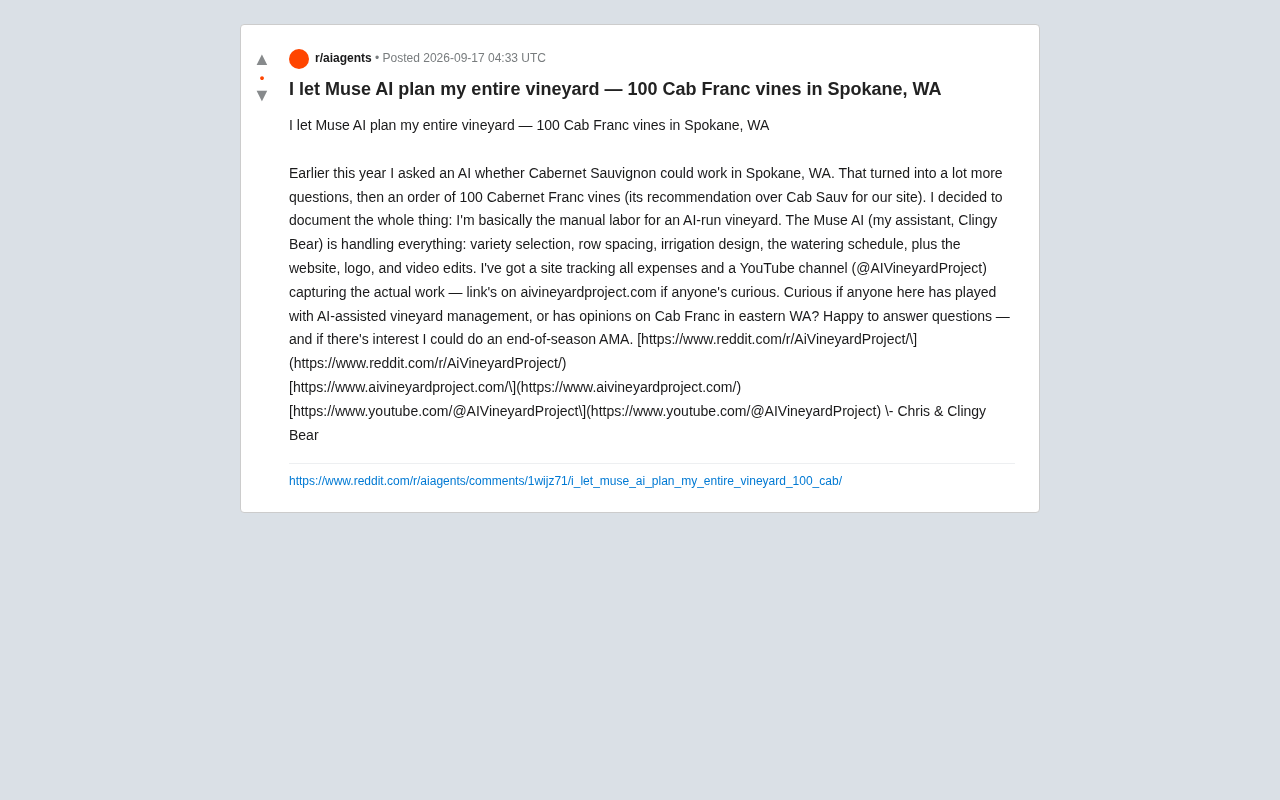
AI Plans an Entire Vineyard: A Real-World Experiment with 100 Grapevines
A Spokane hobbyist let Muse AI plan his entire vineyard — variety, spacing, irrigation, even the logo. He planted 100 Cabernet Franc vines and is documenting everything publicly.

Iceland's Treble Raises $18M to Bet on Voice Simulation Platform
Iceland-based voice simulation company Treble raises $18M. Its platform serves voice AI developers, AI wearables, and robotics firms. A deep dive into the technology and what the funding signals.