The Physics of Warp Drives: How Far Are We from Faster-Than-Light Travel?

Podcast discussion analogizes fluid mechanics singularities with warp drives, revealing the value of cross-domain mathematical tools.
Based on a spontaneous conversation on the Lex Fridman podcast, this article explores the analogy between the Navier-Stokes singularity problem in fluid mechanics and spacetime manipulation in warp drives. The guest suggested that traversing two connected black holes might correspond to blow-up singularities, linking airplane wing aerodynamics with spacetime flow control. The discussion highlights that the core control challenge for warp drives is the lack of a known physical mechanism to generate and precisely regulate spacetime distortion—the source of "force" is unclear. Although self-deprecatingly called "pothead thoughts," it reflects the value of analogical thinking in frontier physics: in the absence of experimental data, borrowing mathematical tools and intuition across fields is a common path in theory construction. The article concludes that while most such ideas are wrong, the occasional accidental hit is the true state of theoretical exploration.
In a Lex Fridman podcast, a spontaneous discussion about warp drives unexpectedly touched on one of the most fascinating intersections in physics: when the singularity problem in fluid mechanics meets spacetime manipulation, is faster-than-light travel really just science fiction?
This conversation arose from an association triggered when Alex mentioned black holes. The guest proposed an idea that seems absurd but is worth pondering: the blow-up singularities observed in the Navier-Stokes equations might find a counterpart in a scenario where a warp drive traverses two connected black holes. This analogy links aerodynamics of airplane wings on Earth with spacetime flow control.
The Unexpected Intersection of Fluid Mechanics and Spacetime Manipulation
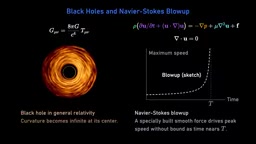
The core of the discussion lies in an analogy: on Earth, airplane wings generate lift by controlling airflow; in a warp drive, what we need to control is the "flow" of spacetime itself. The guest pointed out that when a spacecraft traverses two connected black holes, the mathematical description of singularities in fluid mechanics may become relevant.
The value of this idea lies not in whether it is immediately feasible, but in the research path it suggests: the Navier-Stokes equations are the core equations describing fluid motion, and the problem of the existence and smoothness of their solutions remains one of the Millennium Prize Problems in mathematics. If spacetime behaves like a fluid under extreme conditions, then singularity theory in fluid mechanics might provide clues for the mathematical framework of warp drives.
The Navier-Stokes equations are a set of nonlinear partial differential equations describing the motion of viscous fluids, derived from conservation of mass and conservation of momentum. Their mathematical form shares a similar tensor structure with the Einstein field equations, both involving second derivatives and nonlinear terms. The Millennium Prize Problem specifically refers to: in three-dimensional space, given arbitrary smooth initial conditions, do the Navier-Stokes equations possess global smooth solutions, or can they develop infinite velocity gradients (i.e., blow-up singularities) in finite time? Solving this problem concerns not only mathematical rigor but also directly affects turbulence modeling and fluid control.
The Metaphor of the Singularity Problem: From Black Holes to Warp Drives

"hence the singularity"—the guest used this phrase to stitch the two fields together. In fluid mechanics, solutions to the Navier-Stokes equations may blow up in finite time, forming mathematical singularities; in general relativity, a physical singularity also exists at the center of a black hole. If a warp drive involves traversing black holes or creating similar extreme spacetime structures, then the singularity problem is no longer just abstract mathematics but an engineering constraint.
Alex's reaction to this was rather subtle, and the guest self-deprecatingly admitted that these were "pothead thoughts." But this half-joking association precisely reflects the kind of mental leaps common in frontier physics discussions: in fields lacking experimental data, analogies and metaphors are often the starting point of theory construction.
The warp drive concept originates from the metric scheme proposed by physicist Miguel Alcubierre in 1994: by compressing spacetime ahead and expanding spacetime behind, a spacecraft can achieve faster-than-light travel under the local speed-of-light limit. This scheme requires exotic matter with negative energy density to maintain the spacetime distortion, and quantum field theory imposes strict limits on negative energy. The idea of traversing black holes involves wormholes or Einstein-Rosen bridges, but such structures are unstable in classical general relativity and require a theory of quantum gravity for a complete description. In general relativity, a singularity typically refers to a point where curvature diverges and geodesics cannot be extended, as at the center of a black hole.
Who Applies the "Force"? The Control Problem of Warp Drives

The discussion turned to a practical control theory question: even if you could create a black hole vortex, you would still need to apply a precise "force" at a precise moment. The guest asked "where's the force?"—in the warp drive concept, you need some mechanism to drive and stabilize the spacetime distortion, just as a wing needs precise control of airflow.
This "force application" problem exposes a core gap in warp drive research: we currently have no known physical mechanism capable of generating and manipulating the required spacetime distortion. The discussion mentioned "you could try to write it out," hinting at the common path in theoretical physics of first writing equations and then seeking physical explanations. But being able to write the equations does not mean the force exists.
Control theory applied to physical systems emphasizes feedback and stability. For a warp drive, even if negative energy matter existed, energy density would need to be precisely distributed at the boundary of the spacetime distortion; any perturbation could cause the warp bubble to collapse or produce lethal radiation. In classical mechanics, "force" is the rate of change of momentum, but in general relativity, gravity is not a force but a geometric effect of spacetime curvature. Therefore, the phrasing "applying force" must be reinterpreted as manipulating the energy-momentum tensor, which requires precise control over the behavior of quantum fields in curved spacetime—something for which no experimental means currently exist.
The Humor and Seriousness of Theoretical Physics

The conversation ended with a self-deprecating remark: "when some future system listens to this, it might say this guy was right for once." Behind this humor lies the true state of theoretical exploration: most ideas are wrong, but occasionally a crazy notion may hit the mark by accident.
Examined seriously, although this discussion did not provide a feasible warp drive scheme, it raised a methodological question worth attention: when direct research on spacetime manipulation is fraught with difficulties, could borrowing mathematical tools and intuition from seemingly unrelated fields such as fluid mechanics and condensed matter physics accelerate theoretical breakthroughs? The Navier-Stokes equations and the Einstein field equations share certain similarities in mathematical structure, and this cross-domain analogy is at least worth careful derivation on paper.
The physics of warp drives is far from mature, but this spontaneous conversation in the Lex Fridman podcast reminds us that breakthrough ideas are often born in discussions with blurred boundaries. The next warp theory to be taken seriously may begin with a "far-fetched" brainstorming session.
One-line Summary
A podcast discussion draws an analogy between fluid mechanics singularities and warp drives, revealing the value of cross-domain mathematical tools.
Paragraph Summary
Based on a spontaneous conversation in the Lex Fridman podcast, this article explores the analogy between the singularity problem of the Navier-Stokes equations in fluid mechanics and spacetime manipulation in warp drives. The guest proposed that a scenario traversing two connected black holes might correspond to blow-up singularities in fluid mechanics, thereby linking airplane wing aerodynamics with spacetime flow control. The discussion points out that the core control challenge facing warp drives is the lack of a known physical mechanism to generate and precisely regulate spacetime distortion—the source of "force" is unclear. Although the conversation self-deprecatingly labels itself "pothead thoughts," it reflects the value of analogical thinking in frontier physics: in the absence of experimental data, borrowing mathematical tools and intuition across fields is a common path in theory construction. The article concludes by emphasizing that while most such ideas are wrong, the occasional accidental hit is the true state of theoretical exploration.
Related articles

How Accurate Are Sci-Fi's Predictions About AI?
How accurate are sci-fi's predictions about AI? Drawing on a Hacker News discussion, this article analyzes sci-fi's foresight and blind spots in AI development, arguing its true value lies in inspiring thought rather than precise prediction.

SwarmEvolve: Latent-Space Agent Swarms Accelerate Evolutionary Search
SwarmEvolve lets hundreds of low-cost agents swarm-reason in latent space, sharing info via KV caches to achieve fast evolutionary search for math and science problems—reaching in a median of 3–8 minutes the best scores other frameworks need 60 minutes for.

trainlint: Static Checks Catch ML Training Bugs That Don't Crash
trainlint is a static analysis tool that finds ML training bugs that don't throw errors, including data leakage, leftover eval mode, and softmax/CrossEntropyLoss conflicts across 14 categories. This article covers its principles, validation results, and limitations.