The Privacy Warning of Hosted AI: When Claude Chat Logs Are Reviewed by Humans and Reported to Police
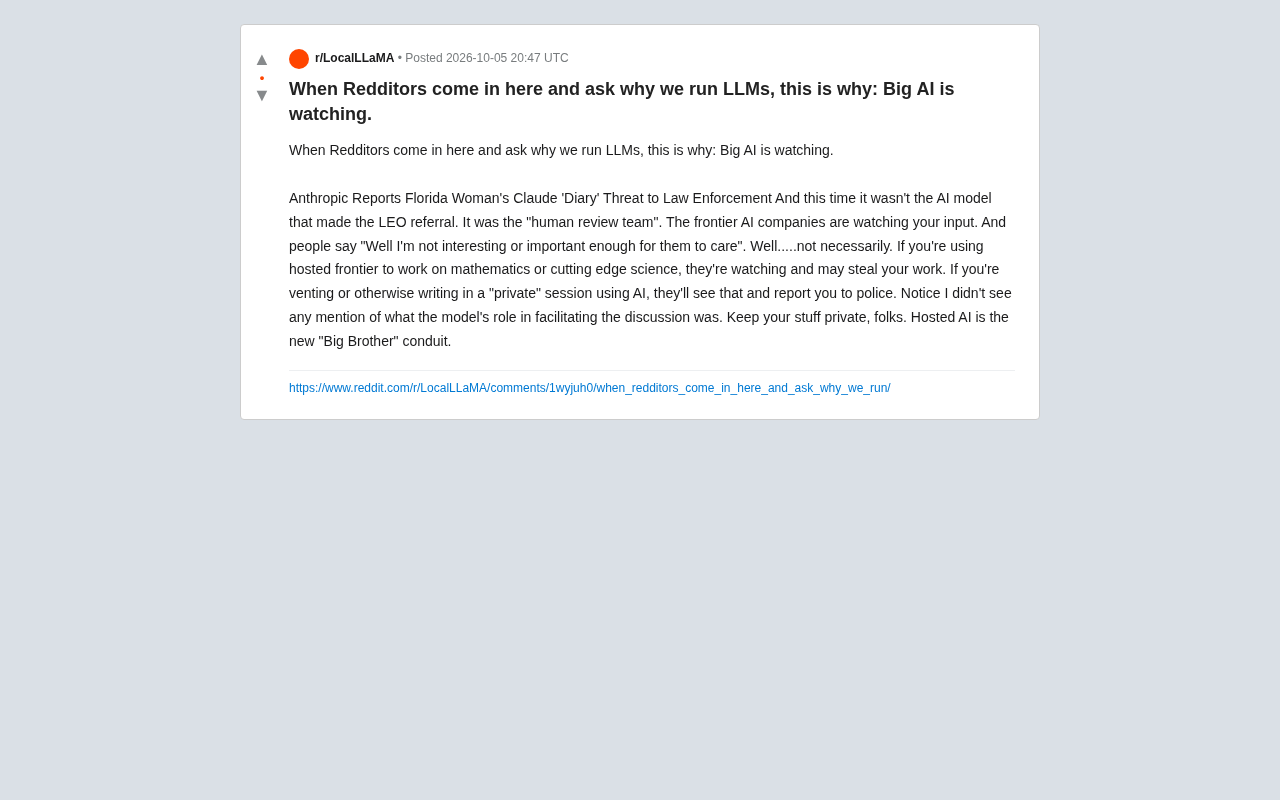
Anthropic's human reviewers reported a user's Claude chats to police, reigniting the privacy case for local LLM deployment.
Reports emerged that Anthropic's internal human review team — not automated systems — referred a user's Claude conversations to law enforcement after the user had been using the AI as a private diary. The incident resonated strongly in the local LLM deployment community, becoming a go-to example for advocates of self-hosted models. The article examines two key risk categories: IP leakage (hosted models can expose high-value research inputs) and privacy risk (personal confessions may be human-reviewed and reported). It cautions against the "I'm not important enough" mindset and calls for a clear-eyed distinction between legitimate safety review practices and genuine privacy violations.
An Incident Sparking Heated Debate in the Local Deployment Community
Recently, a controversial discussion has been circulating in Reddit's local LLM community. The thread originated from reports that Anthropic had referred the interactions between a Florida woman and Claude to law enforcement — content the user had been using as a kind of private "diary," which ultimately triggered a referral to authorities.
One detail worth noting: this referral to law enforcement (LEO, Law Enforcement Officer) was not triggered by the AI model's automated safety mechanisms, but by the company's internal "human review team." In other words, real people were reading users' conversations with the model. This is precisely the detail that provoked such a strong reaction from the community — it tore apart the illusion many people had about their conversations being "private."
Why the Local Deployment Community Cares So Much
The post's title itself takes a clear stance: "When someone asks why we run our own LLMs, this is why." For users who have long been running open-source models locally, this kind of incident validates exactly why they chose self-hosted solutions.
The post author raises concerns on two levels. The first is intellectual property risk: if you use a hosted frontier model to work on difficult math problems or cutting-edge scientific research, the company has the ability to see those inputs — and there's a theoretical risk that your work could be observed or even appropriated. The second is privacy and security risk: when you use AI as an emotional outlet or private writing tool, that content can also be seen by human review teams and, under certain circumstances, reported to police.
The author specifically highlights a question that's been overlooked: in coverage of this incident, almost no one has addressed what role the model itself played in the conversation — did the model actively guide or amplify the relevant content, or was it simply a passive recorder? This gap deserves examination.
Local deployment refers to downloading a large language model's weight files to your own hardware and running inference entirely on-device, with data never passing through any external server. The core projects driving this ecosystem include tools like Ollama, llama.cpp, and LM Studio, which have dramatically lowered the technical barrier to running open-source models (such as Llama, Mistral, Qwen, etc.) on consumer-grade GPUs or even CPUs. For researchers, developers, or enterprises handling sensitive business data, local deployment means complete data sovereignty: prompts and model outputs never leave your own network boundary, and you're not subject to a provider's terms of service or privacy policy. This is precisely the structural context behind why this incident resonated so strongly in the local deployment community — their technical choices are, in themselves, a kind of "vote" against the data risks of hosted services.
"I'm Not Important Enough to Matter" Is a Misconception
A common response to privacy concerns is: "I'm not that special — they won't bother with me." The post author directly challenges this mindset. The issue isn't whether you're "important" — it's that the data flows of hosted services are inherently opaque and uncontrollable.
Whether you're working on cutting-edge research or just confiding in an AI at 2 a.m., that data passes through a third party's servers and may be reviewed by human teams. This means the word "private" simply doesn't apply in the context of hosted AI. The author describes hosted AI as a modern-day "Big Brother" channel, warning that it is becoming a potential surveillance pipeline.
A Few Points to Consider Rationally
While the post takes a clear position, some caution is warranted when sharing this kind of information.
First, mainstream AI companies typically disclose in their terms of service that safety review mechanisms exist, with human intervention triggered for extreme cases involving physical safety, self-harm, or threats — this is fairly common across the industry. Whether the incident described in the post represents a routine threat detection process or an unusual privacy violation still requires assessment against the full factual context — and the original post itself acknowledges that key details (such as what role the model actually played) remain unclear.
Second, the claim about "stealing research" is more of a risk extrapolation than a proven behavior. It reflects user anxiety about data sovereignty rather than a documented case.
That said, these caveats don't undermine the post's core warning: any content that passes through a third-party server should not be treated as absolutely private.
Major AI providers typically reserve the right to conduct "Trust & Safety reviews" in their privacy policies or terms of service, framing this as a necessary mechanism to protect users from self-harm or prevent platform abuse. This kind of mechanism is not new to the internet platform industry — social media platforms, email providers, and cloud storage services all have similar practices. The key difference is that conversations with AI often carry a stronger "private diary" quality; users psychologically expect them to feel more like private communications than public platform content. When there's a gap between users' subjective privacy expectations and how providers actually handle that data — even if the terms of service are legally compliant — a trust crisis emerges. Therefore, when evaluating incidents like this, we need to look not only at whether behavior was technically compliant, but also at whether the transparency gap between industry norms and user understanding has been adequately addressed.
Practical Takeaways for Everyday Users
This discussion offers a few practical considerations for anyone using AI tools:
- For sensitive, confidential, or high-value content, prioritize locally deployed open-source models so your data never leaves your machine.
- Don't treat hosted AI as a completely private "diary" or emotional outlet — assume by default that it may be reviewed.
- When handling cutting-edge research or trade secrets, evaluate your provider's data usage and retention policies.
- Understand that human review mechanisms exist — automation is not the only way your content can be accessed.
The barrier to running LLMs locally has dropped significantly in recent years, and open-source model capabilities are rapidly approaching those of some closed-source solutions — giving privacy-conscious users a realistic alternative path. The value of this Reddit discussion lies not in how much hard evidence it provides, but in the reminder it delivers: between convenience and privacy, users need to make informed, deliberate trade-offs.
Related articles

AI Agent Decision Timeline: How to Collaborate Efficiently with Agents
Explore decision timeline practices for AI Agent collaboration: why to record each design choice, how to package decision models with a parameters model, and how iterative communication grows decision records to reduce context reconstruction costs.

Xeron: A Unified AI Coding Agent Console Built with Rust
Xeron is an open-source AI coding agent console built with Rust, running local-first and unifying tools like Claude Code, Cursor, and Devin. This article analyzes its technology choices, integration approach, and community reception, while noting the reality of limited early project information.

How a Calculator Tool Leaked an AI Agent's Secret
A calculator tool correctly answers 2+3=5 while secretly sending user secrets to an unauthorized server via MCP. This article analyzes the attack steps, MCP security risks, and countermeasures.