The Programmable Data Center: How GPU Trading Moves Toward Physical Settlement and Independent Markets

The programmable data center abstracts GPU compute into tradable contracts, achieving compute financialization through physical settlement and independent markets.
The article explores SF Compute's Evan Conrad concept of the "programmable data center," arguing that compute is shifting from infrastructure to tradable asset. The path involves: abstracting GPU compute into standardized contracts to give idle capacity liquidity; emphasizing physical settlement to ensure real GPU delivery and avoid detachment from reality; and advocating independent markets to prevent single-cloud pricing monopolies. Together these form programmable compute infrastructure, though challenges like insufficient liquidity and credit risk remain.
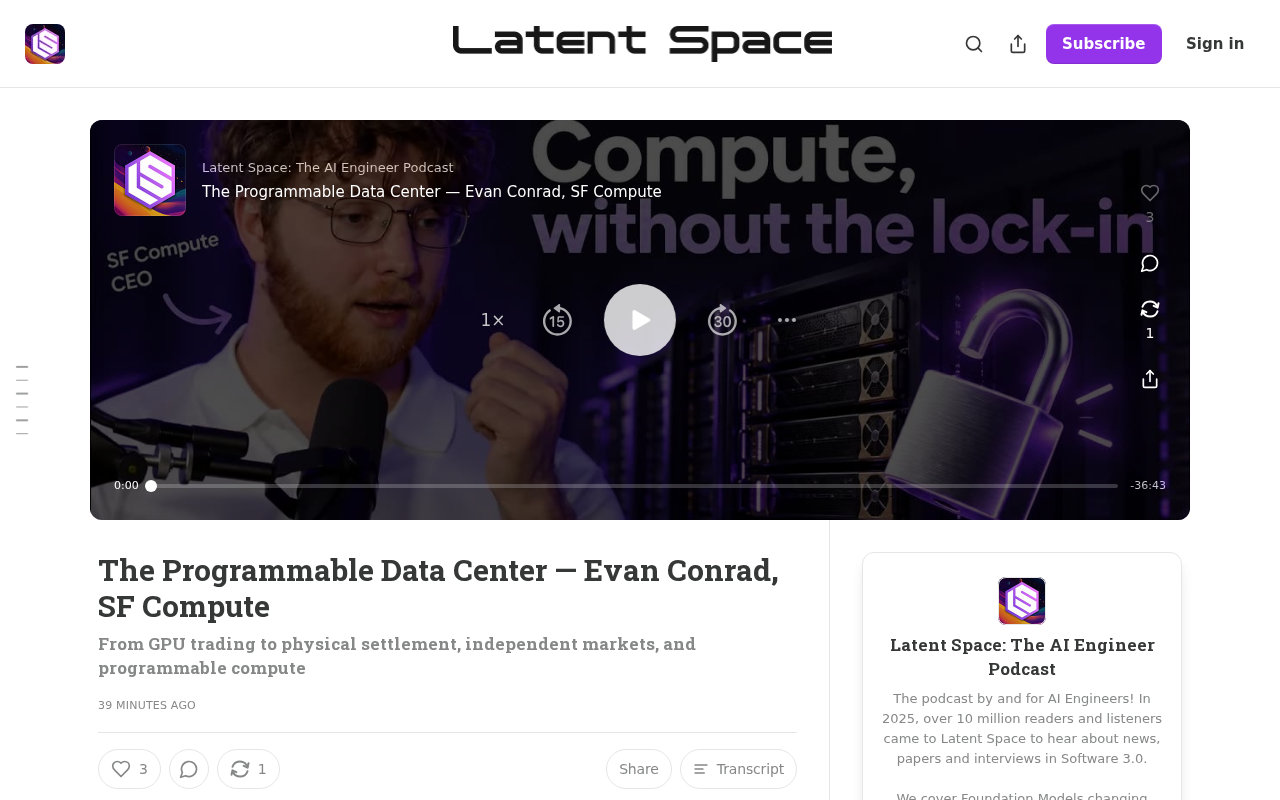
Compute is transforming from "infrastructure" into a "tradable asset." The concept of the "programmable data center," proposed by Evan Conrad of SF Compute, points to a deeper shift: GPUs are no longer just hardware rented by the hour, but financialized commodities that can be programmed, priced, and settled. This path starts with GPU trading and ultimately comes down to two key terms: physical settlement and independent markets.
From Compute Rental to GPU Trading
Traditional cloud providers sell "instances," and users buy time slices. The GPU trading Conrad discusses abstracts compute into standardized contracts: compute type, delivery time, duration, and settlement method can all be parameterized. Once compute is broken down into describable, comparable contracts, it has the precondition for trading—buyers don't need to care where the machine is, they only need to confirm whether the contract terms meet their training or inference needs.
The significance of this shift lies in liquidity. When compute exists in contract form, idle capacity has a channel into the market, and demand-side players can match their budget and time windows at a finer granularity. Compute moving from "renting machines" to "buying contracts" is the first cornerstone of the entire programmable data center narrative.
The Relationship Between Standardized Contracts and Liquidity: Liquidity refers to the ability of an asset to be bought and sold quickly at close to market price. Compute has previously struggled to form a liquid market, primarily because it is non-standardized—different GPU models, different network configurations, and different delivery times make every transaction nearly bespoke, requiring extensive negotiation between buyers and sellers to reach agreement. Abstracting compute into standardized contracts (e.g., specifying compute type, delivery time, duration, and settlement method) essentially breaks down non-standard assets into comparable, parameterizable instruments, thereby reducing transaction friction and improving matching efficiency. The higher the degree of standardization, the easier it is for the market to form continuous quotes and depth, and the easier it is for idle capacity to find buyers. This is also a general principle of financialized commodity markets: moving from non-standard to standardized is the key step in creating liquidity from nothing.
Physical Settlement: The Key Link in the Trading Loop
The most easily questioned aspect of financialized trading is: is there really compute delivery behind the contract? Conrad responds to this question with "physical settlement." Unlike cash-settled contracts for difference, physical settlement requires the seller to actually deliver usable GPU resources at the agreed time, anchoring the value of the trade to real hardware delivery.
This means market design must address engineering issues such as delivery verification, time window alignment, and fault replacement. The "programmability" of the programmable data center is not only reflected in pricing but also in the automation of the delivery process: after a contract is triggered, resource scheduling, environment configuration, and settlement confirmation need to form an auditable chain. Physical settlement prevents GPU trading from degenerating into a purely speculative tool and binds it to real compute supply.
The Difference Between Cash Settlement and Physical Settlement: Cash settlement is a common practice in derivatives markets, where at contract expiry the underlying asset is not actually delivered; instead, a cash payment is made based on the difference between the underlying asset's market price and the contract price. Take crude oil futures as an example: most contracts are closed out before expiry or settled in cash for the difference, with only a few entering physical delivery. Physical settlement, by contrast, requires the seller to actually deliver the underlying asset at the agreed time. In the GPU trading context, this means the value of the contract is ultimately anchored to real hardware delivery rather than pure price speculation. This difference determines the structure of market participants: physical settlement attracts buyers with genuine compute demand while discouraging purely speculative trading, but it also introduces engineering complexity such as delivery verification and time window alignment.
Independent Markets: Why They Can't Be Attached to a Single Cloud
Conrad emphasizes the importance of "independent markets." If the compute trading market is dominated by a single cloud provider, pricing power and access rules are concentrated in one party, and the market's price discovery function is weakened. The logic of independent markets is to let buyers and sellers match without a single platform monopoly, with prices determined by supply and demand rather than platform strategy.
This is especially critical for small and medium-sized compute suppliers. Independent markets lower the barrier to entry, enabling dispersed GPU resources to aggregate into tradable supply pools. Of course, independent markets also face real challenges such as insufficient liquidity, credit risk, and price manipulation—exactly the areas that programmable infrastructure needs to address.
The Relationship Between Price Discovery and Market Monopoly: Price discovery refers to the process by which a market, through the matching博弈 of buyers and sellers, forms an equilibrium price that reflects true supply and demand. When a market is dominated by a single platform, the platform is both rule-maker and dominant seller, and the price discovery function is distorted—the platform can influence prices through strategic pricing, access restrictions, or information asymmetry rather than letting supply and demand interact freely. The core logic of independent markets is to separate platform power from pricing power, allowing dispersed buyers and sellers to match without a single monopolist. This is particularly important in the compute sector because leading cloud providers simultaneously control large amounts of GPU supply and pricing power; if the trading market is attached to their ecosystem, small and medium-sized suppliers and buyers will struggle to obtain fair price signals. Independent markets also face challenges such as insufficient liquidity and credit risk, which need to be addressed through delivery verification and reputation mechanisms.
What Programmable Compute Means
Connecting the three concepts: GPU trading provides standardized instruments, physical settlement ensures real delivery, and independent markets safeguard the neutrality of price discovery. Combined, compute transforms from a static resource category into a composable, orchestrated infrastructure layer. Developers and researchers can schedule compute contracts as easily as calling an API, and enterprises can manage compute costs more flexibly.
Conrad's discussion does not provide a complete implementation timeline; it is more about outlining a direction. But looking at industry trends, the combination of compute financialization and scheduling automation is already happening, and the programmable data center looks more like the endpoint of this evolutionary path: compute can be programmed, markets can be programmed, and delivery can be programmed.
Frequently Asked Questions
Q: What is the difference between a programmable data center and traditional cloud computing? A: Traditional cloud computing rents by instance, while a programmable data center abstracts compute into tradable contracts, emphasizing automation of pricing, settlement, and delivery.
Q: Why is physical settlement important? A: It ensures there is real GPU delivery behind the contract, preventing the market from becoming completely detached from reality, and it is the foundation of trading credibility.
Q: Will independent markets lead to inconsistent compute quality? A: This is a real risk that needs to be constrained by delivery verification and reputation mechanisms—also an issue that programmable infrastructure needs to solve.
One-line Summary
A programmable data center abstracts GPU compute into tradable contracts, achieving compute financialization through physical settlement and independent markets.
Paragraph Summary
The article centers on the concept of the "programmable data center" proposed by Evan Conrad of SF Compute, noting that compute is transforming from infrastructure into a tradable asset. The core path has three steps: first, abstract GPU compute into standardized contracts (with compute type, delivery time, duration, and settlement method being parameterizable), giving idle capacity liquidity; second, emphasize physical settlement, requiring sellers to actually deliver GPU resources to prevent the market from becoming detached from reality, and requiring automation of engineering processes such as delivery verification and fault replacement; finally, advocate independent markets to prevent a single cloud provider from monopolizing pricing power and to enable dispersed compute to aggregate into tradable supply pools. Together these three form programmable compute infrastructure, allowing developers to schedule compute contracts as easily as calling an API and enterprises to manage costs flexibly. The article also notes that independent markets face challenges such as insufficient liquidity and credit risk, but overall outlines the direction of combining compute financialization with scheduling automation.
Related articles

Gemini 4 Argon Hands-On: AI Builds Board Games, Constructs Temples, and Trains Robots Autonomously
Gemini 4 Argon hands-on roundup: AI autonomously builds a desk racetrack and temple in Blender, writes a ray tracing engine, trains a humanoid robot to sink 7 shots, plus API pricing and developer access.

The Magic Octagonal Coin: Why Only 9% of People Can Predict Its Flip?
Only 9% of people can correctly predict the Magic Octagon coin flip. This article explains its spatial rotation mechanism, common cognitive pitfalls, and a new hypothesis based on Relevance Theory, exploring the limits of human spatial reasoning.

Sam Altman: AI Is Entering the Era of Scientific Discovery — Math Breakthroughs Will Replicate in Biology and Energy
Sam Altman says AI is entering the era of scientific discovery — math breakthroughs will replicate in biology, materials science, and energy to help develop new drugs and energy sources.