The Real Daily Life of MLE and MLOps Engineers: Key Differences Between Three Roles and Career Paths

A deep dive into what MLE and MLOps engineers actually do daily, and how to break into these roles.
This article breaks down the real-world differences between data scientists, machine learning engineers (MLEs), and MLOps engineers. It reveals what daily work actually looks like beyond job descriptions, covers essential tool chains for each role, and provides actionable career path guidance including building engineering foundations, mastering frameworks, and creating end-to-end portfolio projects.
Introduction: Why More People Are Paying Attention to MLE and MLOps
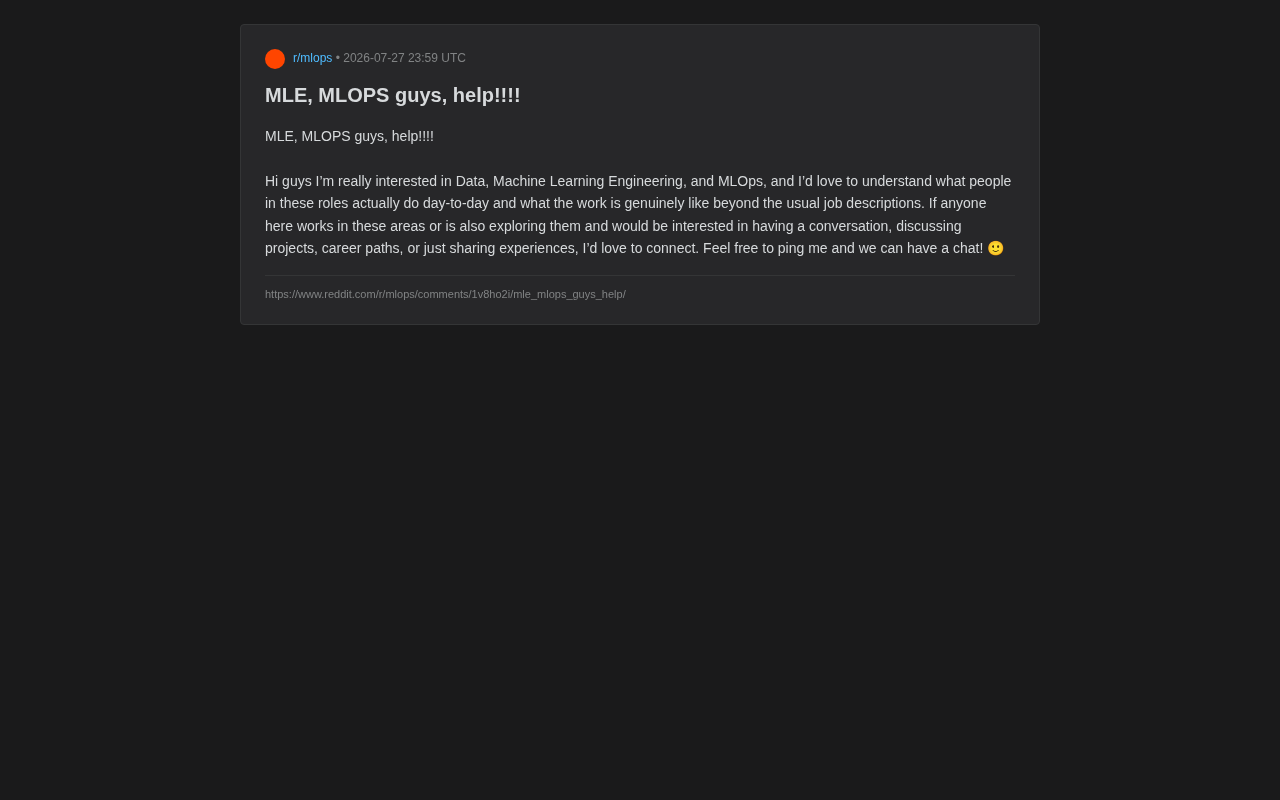
Recently, a developer with a keen interest in data science, machine learning engineering (MLE), and MLOps posted on Reddit seeking to understand the real daily work of professionals in these roles — the actual experience "beyond the job description." This question represents a common confusion in the tech industry today: as AI continues to heat up, MLE and MLOps have become highly sought-after positions, yet outsiders know surprisingly little about what these roles actually entail.
The rise of MLE and MLOps positions is closely tied to the broader trend of machine learning moving from the lab into production environments. According to a 2022 Gartner report, only about 54% of AI projects make it from proof-of-concept to production deployment. This "last mile" difficulty in going live has created enormous demand for engineering talent. Traditional data science education emphasizes algorithms and statistics, but industry has discovered that the real bottleneck lies in running models stably and efficiently in production — which is precisely the core value that MLE and MLOps roles provide.
Job descriptions often sound glamorous — "build scalable machine learning systems" or "deploy production-grade models" — but what do MLE and MLOps practitioners actually do every day? This article draws on widely recognized industry knowledge to provide an in-depth look at the true nature of these roles.
The Fundamental Differences Between Data Scientists, MLEs, and MLOps Engineers
Many beginners conflate data scientists, machine learning engineers (MLEs), and MLOps engineers, but their actual work focuses differ significantly.
Data Scientists: Exploration and Modeling
The core work of a data scientist is extracting value from data. Their daily tasks include data cleaning, exploratory analysis, feature engineering, and model experimentation. This role leans more toward research and analysis, requiring a solid foundation in statistics and business understanding. Their output is typically a "working" model prototype or an analytical report that supports business decisions.
Machine Learning Engineers (MLE): Engineering for Production
MLEs sit at the intersection of data science and software engineering. Their core task is transforming a data scientist's prototype model into a reliable, efficient, and maintainable production system. This means extensive coding, performance optimization, API design, and integration with backend systems. Compared to data scientists, MLEs place greater emphasis on software engineering skills, including code standards, unit testing, and version control.
MLOps Engineers: Full-Lifecycle Operations
MLOps is a role that has only emerged in recent years and can be understood as "DevOps for machine learning." The concept of MLOps derives directly from DevOps (Development + Operations), a cultural and methodological practice that rose to prominence in software engineering during the 2010s, with the core goal of breaking down barriers between development and operations through automation and collaboration to achieve fast, reliable software delivery. MLOps migrates this philosophy to the machine learning domain but faces additional complexity: ML systems don't just have code changes — they have data changes and model changes as three dimensions that need to be managed. Google's famous 2015 paper Hidden Technical Debt in Machine Learning Systems was the first to systematically reveal the engineering complexity of ML systems and is considered the foundational work of MLOps thinking.
MLOps engineers are responsible for building and maintaining the infrastructure across the entire model lifecycle: from model training pipelines and automated deployment to monitoring and alerting, and continuous integration/continuous delivery (CI/CD) for models. This role requires familiarity with containerization technologies (Docker/Kubernetes), cloud platforms, and orchestration tools — an entire infrastructure technology stack.
The Real Daily Life of MLE and MLOps: Far Less "AI" Than You'd Imagine
Here's a harsh but honest truth: in these roles, the time actually spent "training models" may represent only a small fraction of the work.
There's a widely circulated saying in the industry — data scientists spend 80% of their time on data preparation and only 20% on modeling. For MLE and MLOps engineers, the situation is similar: a huge amount of energy goes into managing data pipelines, fixing production issues, optimizing system performance, writing tests and documentation, and dealing with various "unexpected" engineering challenges.
For example, a typical workday for an MLOps engineer might include:
- Investigating a latency spike in a model serving endpoint
- Updating data drift monitoring configurations
- Helping the data team set up a new feature store
- Writing automation scripts to reduce repetitive manual work
Data Drift refers to the phenomenon where the statistical distribution of input data in a production environment shifts relative to the training data. It's one of the most common causes of model performance degradation after deployment. For example, a recommendation model trained on 2023 user behavior data might see accuracy decline by 2024 due to changes in user preferences. Common detection methods include statistical metrics such as KL Divergence (Kullback-Leibler Divergence), the KS Test (Kolmogorov-Smirnov Test), and PSI (Population Stability Index). MLOps engineers need to configure automated drift detection pipelines that trigger alerts or automatically initiate model retraining when data distribution shifts exceed a threshold.
Feature Store is one of the most important infrastructure innovations in the MLOps space in recent years. It's essentially a centralized feature management platform that solves a core problem: in large organizations, different teams may redundantly compute the same features, and the feature computation logic during training may differ from that during inference (known as Training-Serving Skew). Representative open-source projects include Feast, while commercial products include Tecton and Databricks Feature Store. Feature stores provide unified feature registration, version management, dual online/offline serving capabilities, and feature lineage tracking, greatly improving standardization and reuse efficiency in ML engineering.
This work might not sound "sexy," but it's precisely what makes machine learning actually deliver business value.
Career Paths: How to Enter the MLE and MLOps Fields
For those exploring AI career directions, planning a clear learning path is crucial.
Build a Strong Software Engineering Foundation
Regardless of which direction you choose, solid programming skills (especially Python) and software engineering literacy are essential. Many people transitioning from data analysis to MLE find that their biggest weakness isn't algorithms — it's engineering ability: how to write code that's maintainable, testable, and scalable.
Master the Core Tool Chain
- Data Science track: Proficiency with Pandas, NumPy, and Scikit-learn; understanding common model principles and tuning methods.
- MLE track: Mastery of PyTorch or TensorFlow; learning model serving frameworks (such as TorchServe, Triton); understanding distributed training.
- MLOps track: Deep learning of Docker, Kubernetes, CI/CD tools, and specialized platforms like MLflow and Kubeflow.
Regarding model serving framework selection, TorchServe is PyTorch's official serving framework, suitable for deploying models within the PyTorch ecosystem. NVIDIA Triton Inference Server is a high-performance general-purpose inference server that supports multiple frameworks (TensorFlow, PyTorch, ONNX, etc.) and provides enterprise-grade features such as dynamic batching, model ensembling, and GPU resource scheduling. Selection criteria should consider the model framework, latency requirements, throughput needs, and hardware environment. In recent years, with the rise of large language models, serving frameworks specifically optimized for LLMs — such as vLLM and TGI (Text Generation Inference) — have also gained widespread attention.
For MLEs, distributed training is a core skill that must be mastered. Distributed training refers to spreading model training tasks across multiple machines or GPUs for parallel execution to reduce training time. There are two main paradigms: Data Parallelism shards data across different devices with each device holding a complete model replica; Model Parallelism splits the model itself across different devices, suitable for ultra-large models that cannot fit on a single GPU. MLEs need to handle engineering problems such as gradient synchronization communication overhead, load balancing, and fault tolerance recovery. Common frameworks include PyTorch's DistributedDataParallel (DDP), DeepSpeed, and Megatron-LM.
Build Practical Experience Through End-to-End Projects
Beyond theoretical learning, end-to-end practical projects are the most effective way to grow. Try independently completing a full project from data collection and model training to deployment — you'll truly experience the real challenges these roles face, and this is also the most convincing proof of capability in job interviews. A high-quality end-to-end project should include: data version management (e.g., DVC), experiment tracking (e.g., MLflow or Weights & Biases), model packaging and containerization, automated testing, deployment pipelines, and a basic monitoring system. Such a project demonstrates not only technical depth but also an understanding of the full picture of production-grade ML systems.
Conclusion: Connect with the Community and Accelerate Career Growth
The Reddit user's proactive approach of seeking direct exchange with practitioners is well worth emulating. In the AI field, technology iterates extremely fast, and community and peer exchanges often bring more valuable practical insights than textbooks.
Whether your goal is to become a data scientist, MLE, or MLOps engineer, understanding the true nature of these roles, identifying your interests and strengths, and continuously accumulating experience through projects and community engagement is the right path to steady advancement. Although these three roles have similar names, they emphasize different capabilities — planning early and focusing your efforts precisely is how you'll stand out in the fiercely competitive AI job market.
Related articles

DIY Air Purifier: Building a Silent CR Box with PC Fans and an Aluminum Frame
Learn how to build a quiet Corsi-Rosenthal air purifier using PC case fans and an aluminum frame, covering fan selection, PWM speed control, and cost analysis.

Universality of Gradient Descent Training: Does Neural Network Architecture Choice Really Matter?
Exploring the universal approximation capability of gradient descent training, analyzing the relationship between neural network architecture choice and learnability, from UAT to NTK theory.

From AI to Large Models: Understanding the Conceptual Landscape and Technological Evolution of Artificial Intelligence
Understand how AI, machine learning, deep learning, large models, and generative AI relate to each other. From Deep Blue to ChatGPT, learn how Transformer architecture gave rise to LLMs.