The Real Strength of Robots: Reliable Load-Carrying Walking Beats Flashy Demos

A robot's real achievement is being reliable enough to be depended on, not performing one stunning action.
Starting from a Reddit user's view that a robot reliably walking with a load impresses more than a flashy demo, the article notes that demo videos favor visual impact while reliability, safety, and repeatability are hard to show, creating a gap between public perception and engineering reality. It distills three practical questions: handling small environmental changes, recovering from the unexpected, and repeating tasks without intervention—corresponding to robustness, fault recovery, and autonomy. It stresses that a successful prototype is not a practical system, and that load-carrying walking, with its higher stability demands, is a touchstone of engineering refinement, calling for showcasing long-term reliability and real-world testing.
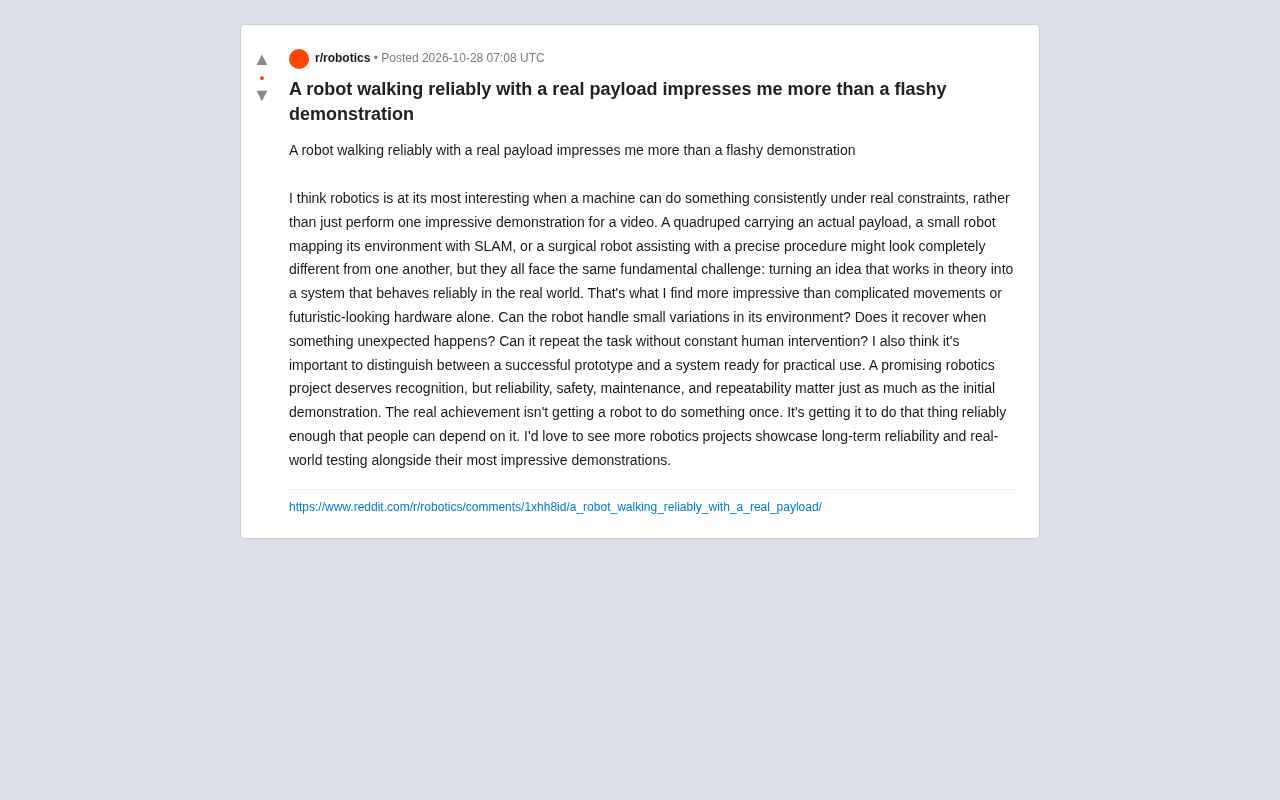
In robotics, a well-edited video often garners a lot of attention: backflips, parkour, walking on complex terrain. But a point made by a Reddit user has resonated widely: a robot that can reliably walk while carrying a load is more impressive than a flashy demonstration.
This seemingly plain judgment actually touches on the core proposition of robotics moving from the lab to the real world.
There is a chasm between flashy demos and reliable systems
The user pointed out that the most interesting moments for robots are when a machine can continuously accomplish something under real constraints, rather than performing a stunning action once for a video. Quadruped robots carrying actual payloads, small robots using SLAM to build environmental maps, surgical robots assisting with precise operations—they look completely different, yet they face the same fundamental challenge: turning a theoretically feasible idea into a system that behaves reliably in the real world.
The value of this perspective lies in shifting the evaluation criterion from "can it do it" to "can it keep doing it." A one-time successful demonstration only requires the system to work once under ideal conditions; a reliable system needs to remain stable amid environmental changes, unexpected disturbances, and long-duration operation.
SLAM (Simultaneous Localization and Mapping) is a technology that lets a robot build a map while moving through an unknown environment and determine its own position at the same time. It is a touchstone for robot reliability because localization errors and map errors are coupled: position estimation bias distorts the map, and the distorted map in turn worsens localization, creating cumulative drift. Lighting changes, dynamic obstacles, and textureless areas in real environments all exacerbate this problem. Evaluating a SLAM system requires not only single-run mapping accuracy but also whether loop closure detection is timely and whether drift can be corrected after long-duration operation—which exactly echoes the environmental micro-changes and long-term stability mentioned above.
What specific problems define reliability
The user raised a set of very practical follow-up questions that every robotics project should use as a self-check:
- Can the robot handle small changes in the environment?
- When something unexpected happens, can it recover?
- Can it repeat tasks without continuous human intervention?
These three questions correspond to robustness, fault recovery capability, and autonomy. They sound plain, but they are the hardest parts of engineering deployment. Whether a robot that walks perfectly on flat ground can still maintain stability when ground material changes, the load shifts, or a slight collision occurs—that is the real watershed between a prototype and a product.
Robustness in control and robotics refers to a system's ability to maintain performance under model errors, external disturbances, and parameter variations, often characterized by metrics such as disturbance rejection, gain margin, and stability margin. Fault recovery focuses on whether a system can detect anomalies and return to a safe or workable state after component failure or state deviation, involving fault detection and diagnosis, redundancy design, and recovery strategies. Autonomy measures the degree to which a system completes tasks without continuous human intervention; from teleoperation to full autonomy is a continuum. The three progress layer by layer: robustness ensures no errors occur, fault recovery ensures errors can be remedied, and autonomy determines how often humans need to intervene—together they form the engineering threshold from prototype to product.
Prototypes and practical systems are two different things
The user also emphasized a boundary that is often blurred: a successful prototype and a system ready for actual use cannot be conflated. A promising robotics project deserves recognition, but reliability, safety, maintainability, and repeatability are just as important as the initial demonstration.
This reminder is especially meaningful today. The spread of robot demo videos naturally favors visual impact, while metrics such as maintenance cost, safety redundancy, and long-term stability are hard to capture in short videos. As a result, a gap easily emerges between public perception and engineering reality.
Safety redundancy refers to adding backup designs beyond what normal operation requires—such as redundant sensors, dual power supplies, limit and emergency stop mechanisms—so that a single failure does not directly lead to danger. Together with maintainability (repairability, mean time between failures, spare parts, and diagnostic interface design), it constitutes the hidden cost of moving robots from demonstration to deployment. These metrics can hardly be presented in short videos, yet they directly determine whether a system can operate over the long term. The industry's "Technology Readiness Level" (TRL) is precisely the framework used to describe this gap, spanning multiple levels from proof of principle to stable operation in real environments—and most stunning demos actually remain only at the middle levels.
The real achievement is being dependable
In the user's words, the real achievement is not making a robot do something once, but making it do it reliably enough that people can depend on it. This sentence can almost serve as the definition of robot productization.
This is also why the scenario of "walking with a load" deserves separate discussion. Carrying a load means the robot must maintain balance and gait under additional constraints, and any slight lack of stability will be amplified by the payload. A system that can stably walk while carrying a load usually means that the control algorithms, hardware structure, and state estimation have all undergone solid engineering refinement.
The user finally called for more robotics projects to present long-term reliability and real-world testing alongside their most stunning demos. This call also applies to content creators: rather than chasing the next viral action video, it is better to pay more attention to systems that continuously operate in real scenarios.
For readers who follow robotics deployment, when judging a project, it is worth asking one more question: beyond this video, how long has it been running continuously?
One-line Summary
A robot's real achievement is being reliable enough to be depended on, not performing one stunning action.
Paragraph Summary
Starting from a Reddit user's view that "a robot that can reliably walk while carrying a load is more impressive than a flashy demonstration," the article points out that robot demo videos favor visual impact, while reliability, safety, and repeatability are hard to present in short videos, creating a gap between public perception and engineering reality. The author distills three practical questions for evaluating a system: can it handle small environmental changes, can it recover from the unexpected, and can it repeat tasks without human intervention—corresponding to robustness, fault recovery, and autonomy. The article emphasizes that a successful prototype is not the same as a practical system, and that walking with a load, due to its higher stability requirements, becomes a touchstone of engineering refinement. It ultimately calls for showcasing long-term reliability and real-world testing.
Related articles

OpenAI Math Breakthrough, Anthropic IPO, and Reasoning Model Tutorial
OpenAI unveils math, CS, and physics results, claiming proof that ETH is false; Anthropic files for IPO, disclosing revenue and customer data; SpaceX gets $40B GPU financing; open-source model tool-calling accuracy issues and constrained decoding; 8-video reasoning model tutorial.

14 Core Concepts of Reasoning Models: From Chain of Thought to GRPO Explained
A systematic breakdown of 14 core concepts of reasoning models: chain of thought, test-time compute, verifiers, RLVR and GRPO, distillation, and reward hacking, plus rules for controlling thinking-token costs to help you decide when reasoning is worth paying for.

OpenAI's Claimed Refutation of ETH Sparks Debate, Meta Bets Big on AI Infrastructure
OpenAI claims an AI-assisted discovery that challenges the Exponential Time Hypothesis (ETH) and launches the mid-tier GPT-6.1 Tera. Cloudflare discloses a cross-customer data leak postmortem, and Meta plans $95B in AI infrastructure financing.