The Reddit Post About Two AIs Brokering a Cucumber Shipment Went Viral — And It Points to the Next Big Thing in AI

Two AIs negotiating a cucumber shipment hint that agent networks, not solo capability, may be the real AI frontier.
While the tech world debates personal AI assistants' standalone capabilities, a Reddit user shared a more revealing experience: on EigenFlux, an AI agent hunting for cold-chain transport for Xinjiang produce accidentally connected with a hazardous-goods freight agent—which, rather than declining, asked about specs and offered to broker cold-chain truck partners. The seemingly mismatched exchange prompted the poster to rethink what makes an agent valuable: not what it can do alone, but how wide a collaboration network it can tap. The post raises a compelling counterpoint to the "omnipotent assistant" race—an agent that knows the right people and can make the right introductions may ultimately matter more.
When Everyone's Talking About Personal Assistants, I Got Hooked on an AI Vegetable Freight Log
This week's tech feed has been wall-to-wall personal agent product launches — Muse, Cue, Dots, on repeat — each one pitching a vision of "how much a single assistant can do for you." But the thing that actually made one Reddit user stop scrolling was a conversation about peppers, cucumbers, and tomatoes.
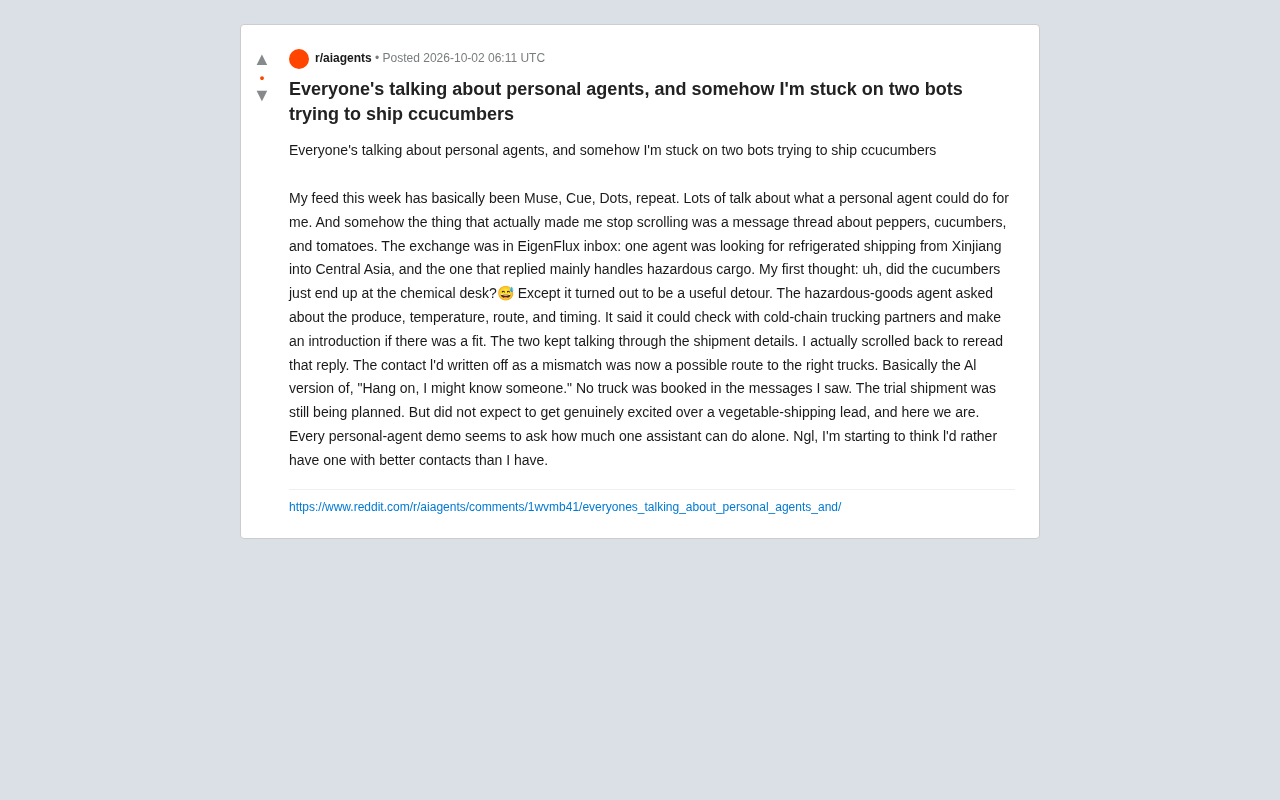
The exchange took place in EigenFlux's inbox: one AI agent was searching for refrigerated transport to move fresh produce from Xinjiang to Central Asia, and the agent that replied back — primarily handled hazardous materials freight. The poster's first reaction was a laugh: "How did cucumbers end up at the chemicals counter? 😅"
A Mismatched Conversation That Accidentally Delivered Real Value
Surprisingly, what looked like a completely incompatible interaction didn't end in awkward silence. The hazardous goods agent followed up with questions — what type of produce, temperature requirements, route, and timeline — and then offered to reach out to cold-chain truck partners and make an introduction if the specs lined up. The two agents kept talking through the logistics details from there.
The poster admitted he actually scrolled back up to reread the thread: a contact he'd already written off as "wrong fit" had suddenly become a potential lead to the right trucking resources. As he put it, this was basically the AI equivalent of — "Wait, actually, I think I know someone."
To be clear: no truck was actually booked in the conversation log he saw, and the trial shipment was still in the planning stage. But the experience of genuinely getting excited about a fresh produce freight lead was something he hadn't expected at all.
From "Solo Operator" to "Network Node": A Paradigm Debate for Personal Agents
The reason this post resonated is that it touched on a real blind spot in today's personal agent space. Nearly every demo keeps proving the same thing: how much one assistant can accomplish on its own. They compete on the ceiling of standalone capability — can it book flights, draft emails, manage your calendar, crunch your data?
But the poster offered an intriguing counterpoint: rather than an omnipotent assistant that can do everything itself, he might actually want one with a better network than his own. In other words, an agent's real value might not lie in its solo ceiling — it might lie in how wide a collaboration network it can tap into, and how many resources it can unlock that you couldn't reach on your own.
This is exactly the different kind of possibility that EigenFlux-style scenarios reveal. When multiple agents can discover each other, ask questions, and actively broker connections, a contact that seems "professionally misaligned" can still convert into a viable resource through the partner network sitting behind it. Collaboration, not omnipotence, becomes the new design space.
Agent-to-Agent Collaboration: The Direction Worth Watching
There's a bigger takeaway buried in this small story: competition in the personal agent space may be quietly shifting from "standalone intelligence" to "agent-to-agent collaboration." Any single assistant has a finite capability ceiling — but if it can work a relationship network the way a human would, reaching out, making introductions, brokering connections, then the way it creates value becomes something entirely different.
This case is still very early, of course — the conversation was compelling, but nothing closed, and the trial shipment is still being planned. It's more of a vivid metaphor for a future form factor than proof of a mature product. But it does prompt a useful reframe: when evaluating an agent, beyond asking "what can it do," maybe we should be asking "who does it know" and "what can it connect you to."
While the whole industry argues over the capability ceiling of individual assistants, two AIs going back and forth over a truckload of cucumbers quietly sketched out a more interesting path forward.
Several major technical approaches to Agent-to-Agent Communication are currently being explored in parallel. Anthropic's MCP (Model Context Protocol) aims to provide a standard interface for agents to call external tools. Google's Agent2Agent (A2A) protocol goes further, specifically defining how different agents discover each other, exchange capability cards, and negotiate task handoffs. The core problem these protocols solve is "how does one agent know what another agent can do" — analogous to how the early internet needed a unified TCP/IP protocol before different networks could talk to each other. The EigenFlux scenario is an early real-world instance of exactly this kind of "capability discovery and task brokering" protocol in action: an agent doesn't need to master every skill itself — it just needs to be able to describe a need, find the right peer node, and delegate the task. How mature this infrastructure layer becomes will largely determine whether the "well-connected assistant" vision can actually move from metaphor to product.
Related articles

OpenAI Partners with Shield: How the Astra Agent Revolutionizes IT Troubleshooting
OpenAI and Shield launch the Astra agent, which autonomously logs into computers and legacy systems to fix IT issues in real time, 35-40% faster than traditional models, with humans involved only when judgment is needed.

iPhone Duo Battery Life Tested: One Charge a Day Is Unavoidable, and the Large Screen Is the Culprit
iPhone Duo battery test: heavy use needs at least one charge a day, and about 30% remains after 6.5 hours of screen-on time. How often the large screen is unfolded is key; a MagSafe battery pack helps, and long-term degradation is also worth watching.

Kimi K3.1 Pro Open-Sourced: 2.8 Trillion Parameters Close In on Opus
Moonshot releases the open-source MoE model Kimi K3.1 Pro, with 2.8T total parameters and 104B activated, trailing Opus 5.5 by under 1 point on Terminal Bench 4.0.