The Rise of Overfit Inference Engines: How Specialization Is Reshaping Local AI Deployment

Specialized 'overfit' inference runtimes trade generality for peak performance, pushing local AI toward layered coexistence.
A new wave of inference runtimes — including Strata, ninfer, and DwarfStar — deliberately abandons multi-model and multi-hardware compatibility to deeply optimize for specific platforms and extract maximum performance. Unlike general-purpose runtimes such as llama.cpp and vLLM, these 'overfit inference engines' embrace a disposable engineering philosophy: no need for elegance or long-term maintenance, just peak throughput on a given configuration. This trend represents a new dimension of AI democratization, giving non-mainstream consumer hardware access to purpose-built optimization. The likely outcome is layered coexistence rather than displacement, though fragmentation, sustainability, and lock-in remain real concerns.
A New Class of Inference Runtime Is Emerging
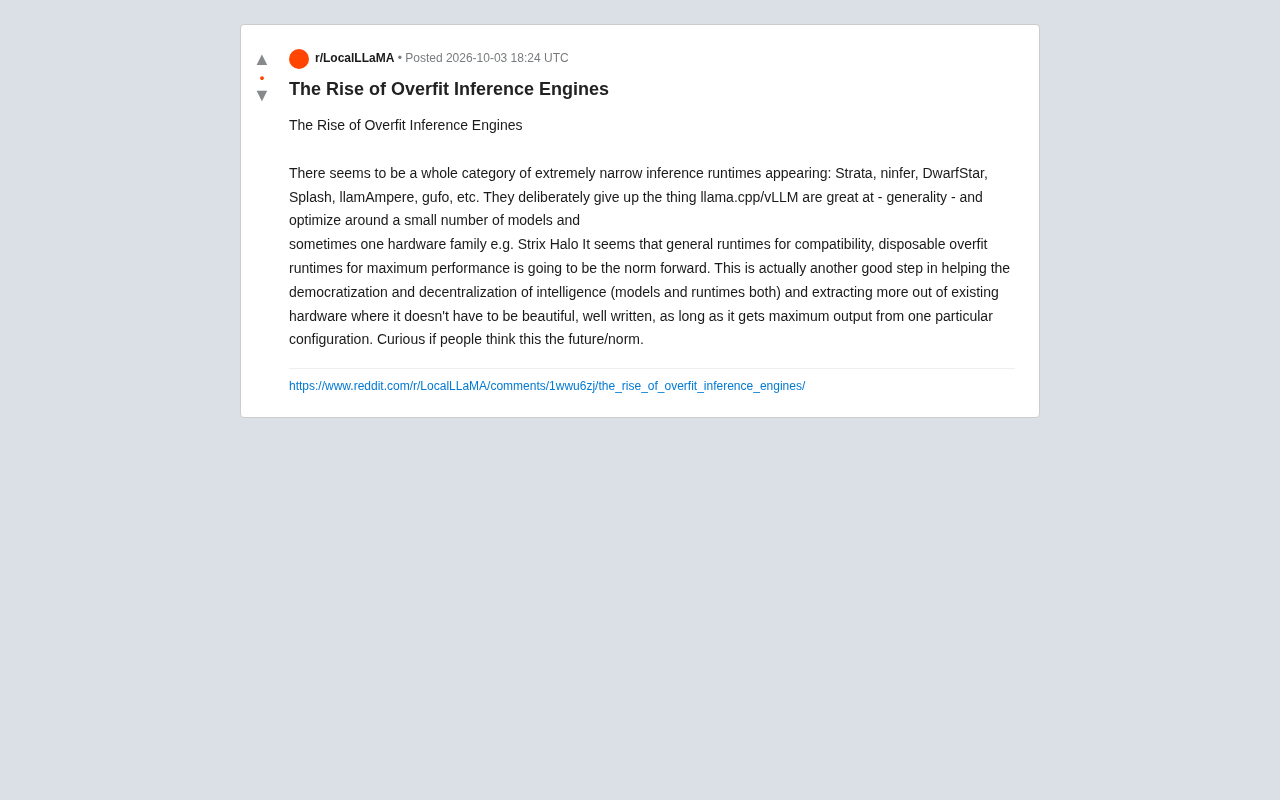
While most people are still debating whether llama.cpp or vLLM reigns supreme, a wave of unfamiliar inference runtimes has been quietly taking shape: Strata, ninfer, DwarfStar, Splash, llamAmpere, gufo… These projects share a defining trait — they don't chase generality. Instead, they deliberately abandon compatibility, betting everything on squeezing peak performance out of a handful of models or even a single hardware family.
One Reddit user coined the term "Overfit Inference Engines" to describe this category — a metaphor borrowed from machine learning that's surprisingly apt. Like a model overtrained on a narrow dataset, these runtimes sacrifice generalization in exchange for extreme performance on a specific configuration. Strata, for instance, is built around deep optimization for AMD's Strix Halo platform.
General vs. Specialized: A Fork in the Road for Inference Runtimes
For the past few years, the narrative around local inference has been dominated by llama.cpp and vLLM. Their core strength lies in generality — broad model architecture support, multiple hardware backends, and active community ecosystems. That universality made them de facto standards. But universality also means compromise: to remain compatible across a wide range of scenarios, runtimes inevitably can't fully exploit any single piece of hardware.
Overfit inference engines take the opposite approach. Their logic is straightforward: if you're only running one or two models on one type of hardware, why pay a performance tax for compatibility you'll never use?
The Value Proposition of "Disposable" Runtimes
The original post put forward a compelling thesis — the future may be a dual-track model where general-purpose runtimes handle compatibility and disposable overfit runtimes chase peak performance. The word "disposable" is key here: these runtimes don't need to be elegant, architecturally sound, or maintained long-term. As long as they can extract maximum throughput from a specific configuration, they've served their purpose.
This "good enough, then discard" engineering philosophy is often treated as an anti-pattern in traditional software development. But in inference scenarios where hardware utilization is paramount, it may actually be the rational choice. When hardware is expensive and compute is precious, even ugly, hard-to-maintain code that squeezes out an extra 20% performance has real-world value.
Understanding this divergence requires clarity on what an inference runtime actually does. It's the execution layer sitting between model weight files and final output — responsible for efficiently mapping a model's computation graph onto physical hardware, including memory allocation strategies, operator fusion, quantized computation, and batched scheduling. llama.cpp's core competency is cross-platform CPU/GPU hybrid inference, capable of running on virtually any device from a Raspberry Pi to a server. vLLM is renowned for its PagedAttention mechanism, optimized for GPU throughput in high-concurrency serving scenarios. Both runtimes' generality is built on layers of abstraction — and those abstraction layers are themselves a source of performance overhead.
From an engineering standpoint, "overfit" optimizations typically include: handwritten kernels targeting specific hardware ISAs (such as ROCm kernels tailored to AMD's RDNA/CDNA architectures), hardcoding common sequence lengths instead of dynamic shape inference, layer fusion for attention computation in a single model architecture, and custom KV Cache layouts based on a device's specific SRAM/HBM bandwidth ratio. General-purpose frameworks can't apply these optimizations aggressively because they must account for other scenarios — but specialized runtimes can enable all of them without restraint. AMD's Strix Halo became Strata's target platform partly because its distinctive unified memory architecture (up to 96GB of shared LPDDR5X memory) differs significantly from the mainstream CUDA ecosystem, leaving relatively weak support in general runtimes and creating exactly the kind of opening that specialized optimization can exploit.
Why This Is Another Step Toward the Democratization of Intelligence
The original post frames this trend as an advancement in the decentralization and democratization of intelligence — a point worth unpacking.
We've already seen democratization at the model layer: open-weight models have allowed individuals and small teams to bypass closed-source APIs. Diversification at the runtime layer represents a different dimension of openness. As more runtimes optimized for consumer or niche hardware appear, it means that the "non-mainstream" hardware in an average user's hands may finally have a purpose-built inference solution tuned specifically for it.
In other words, overfit runtimes lower the barrier to getting the most out of existing hardware. You don't need a top-tier data center GPU. A specific APU model or consumer graphics card, paired with a runtime custom-built for it, can deliver performance approaching the hardware's theoretical ceiling. For developers and hobbyist communities with limited compute resources, that's a genuinely meaningful form of empowerment.
Will This Become the Norm?
The original post ends with an open question: is this a lasting trend, or a passing curiosity?
From the perspective of technological evolution, the coexistence of specialization and generalization is hardly unprecedented in computing history. We have general-purpose CPUs alongside task-specific ASICs; we have general-purpose databases alongside specialized time-series and graph databases. A similar divergence in inference runtimes fits the same pattern.
That said, there are real concerns worth acknowledging:
- Fragmentation risk. Too many niche runtimes may scatter community energy, leave users confused by choice, and cause projects to become obsolete quickly due to lack of maintenance.
- Sustainability questions. "Disposable" sounds liberating, but models and hardware iterate fast. Extreme optimizations targeting one generation of hardware may lose relevance quickly when new silicon arrives.
- Ecosystem lock-in. Deep binding to a single hardware family also means users become locked in to some degree.
A Structural Outlook
The most likely endgame probably isn't "one replacing the other," but rather a layered coexistence: general-purpose runtimes serve as foundational infrastructure offering stable, broad support for most everyday use cases, while overfit runtimes act as performance specialists, delivering extra gains on specific hardware-model combinations. For typical users, the general-purpose option remains the default; for power users and niche hardware enthusiasts chasing the ceiling, specialized runtimes open new possibilities.
Regardless of how far these projects ultimately go, their emergence signals something healthy: the local inference ecosystem is moving from "dominated by a few giants" toward a genuine pluralism — and that is precisely what the democratization of technology looks like in practice.
The tension between specialization and generalization runs throughout the history of computer architecture. The RISC vs. CISC debate of the 1980s, the evolution of GPUs from dedicated graphics chips into general-purpose compute platforms (GPGPU) in the 2000s, the rise of AI-specific accelerators like TPUs and NPUs in recent years — all follow a similar pattern. When a computing paradigm becomes important enough and its requirements well-defined enough, specialized solutions emerge and outperform general ones on targeted metrics, while general solutions hold their ground through ecosystem breadth and flexibility. The divergence in inference runtimes follows the same logic. What makes it distinctive is the explosive growth in hardware-model combinations — consumer GPU SKUs, mobile NPUs, various APUs, and the combinatorial explosion of model architectures — which makes the coverage cost for general runtimes increasingly high, and makes the value of specialized optimization increasingly easy to quantify and demonstrate.
Related articles

A Single Prompt Triggers a Global PHP Security Storm: Is AI a Savior or a Hidden Risk?
A single AI prompt triggered a global PHP security crisis affecting Wikipedia and the Internet Archive. This article reviews the incident, analyzes the OpenAI-Amazon controversy, and explores the security paradox of lowered vulnerability discovery barriers in the AI era and developer response strategies.

When AI Is Taken Away: How Reliance on Shortcuts Undermines Your Problem-Solving Resilience
A study of 1,222 people found that after using AI to answer questions, once AI was removed, people gave up on more problems than a control group that never used AI. The article analyzes the impact of AI reliance on learning resilience and metacognition, and explores design implications for AI learning tools.

Carta and NewView Partner to Let Startup Employees Cash Out Equity Early
Carta and NewView Capital partner to simplify startup tender offers, helping employees sell equity early. Analysis of the mechanism, liquidity pain points, and impact.