The Rise of Personal AI Agents: Why Meta Muse Is Igniting the Consumer Market

Meta Muse's App Store surge marks a pivotal shift from enterprise to consumer AI agents.
This article documents a directional shift in the AI agent space in late 2024: consumer agents, once considered too complex for mainstream adoption, are breaking through thanks to "computer use" capabilities and the viral rise of Meta Muse. Through persistence, smart defaults, and progressive disclosure, Muse has become the most accessible agent yet. Meanwhile, Anthropic's unification of Claude's interfaces and the rapid growth of assistantbenchmark.com signal a fast-maturing space — though cold-start problems and infrastructure gaps remain real challenges.
From Enterprise to Consumer: A Turning Point for AI Agents
For the past year, almost all the energy around AI agents has been concentrated in enterprise settings — from OpenClawAd to ClaudeCode, agents built around coding and business workflows have dominated the industry narrative. A question that kept coming up: could this energy spill over into the consumer market? Could personal use cases like booking travel, discovering hidden subscriptions, and cleaning up inboxes actually justify the deployment costs and complexity of agents?
Skeptics had the upper hand for a while. As recently as August, WIRED published a piece asking "Why Aren't Regular People Using AI Agents?" Author Maxwell Zeph identified the core tension: a clear disconnect between the excitement of technical builders around agent capabilities and the actual needs of everyday users. At the time, almost no one pushed back on that premise — regular people really weren't using agents.
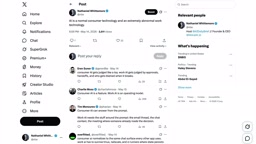
Over the past month, though, the wind has clearly shifted. Personal agents are back at the center of the conversation — and this time it's not just AI insiders talking to themselves. Meta's Muse agent climbed to #2 on the Apple App Store charts, right behind ChatGPT. People are now asking seriously: are we actually standing at the threshold of the personal agent era?
Why This Time Is Different: Capability Unlocks and a Product Explosion
The signal of a turning point came fast. Right after that WIRED piece, a16z partner Olivia Moore said that consumer agents had made remarkable progress in the past month — for the first time, she could imagine letting AI fully take over her email and calendar. Her sister Justine Moore (also at a16z) explained the key breakthrough: an upgrade in "computer use" capabilities. Agents no longer need to manually connect to each service through a dedicated API; they can now operate directly on behalf of the user.
This wave came alongside a batch of buzzy products: Town AI gained sustained attention, Instinct was championed as a darling by industry insiders (the enthusiasm was so intense it made some wonder if there was a promotion campaign behind it), and then there was Grokbot. But the product generating the most discussion and sitting most squarely at the center of the moment is Meta's Muse.
Node.js creator Ryan Dahl put it bluntly: "Muse is unreasonably good — they've nailed simplicity." Podcast host Armand Domoluski shared something more concrete: he finally got around to booking hotels, finding apartments, and canceling subscriptions all in one go, plus handled a backlog of insurance claims and an out-of-control inbox, noting "if you have ADHD, Muse is a game changer." Investor Trace Cohen had an even more dramatic story — after Muse connected to his Chase account, it found an Adobe subscription he didn't recognize. Digging deeper revealed his credit card was paying for someone's Adobe account at a roofing company in Utah — and he's in Florida. The kicker: "Chase never flagged it. Muse found it."
It's worth emphasizing that most of this praise comes from seasoned observers who can tell signal from noise — not bots funded by Zuckerberg.
"Computer use" is the core concept for understanding this turning point. Traditional AI agents interacting with external services required developers to pre-build dedicated API integrations for each service — booking flights meant integrating an airline API, managing email meant integrating the Gmail API, canceling subscriptions meant connecting to each platform one by one. Not only is this engineering-intensive, it means agents can only operate on services that have been pre-wired in.
The computer use capability (first introduced by Anthropic for Claude in 2024) bypasses that constraint entirely: agents can "see" the screen through screenshots, then operate any interface by simulating mouse clicks and keyboard input — just like a human would. In theory, it can use any software or website a human can, with no dedicated integration required. This leap explains why the usability of consumer agents underwent a qualitative shift in such a short time — coverage expanded from "services we've connected" to "everything on the internet."
Breaking Down Muse: The Patterns That Make an Agent Actually Good
Lance Hasson from Upwork's product team wrote a piece called What Makes Muse Good, identifying several key patterns worth studying by anyone building agents.
Persistence: Once Muse identifies a goal, it keeps working toward it without needing repeated prompting. Other agents often require multiple prompts and extensive clarification even with slash goal commands.
Goal Building: It extrapolates the task you've described into a larger goal, saves it to a goal list, and follows up on it over time. Lance argues that other systems also do task decomposition and planning, but Muse is the first one that feels "ambitious" — it's not satisfied with one-off tasks; it has an internal drive to take on more. He predicts this will become a universal primitive across all agents.
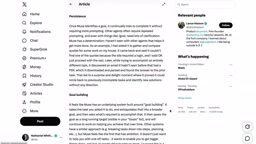
Smart Defaults and Progressive Capability Disclosure: Muse ships pre-configured with plugins and skills that other tools require users to set up themselves. Better yet, it doesn't overwhelm users with a wall of configuration options — new tools and connectors surface only at the moment they become relevant.
There's also proactive background operation, and memory and context management through a single-thread model — a unified conversation interface for navigating all tasks rather than fragmenting across multiple threads. Together, these make Muse "one of the most capable and approachable agents built so far" and the most accessible to mainstream consumers.
a16z's Alex Kwan further noted that as these high-value features become widely recognized, they'll rapidly become table stakes across the entire personal agent space. This week's cluster of consumer agent launches happened precisely because Muse was "coming for everyone's lunch" — forcing every startup to ship before it was too late.
Benchmarks and Use Cases: From Scores to Real Scenarios
To help measure this exploding space, David Poulin launched assistantbenchmark.com, which scores agents across 16 dimensions: online task execution, travel booking, recommendation quality, shopping, email response, proactive behavior, third-party integrations, privacy permissions, memory, personality, phone calls, multi-user collaboration, and more. Notably, the number of assistants being benchmarked jumped from 3 (Instinct, Grokbot, Poke) to 108 within a week of launch — with Muse leading at roughly 9 points overall.
That said, the benchmark is still early-stage: it's mostly being run manually by David and Cohere's Autumn Mulder, and most scoring dimensions remain incomplete (Muse has only finished 7/15 dimensions; Instinct 11/15). Its value lies as much in "use case inspiration" as in the scores themselves. OpenAI President Greg Brockman has noted that one major barrier to consumer agent adoption is that ordinary people don't know what to ask an AI to do when faced with a blank input box. He advocates for agents to proactively suggest tasks based on context — and collecting effective use cases from others is equally valuable for lowering the barrier to entry.
Use cases are what the community is posting around the clock: canceling subscriptions, verifying code, content creation, and Chris Back's "billionaire bot" — he hands it every tedious problem and gets back "how would I solve this if I didn't want to deal with it personally and had unlimited resources?" He discovered that even a DMV notarization can be outsourced to a mobile notary for $150.
The "blank input box problem" that Greg Brockman describes has a more systematic name in human-computer interaction research: the "cold start problem" or "blank canvas anxiety." Research shows that when users face unlimited possibilities without guidance, they're more likely to give up. This is why traditional software typically lowers the onboarding barrier through templates, tutorials, and preset scenarios.
The rapid expansion of assistantbenchmark.com (from 3 to 108 in a week) reflects a broader phenomenon in today's AI application ecosystem: product iteration speed far outpaces the construction of evaluation infrastructure. The benchmark's current state — largely manual testing, low dimension completion rates — also exposes the reality that there's no widely accepted standard framework for evaluating AI agents. This stands in stark contrast to the LLM era, which already has relatively mature benchmarks like MMLU and HumanEval. It signals that the diversity of evaluation dimensions and the open-ended nature of agent tasks make automated assessment far more complex than model evaluation.
Toward Unification: The Line Between Personal and Professional Is Disappearing
Another clear trend is that product companies are collapsing the distinction between "personal" and "professional." This was underscored when Anthropic announced that Claude Cowork and Chat would merge into a unified Claude experience. The official explanation: what users found most frustrating was deciding which product to use for which task, so "we simply stopped making you choose" — Claude can now determine on its own what capabilities a task requires.
This merger is seen as inevitable: Cowork proved that knowledge workers can "hand over a task brief and come back to a finished deliverable." The direction is a unified Claude that carries context across all work scenarios — simple enough for anyone to use. The response from users has been overwhelmingly positive, especially from non-technical users who no longer have to puzzle over the difference between chat, cowork, and code.
Who Will Win Consumer AI?
Money and sentiment are heating up fast. Instinct's funding valuation has reportedly climbed steadily, and Cisco President Jitu Patel went so far as to say "nothing has changed my life like Instinct since ChatGPT… if done right, this could be a trillion-dollar company." But OpenCode's Dax was blunt: "There's something off about Instinct everywhere you look."
More bets are being placed on Muse. Some argue that through Muse — especially through its connectors — Meta is generating massive amounts of deeply personalized, actionable AI training data: what people look at, want, choose, buy, and ignore. The compounding effect of this data flywheel is just getting started; "Muse is essentially Facebook 2.0." Y Combinator President Gary Tan reshared this take and weighed in: "Honestly I think Muse is going to win." Meanwhile, Muse continues to hold the #2 spot in the US App Store free charts, and the team keeps shipping — they just expanded their outbound calling beta to US merchants.
Even with a clear inflection point underway, some argue the transformation is far from finished. Collab Fund's Sophie Bacalar points out that agents today are adapting to systems designed for humans, while the entire underlying "rails" — payments, logins, apps, hardware — need to be rebuilt from scratch. Stripe's Jeff Weinstein is more bullish on agentic payments for enterprises.
Whatever the ultimate outcome, one fact is already clear: something is changing right now. If you haven't tried these products in a while, it might be time to actually give Muse, Grokbot, or Instinct a spin and see if they're more valuable than you expected.
The "data flywheel" is the key framework for understanding Meta's strategic positioning. The logic: users generate behavioral data by using the product → data trains better models → better models attract more users → the cycle accelerates. In the social media era, Meta already used this mechanism to accumulate the world's largest dataset of human social behavior.
If Muse succeeds, it means Meta is building a data flywheel in an entirely new dimension: capturing users' "intent and decision" data, not just "social interaction" data. The bank accounts, calendars, and emails users authorize through Muse — along with the purchasing decisions and task delegations made under the agent's guidance — will form a highly structured map of personal preferences. The value of this kind of data for training the next generation of personalized AI models may far exceed that of traditional social data. That's the real meaning behind the "Facebook 2.0" judgment in this article.
Related articles

Should U.S. College Fraternities Be Banned? A Researcher's Incisive Observations
Why not just ban U.S. college fraternities? A researcher finds the key resistance comes from decision-makers' own fraternity identities and schools' "willful ignorance."

Microsoft Discovery: Accelerating Scientific Discovery with AI Agents
Microsoft's Discovery platform runs specialized AI agents to help researchers screen and prioritize the most promising compounds and experimental paths, reducing experiments and accelerating scientific discovery.

Cambridge Heavy Industries Secretly Develops Desktop-Scale Nuclear Fusion Device
Cambridge Heavy Industries is secretly developing a desktop-scale laser-driven nuclear fusion device, targeting the equipment supply market for fusion power plants. This article analyzes its miniaturization technology path, commercialization logic, and unique positioning in the fusion startup wave.