The Rise of the Forward Deployed Engineer: How to Excel in the FDE Role
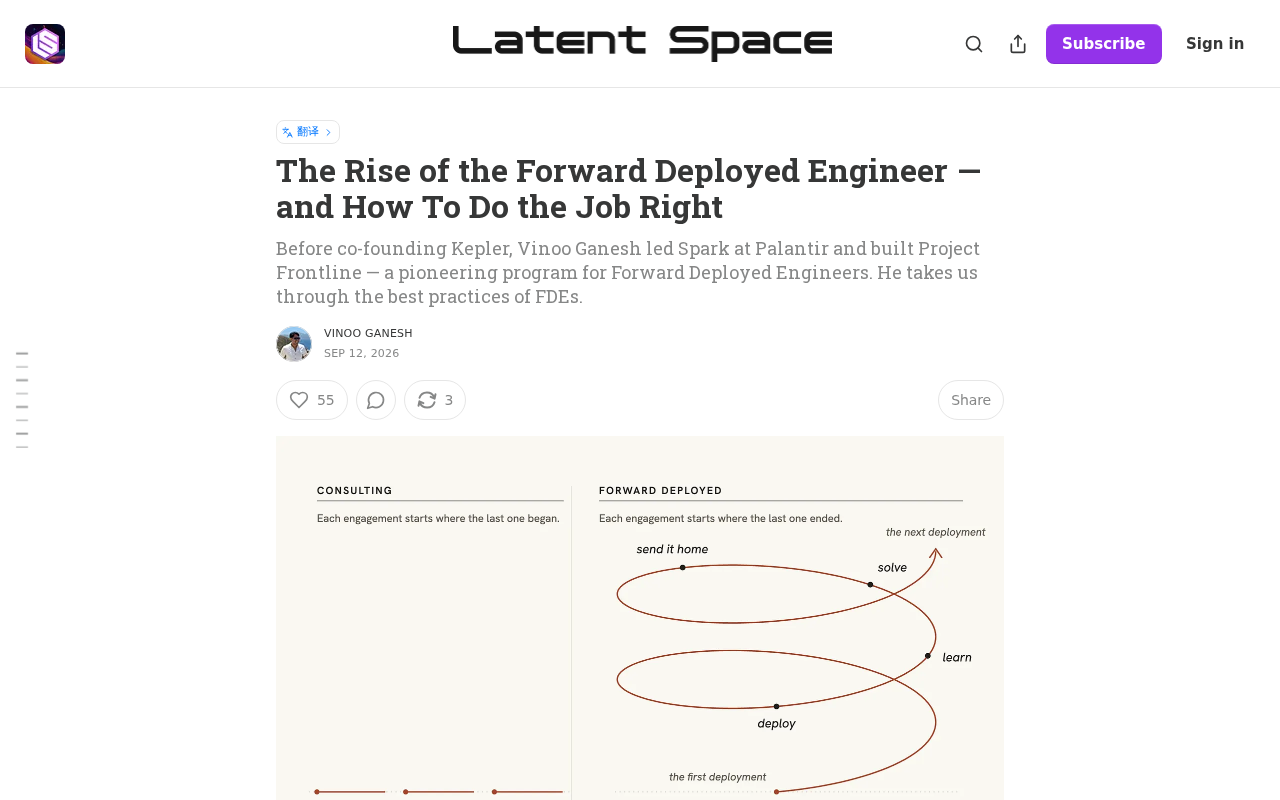
FDEs bridge the gap between product and customer by combining technical skills with deep business understanding.
Forward Deployed Engineers (FDEs) break the traditional barrier between engineers and customers — a model first systematized at Palantir through Project Frontline. FDEs bridge the gap between general-purpose products and real customer needs by combining technical execution with business understanding to deliver rapid, visible value. Three key practices define great FDEs: diagnosing true pain points beneath surface requests, validating value through prototypes and pilots, and judging when to customize versus when to productize. Kepler co-founder Vinoo Ganesh emphasizes that FDE success depends not on individual heroics, but on organizational support systems and feedback loops that allow the model to scale.
What Is a Forward Deployed Engineer (FDE)?
In traditional software engineering teams, engineers typically maintain a certain distance from customers — product managers gather requirements, engineers write code in the office, and sales and customer success teams handle delivery. The Forward Deployed Engineer (FDE) breaks this division of labor by going directly into the field with clients, engaging firsthand with real business scenarios, and translating product capabilities into solutions customers can actually use.
This role was first systematized at Palantir. As background context explains, Kepler co-founder Vinoo Ganesh previously worked at Palantir on Spark-related initiatives and led the development of Project Frontline — a pioneering program designed specifically for forward deployed engineers. That experience gave him a deep understanding of the FDE role's value and methodology.
Why FDEs Are on the Rise
As AI and enterprise software grow increasingly complex, the gap between products and customers' actual needs continues to widen. A general-purpose platform or model often can't directly address the specific pain points of a given industry client. What customers need isn't just software — it's a complete, customized solution tailored to their business processes.
The value of FDEs lies precisely in bridging this gap. They're technically proficient — able to quickly write code, integrate systems, and handle data — while also being business-savvy enough to understand customer workflows and real-world requirements. This dual capability makes them a critical link between product teams and clients.
In the AI era, this role has become even more important. The boundaries of large language models and AI platforms are inherently fuzzy, and unlocking real-world value and validating ROI depends heavily on engineers who can work at the front lines. FDEs aren't just deliverers — they're a vital feedback loop for guiding product iteration.
Key Practices for Excelling as an FDE
Deeply Understand the Customer's Business
An FDE's first priority isn't writing code — it's understanding what problem the customer is actually trying to solve. Often, what a customer asks for is just the surface layer; the real pain points are buried deeper in their business processes. Great FDEs spend significant time observing, asking questions, and mapping out workflows to ensure they're solving the right problem.
Deliver Visible Value Quickly
Unlike traditional projects with delivery cycles that can stretch for months, FDEs emphasize producing visible results fast. Through prototypes, demos, or small-scale pilots, the goal is to show customers value as early as possible — building trust while gathering feedback for rapid iteration. This "build and validate as you go" approach dramatically reduces the risk of project failure.
Balance Customization with Productization
This is the most nuanced part of the FDE role. Deep customization for a single customer can absolutely solve immediate problems, but if every client gets a completely bespoke solution, the product loses its replicability and scale potential. Great FDEs need a sharp sense of judgment: which requirements are common enough to be worth folding back into the product, and which are one-off needs that can be handled ad hoc. Projects like Project Frontline exist precisely to systematize the lessons learned on the front lines and feed them back into product evolution.
FDE Collaboration with Product Teams
FDEs don't operate in isolation. The insights they gather in the field need to be effectively communicated back to product teams. This feedback loop is at the core of whether the entire model succeeds.
Based on Vinoo Ganesh's experience at Palantir, the value of Project Frontline was in establishing a mechanism for FDEs to operate at scale — not by relying on the talents of a few star engineers, but by institutionalizing the FDE's working methods, collaboration processes, and knowledge-sharing practices. This means organizations can continuously develop and replicate this type of talent, rather than depending on occasional individual heroics.
For teams looking to adopt the FDE model, this offers an important lesson: an FDE's success depends not only on the individual engineer's abilities, but also on whether the organization provides the right support structure, feedback channels, and growth paths.
Conclusion
The rise of the forward deployed engineer reflects a deeper shift in the software industry — from "delivering products" to "delivering value." In the age of AI, engineers who can work at the client front lines and understand both technology and business are becoming increasingly rare and valuable. The methodology that Vinoo Ganesh has developed through his work at Palantir and Kepler reminds us: excelling as an FDE isn't about a single technical skill — it requires the combined ability to understand problems deeply, deliver quickly, balance customization with scalability, and build sustainable collaboration mechanisms.
Related articles
Anthropic CEO Calls for Hitting the Brakes on AI Development: A Three-Step 'Pace the Frontier' Plan
Anthropic CEO Dario Amodei calls for slowing AI development with a three-step 'pace the frontier' plan, including opening model access to third-party evaluators like METR.

Insufficient Source Material: Unable to Generate Article on Sylvan Esso
The source material provided covers music duo Sylvan Esso — unrelated to AI/tech and incomplete. No viable article could be produced; publication not recommended.
"LLMs Are Real, AI Is Fake": A Debate Worth Having
Hacker News post 'LLMs are real, AI is fake' sparks debate: why LLMs are concrete and verifiable while 'AI' is often marketing hype. What this means for practitioners.