The Skill Usage Dilemma of Medical AI Agents and an Evolutionary Solution

Medical agents suffer from Enable But Underuse (EBU), which can be mitigated through skill evolution.
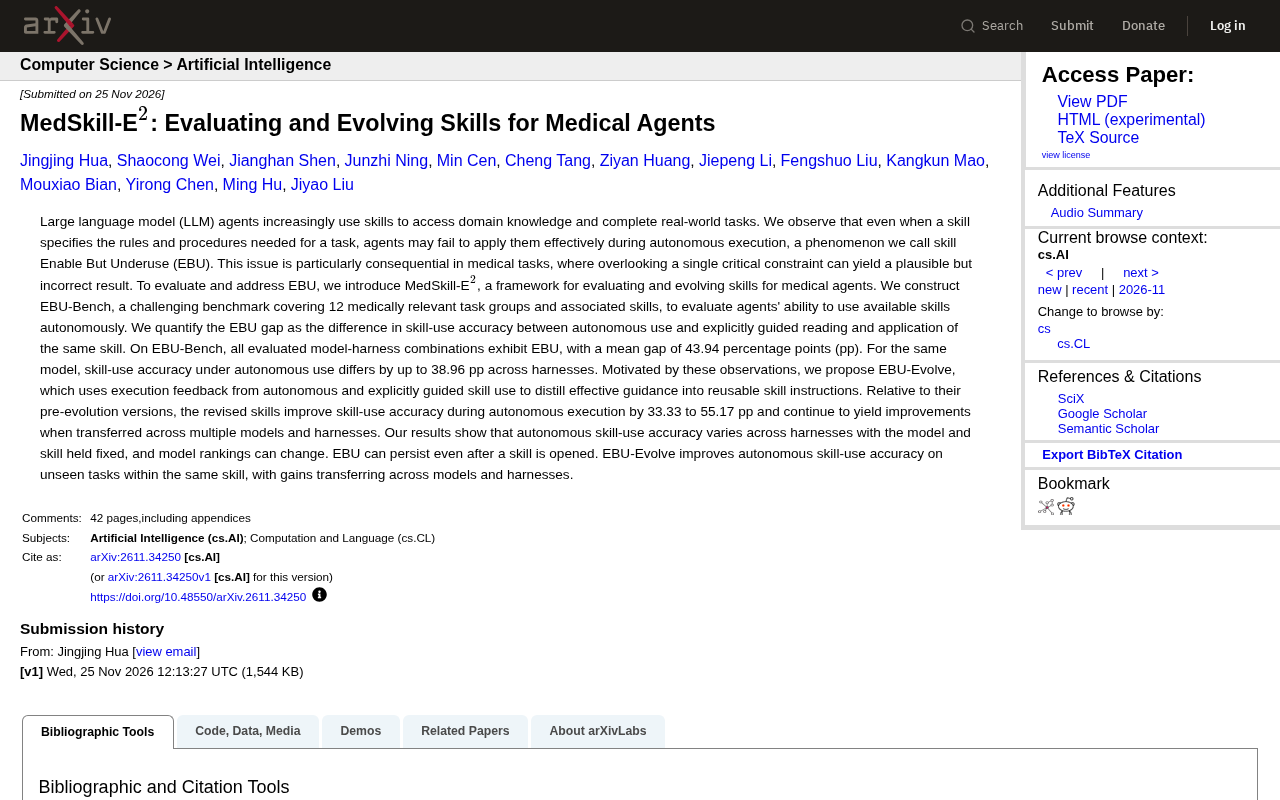
The study reveals that large language model agents exhibit the "Enable But Underuse" (EBU) phenomenon in medical tasks: even when skills specify rules, agents still fail to apply them effectively during autonomous execution, with an average skill usage accuracy gap of 43.94 percentage points. The team built the EBU-Bench benchmark covering 12 medical task groups and found that the same model can differ by up to 38.96 percentage points in accuracy across different execution frameworks, and EBU does not automatically disappear when skills are opened or read. To address this, they proposed EBU-Evolve, which distills skill instructions by comparing feedback from autonomous and guided execution, improving autonomous usage accuracy by 33.33 to 55.17 percentage points, with gains transferable across models and frameworks and sustained on unseen tasks.
Large language model (LLM) agents are increasingly leveraging "skills" to acquire domain knowledge and accomplish real-world tasks. However, a study from the academic frontier reveals an easily overlooked phenomenon: even when a skill explicitly specifies the rules and procedures required for a task, agents may still fail to apply them effectively during autonomous execution. Researchers named this phenomenon "Enable But Underuse" (EBU). In medical scenarios, this deviation is particularly dangerous—ignoring a single critical constraint can lead to seemingly plausible yet incorrect conclusions.
To systematically evaluate and address the EBU problem, the research team proposed the MedSkill-E² framework and built a dedicated benchmark called EBU-Bench. This article provides an in-depth analysis of the study's core findings, methodology, and implications for medical AI application development.
The EBU Phenomenon: Having the Skill at Hand Doesn't Mean Using It Well
The research team observed that when agents execute tasks autonomously, even if the skill already contains the necessary rules and steps, their performance is significantly lower than when they read and apply the same skill under explicit guidance. This gap is quantified as the difference in "skill usage accuracy"—that is, the accuracy gap between autonomous use and explicitly guided use.
In the medical domain, the risks posed by this gap are amplified. A single ignored constraint can lead to subtle deviations in diagnostic recommendations or treatment plans, and such deviations often wear the guise of "reasonableness," making them difficult for non-experts to detect. Therefore, EBU is not merely a performance issue—it concerns the safety and reliability of medical AI.
Execution Framework (Harness) is the software layer that connects large language models to specific task environments, responsible for prompt assembly, tool invocation, context management, memory mechanisms, and output parsing. The same model can exhibit significantly different task completion capabilities under different frameworks, because the framework determines the instruction structure the model receives, the available information, and the interaction modality. In the EBU context, even if the model and skill remain unchanged, merely switching the framework can alter the agent's understanding and application pathway of the skill content, leading to large fluctuations in autonomous skill usage accuracy. This also explains why the relative positions on model leaderboards may change depending on the framework—leaderboard results essentially reflect the capabilities of the "model + framework" combination, not the model's capabilities alone.
EBU-Bench: Quantifying the Skill Usage Gap
To measure the severity of EBU, researchers constructed the EBU-Bench benchmark, covering 12 medical-related task groups and their corresponding skills. This benchmark specifically evaluates an agent's ability to autonomously use available skills and compares it with skill usage under explicit guidance.
The evaluation results are sobering: across all tested model-framework combinations, the EBU phenomenon is pervasive, with an average gap of 43.94 percentage points. This means that for the same model, the skill usage accuracy differs by nearly 44 percentage points between "figuring it out on its own" and "being explicitly told how to apply the skill." More notably, for the same model, the skill usage accuracy can vary by up to 38.96 percentage points across different execution frameworks (harnesses).
This finding points to a key conclusion: an agent's skill usage performance depends not only on the model itself but also heavily on the execution framework that hosts it. Relative positions on model leaderboards may change depending on the framework.
Skill Usage Accuracy is a metric that measures how correctly an agent invokes and applies the rules and procedures within a skill for a given task. The study defines it as the accuracy difference between two conditions: "autonomous use" and "explicitly guided use." Autonomous use means the agent receives only the skill documentation and must decide on its own when to invoke it and execute it correctly; explicitly guided use means the prompt explicitly tells the agent to refer to the skill and operate according to its rules. The difference between the two quantifies the degree of EBU—the larger the gap, the more the agent relies on external guidance to use the skill correctly. This dual-condition comparison design can strip away the influence of the model's own knowledge level, focusing the problem on "whether knowledge can be effectively invoked," thereby providing a reproducible baseline for subsequent evaluation and optimization.
Framework Differences: Same Model, Different Fates
The study explicitly verifies the existence of the "framework effect." When the model and skill remain unchanged, merely switching the execution framework causes significant fluctuations in autonomous skill usage accuracy. This means that in the selection and deployment of medical AI systems, decisions cannot be made solely based on a model's performance on general leaderboards—the execution framework must be included as an evaluation dimension.
Another counterintuitive finding is that EBU does not automatically disappear just because a skill is "opened" or "read." Even if the agent has accessed the skill content, the problem of failing to apply it effectively may persist. This breaks the simple assumption that "providing knowledge solves the problem" and indicates that the presentation of skills, guidance mechanisms, and feedback loops are equally critical.
EBU-Evolve: Letting Skills Self-Evolve Through Feedback
To address the EBU problem, the research team proposed the EBU-Evolve method. Its core idea is to use execution feedback from both autonomous use and explicitly guided use conditions to distill effective guidance information into reusable skill instructions.
In other words, the system compares the differences between "the agent executing on its own" and "executing under explicit guidance," extracts instructional content that helps the agent better apply the skill, and solidifies it into the skill description. Compared with the original version, the evolved and revised skills improve autonomous skill usage accuracy by 33.33 to 55.17 percentage points.
More importantly, this improvement is transferable: the revised skills continue to deliver improvements when transferred across multiple models and multiple execution frameworks. This means that EBU-Evolve is not an overfitting solution for a single model or framework, but a skill optimization pathway with general value.
Knowledge Distillation in EBU-Evolve manifests as distilling effective guidance information from the "explicitly guided use" condition into compact, reusable skill instructions. Specifically, the system compares trajectory differences for the same task between autonomous execution and guided execution, identifies which elements in the guidance prompt contributed to correct behavior, and then compresses and writes this information back into the skill description. This process is analogous to the distillation concept in model compression—using the output of the "teacher" condition (guided execution) to guide the behavior of the "student" condition (autonomous execution)—but the object is not the model weights; it is the skill document itself. Its advantage lies in improving autonomous usage accuracy solely through iterative refinement of skill text without retraining the model, and the distilled instructions tend to be more general and transferable across models and frameworks.
Implications for Medical AI Development
This study provides several practical reference directions for the development and evaluation of medical agents. First, writing skill documentation should not stop at "writing it clearly"—it must verify whether the agent can "actually use it." Second, when evaluating medical AI systems, the execution framework must be included as an independent variable in the test matrix to avoid performance misjudgments caused by framework differences. Third, the skill itself can be an object of optimization—continuously iterating skill instructions through execution feedback is a low-cost, highly transferable improvement approach.
The study also shows that EBU-Evolve can improve autonomous skill usage accuracy on unseen tasks under the same skills, and the gains are transferable across models and frameworks. For teams that need to deploy agents in real medical scenarios, this means that maintaining a skill library should be a process of continuous evolution, not a one-time writing task.
The reliability of medical AI depends not only on the model's knowledge base but also on how that knowledge is invoked. The MedSkill-E² study reminds us: making an agent "know" is only the first step; making it "use it correctly" is the real challenge.
One-line Summary
Medical agents suffer from Enable But Underuse (EBU), which can be mitigated through skill evolution.
Paragraph Summary
The study reveals that large language model agents exhibit the "Enable But Underuse" (EBU) phenomenon in medical tasks: even when skills specify rules, agents still fail to apply them effectively during autonomous execution, with an average skill usage accuracy gap of 43.94 percentage points. The team built the EBU-Bench benchmark covering 12 medical task groups and found that the same model can differ by up to 38.96 percentage points in accuracy across different execution frameworks, and EBU does not automatically disappear when skills are opened or read. To address this, they proposed EBU-Evolve, which distills skill instructions by comparing feedback from autonomous and guided execution, improving autonomous usage accuracy by 33.33 to 55.17 percentage points, with gains transferable across models and frameworks and sustained on unseen tasks.
Related articles

Nothing CMF Buds 2A Drops to $17.89 on Black Friday: A New Low for ANC Earbuds
Nothing CMF Buds 2A wireless earbuds Black Friday deal: just $17.89 on Amazon, about $11 off retail and a record low. ANC earbuds at an entry-level price.

When AI Creation Gets Accused of "Spitting": Hacker News Heats Up Over the Glaude Controversy
A Hacker News post, "Spitting in the Face of Glaude," sparks debate on AI creation transparency and attribution ethics. This analysis examines the blurred creator identity behind the controversy and offers practical advice for AI content production.

Akai Embraces Custom Firmware: MPC Sample 1.4 Lets Users AI-Program Their Sampler
Akai embraces the modding community with MPC Sample 1.4 firmware, supporting vibe-coded custom firmware and effects. We analyze the impact of this open strategy on music hardware and AI-assisted programming.