The Statistical Mechanics of Attention: Transformer Inference Phase Transitions Through the Lens of Hopfield Models

Research uses modern Hopfield models to build a free-energy framework for attention, revealing first-order phase transitions between glassy and robust-inference phases.
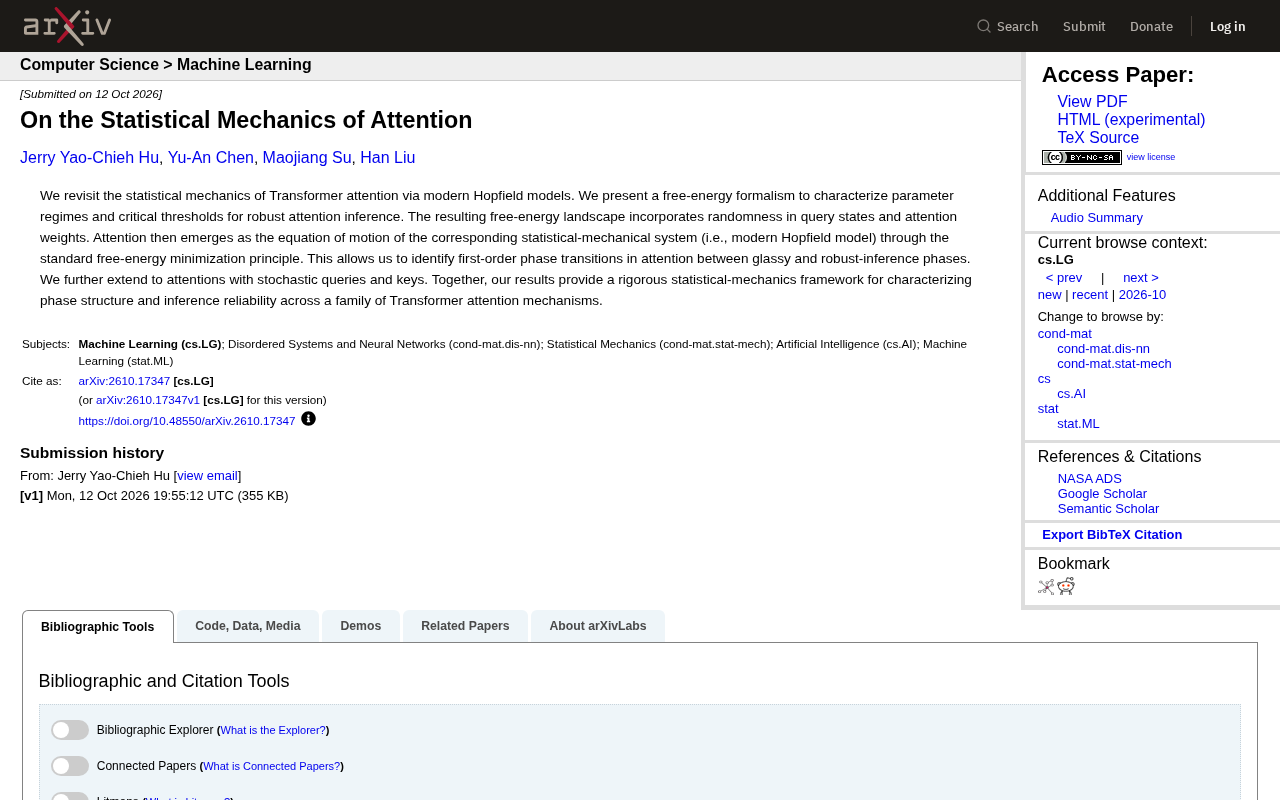
This study maps Transformer attention onto a statistical mechanics system through modern Hopfield models, introducing a free-energy formalism that interprets attention weight computation as an equation of motion derived from free-energy minimization. Within this framework, attention exhibits first-order phase transitions: the system can switch between an unstable glassy phase and a stably converging robust-inference phase, where small parameter changes near the critical threshold can cause sharp degradation in inference quality. The study further extends to attention with stochastic queries and keys, making the analysis more relevant to noisy environments. The framework provides a unified tool for analyzing the phase structure of different attention mechanisms, enables prediction of inference reliability, and guides more stable attention design, bridging deep learning practice and statistical physics theory.
Attention is the core of the Transformer architecture, yet the stability and reliability of its inference process have long lacked a rigorous physical explanation. A study titled "On the Statistical Mechanics of Attention" revisits this problem, constructing a statistical mechanics framework for attention through modern Hopfield models and revealing the phase transition behavior of attention across different parameter regimes.
Free-Energy Formalism: Attention as the Equation of Motion of a Physical System
The core innovation of the study lies in introducing a free-energy formalism that maps the Transformer attention mechanism onto a statistical mechanics system. Within this framework, the stochasticity in query states and attention weights is naturally incorporated into the description of the free-energy landscape.
Attention computation can thus be understood as the equation of motion of this statistical mechanics system (i.e., the modern Hopfield model) — derived through the standard free-energy minimization principle. This means that the computation of attention weights is no longer merely a mathematical operation, but corresponds to the evolution of a physical system toward its lowest-energy state.
The value of this perspective lies in providing analyzable physical quantities for the attention mechanism, enabling researchers to characterize the parameter regimes and critical thresholds of attention using statistical mechanics tools.
Modern Hopfield models are variants of the classical Hopfield network extended to continuous states and high-capacity storage. Their core idea is to write the network energy function as a continuous similarity aggregation over stored patterns, with retrieval weights given in softmax form. Ramsauer et al. demonstrated in 2020 that single-head attention in Transformers is mathematically equivalent to one retrieval update of a modern Hopfield network: the query corresponds to the current state, the keys correspond to stored patterns, and the attention weights correspond to the retrieval distribution. The value of this equivalence is that it transforms attention from a purely algebraic operation into a physical system with an energy function, temperature, and phase transitions, allowing tools from spin glass theory and mean-field methods to be directly transferred to analyze attention's convergence, capacity, and failure modes.
Free energy is a quantity in statistical mechanics that characterizes a system's effective energy landscape at a given temperature, defined as F = U - TS, where U is internal energy, S is entropy, and T is temperature. Unlike pure energy minimization, free-energy minimization simultaneously balances two forces: "landing in a low-energy state" and "maintaining sufficient entropy, i.e., diversity." In the context of attention, the temperature parameter controls the sharpness of the softmax: low temperature concentrates attention on a few keys (low entropy, potentially overfitting), while high temperature makes weights more uniform (high entropy, potentially under-focusing). The significance of the free-energy formalism is that it provides a computable criterion for "why attention fails at certain temperatures" and allows researchers to predict whether inference is reliable by analyzing the number and stability of minima in the free-energy landscape.
First-Order Phase Transitions: Switching Between the Glassy Phase and the Robust-Inference Phase
Based on the free-energy framework, the study identifies the existence of first-order phase transitions in the attention mechanism, where the system can switch between two distinctly different phases:
Glassy phase: In this phase, attention inference is unstable, and the system may become trapped in numerous local minima, leading to unreliable inference results. This resembles the complex energy landscapes commonly found in spin glass systems.
Robust-inference phase: In this phase, attention can stably converge to effective solutions, and inference reliability is significantly improved. The system resides near a well-defined energy minimum and exhibits stronger resistance to external perturbations.
The existence of first-order phase transitions implies that near a certain critical threshold, the performance of the attention mechanism may undergo abrupt changes — a small change in parameters can cause inference quality to degrade sharply from reliable to unreliable. This finding has direct implications for understanding the failure modes of Transformers in real-world applications.
First-order phase transitions refer to phase transitions in which the order parameter undergoes a discontinuous jump at the critical point, accompanied by latent heat and hysteresis phenomena; a typical example is the coexistence of ice and water. In contrast, in continuous (second-order) phase transitions, the order parameter changes continuously. In attention systems, a first-order phase transition means that when a control parameter such as temperature or key variance crosses a critical threshold, the system suddenly "jumps" from one free-energy minimum to another rather than transitioning smoothly. Consequently, a tiny parameter perturbation can cause a drastic change in inference quality, and the system may exhibit hysteresis — the threshold for degradation from the robust state differs from the threshold for recovery. This has direct implications for understanding Transformer temperature scheduling, attention collapse, and training instability: parameter tuning should not approach the phase transition surface but should leave a margin.
Glassy phase and spin glasses: A spin glass is a type of magnetic alloy in which the interactions between spins involve random competition (a mixture of ferromagnetic and antiferromagnetic couplings), resulting in an extremely rugged energy landscape with exponentially many local minima, making it very difficult for the system to find the global optimum. This concept has been widely borrowed for optimization and neural network analysis. In attention, the glassy phase refers to a free-energy landscape with numerous similar local minima, where retrieval can fall into incorrect patterns, manifesting as sensitivity to small input perturbations, unstable outputs, and large variations in results across different random seeds. The significance of identifying the glassy phase regime is that it provides a quantifiable diagnostic indicator: by estimating the density of minima in the energy landscape or the replica overlap parameter, one can determine before deployment whether a given set of hyperparameters has slid into an unreliable region.
Extension to Stochastic Queries and Keys
The study further extends the framework to attention mechanisms with stochastic queries and keys. In real-world application scenarios, queries and keys often contain noise or uncertainty (e.g., inherent noise in input data, sampling bias), and this extension makes the statistical mechanics analysis more relevant to actual deployment conditions.
By incorporating the stochasticity of queries and keys, the shape of the free-energy landscape changes, and the critical thresholds of phase transitions shift accordingly. This provides a theoretical tool for evaluating the inference reliability of attention mechanisms in noisy environments.
Implications for Transformer Architecture
The significance of this work extends beyond the theoretical level. It provides a rigorous statistical mechanics framework for the following questions:
- Characterization of phase structure: Different types of attention mechanisms (e.g., softmax attention, linear attention) belong to the same family in the statistical mechanics sense, and their phase structures can be analyzed within a unified framework.
- Prediction of inference reliability: By analyzing the free-energy landscape, one can determine before training or inference whether attention under a given parameter configuration resides in the robust-inference phase.
- Design guidance: Understanding the critical thresholds of phase transitions helps design more stable attention mechanisms and avoid falling into the glassy phase.
From a broader perspective, this study incorporates empirical observations of attention mechanisms in deep learning (such as the effect of temperature parameters on performance and attention collapse) into a derivable physical theoretical framework. This theoretical effort is in line with the recent trend of introducing physics tools into deep learning analysis.
The free-energy formalism and phase transition analysis framework provided by the paper open up multiple possible directions for future research, including statistical mechanics analysis of stacked multi-layer attention, the relationship between training dynamics and inference phase transitions, and the design of novel attention mechanisms based on phase transition theory. The statistical mechanics understanding of attention mechanisms may serve as an important bridge connecting deep learning practice and statistical physics theory.
Related articles

NVIDIA's 30,000 Developers Use Cursor, Code Commit Volume Triples
Cursor engineer Chris Diaz breaks down five organizational gaps blocking enterprise AI coding scale—strategy, risk tiering, governance, metrics, and operating model. NVIDIA's 30,000 developers use Cursor daily, tripling code commits while defect rates stay flat. The key: rewrite the SDLC, not add tools.

Ponytail: Giving AI Coding Agents a Senior Engineer's Mindset
Ponytail is a free GitHub tool that injects a senior engineer's mindset into AI coding agents, making them ask whether code is even necessary first. According to TamilDeck, it can compress 200 lines of AI-generated code to 30, cutting token costs, with support for Cursor rules and Claude Code skill integration—though security review still requires human oversight.

Complete Guide to Connecting Cursor AI to the GitHub MCP Server
A step-by-step guide to connecting Cursor AI to the GitHub MCP server: create a personal access token, configure mcp.json, store the token in the ENV block, and verify with a PR query.