The T-Parameter Era of Open-Source LLMs: Four Chinese AI Companies Break the Trillion-Parameter Barrier

Four Chinese AI companies hit trillion-parameter scale simultaneously, marking a new era for open-source LLMs.
In just 18 months, China's open-source LLM ecosystem made an order-of-magnitude leap from billions to trillions of parameters. Moonshot AI, Alibaba, DeepSeek, and Meituan all crossed the 1T threshold in rapid succession, signaling that trillion-parameter training has gone from rare privilege to industry baseline — while the real challenge of making these models deployable and accessible remains largely unsolved.
From B to T: A Quiet but Monumental Leap in Scale
Just a few years ago, Chinese open-source large language models were still celebrating "tens of billions of parameters" as a badge of honor. By 2025, that benchmark feels like ancient history. The jump from B (billions) to T (trillions) took China's open-source model ecosystem roughly 18 months — a staggering order-of-magnitude leap.
This wasn't a lone breakthrough by any single company. It was a collective phenomenon: Moonshot AI, Alibaba, DeepSeek, and Meituan all crossed the trillion-parameter threshold within roughly the same window. That signal is far more significant than any individual milestone — it marks a shift from trillion-parameter training being a rare privilege to becoming an industry baseline.
Historically, multiple players hitting the same technical milestone simultaneously isn't unusual in AI. After the Transformer architecture was introduced in 2017, Google, OpenAI, and Meta all completed large language model pre-research based on it within the same year. During the "open-source LLM year" of 2023, dozens of fine-tuned derivatives of Meta's LLaMA emerged within months of its release. The underlying logic: once a core technical breakthrough is made public — via a paper or technical report — it becomes shared knowledge across the industry. Organizations with sufficient capability will independently reproduce and surpass it in a similar timeframe. China's trillion-parameter wave in 2025 follows this same pattern, with DeepSeek V3's technical report and publicly disclosed training methodology providing a meaningful engineering reference for those who followed.
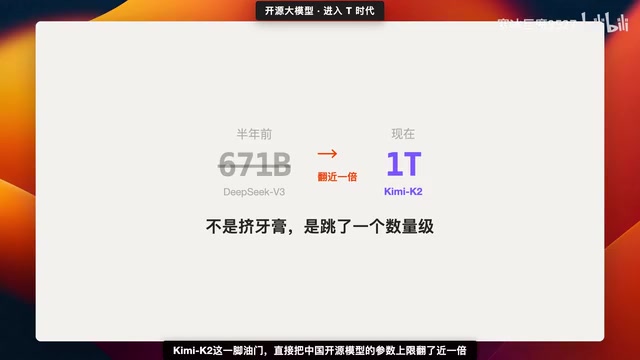
One important nuance: this growth isn't incremental "squeezing the toothpaste" — it's genuinely leaping up a staircase. Players that were hovering around 60+ billion parameters just six months ago are now being lapped by models two to five times their size. The pace of this parameter race is now measured in quarters, not years.
The Four Who Crossed: Order of Entry into the Trillion-Parameter Club
Moonshot AI: First Across the Line
Moonshot AI launched Kimi K2 with 1T parameters, becoming the first to cross into the trillion-parameter tier. Just six months earlier, the domestic open-source benchmark — DeepSeek V3 — sat at roughly 67 billion parameters. Kimi K2 effectively doubled the ceiling for Chinese open-source models in a single move, making it a deeply symbolic milestone.
Moonshot didn't stop there. The subsequent Kimi K3 reportedly pushed the figure to 2.8T, setting a new record and claiming the top spot in the parameter count rankings.
Alibaba Qwen: Efficient Scaling via MoE Architecture
Alibaba's Qwen3 Max crossed the trillion-parameter mark, making it the second company to reach T-scale. Rather than simply stacking parameters, Qwen employs a MoE (Mixture of Experts) architecture, using selective activation to balance scale with inference cost.
MoE (Mixture of Experts) is a sparse-activation neural network design paradigm. The core idea: even though the model has a massive total parameter count, only a small subset of "expert" sub-networks is activated for each input token — typically 1/8 to 1/16 of the total expert pool — rather than engaging all parameters simultaneously. This allows models to maintain enormous total capacity while keeping actual inference compute (FLOPs) at a manageable level. DeepSeek V3's 671B total parameters, for instance, activate roughly 37B per inference pass — a textbook example of MoE in practice. Alibaba's use of MoE means its trillion-parameter count doesn't translate directly to trillion-parameter compute overhead; it's a calculated balance between perceived scale and inference efficiency.
One telling detail: between Qwen3 Max's 1T and a later version at 2.4T, the parameter count doubled again — yet Alibaba published no parameter figures for several intermediate releases. Silence is itself a signal. When a company doesn't disclose numbers, it usually means something bigger is being held back.

In today's hyper-competitive landscape, parameter counts have become a key lever in brand narrative and industry positioning. The decision to go public with the numbers this time around was almost certainly a response to being upstaged.
DeepSeek: A Nearly 3x Jump from 671B to 1.6T
As a flagship name in Chinese open-source AI, DeepSeek V3 once led the industry at 671B parameters. Its next-generation model reportedly launches at 1.6T — nearly tripling the scale. Every DeepSeek release ripples through the industry, and this one significantly raises the ceiling for the entire field.
It's worth noting that a jump in parameter count doesn't automatically translate to a proportional jump in capability. This point traces back to OpenAI's 2020 "Scaling Laws" research, which established predictable power-law relationships between model performance, parameter count, training data volume, and compute. However, DeepMind's 2022 Chinchilla paper refined that picture, showing that under a fixed compute budget, optimal performance requires balanced scaling of both parameters and training data — simply stacking parameters without sufficient training data results in models that are large but not particularly capable. The actual capability gains from scaling 671B to 1.6T will need to be backed by a commensurate expansion in training data and compute investment to be fully realized.
Meituan: An Unlikely Entrant from the Food Delivery World
The most surprising participant in this race is Meituan. The company best known for food delivery reportedly pushed its model Longcat 2.0 to 1.8T parameters — a figure that actually exceeds DeepSeek's flagship product.
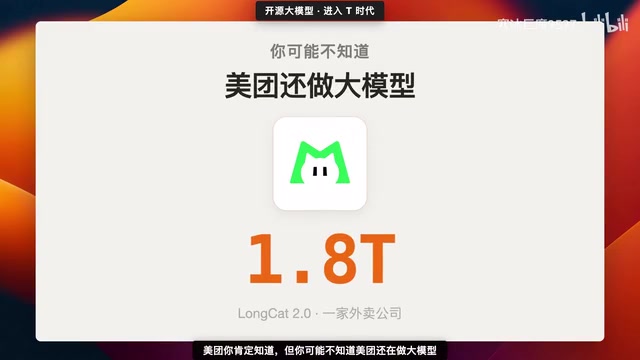
Meituan's entry makes one thing clear: the large model arms race has long since spilled beyond the boundaries of traditional AI companies. Any tech giant with sufficient compute, data, and real-world application scenarios can now be a viable candidate for the trillion-parameter club.
Who's Next: Zhipu and MiniMax Closing In
Beyond the four companies already in the T-tier, the next wave of candidates deserves attention.
Zhipu GLM: Methodical Progression Through a "Comfort Zone"
Zhipu's GLM series has taken a notably different approach. From GLM4.5 to GLM4.7, the team iterated three consecutive generations at the 358B parameter range — deliberate, patient, unhurried. GLM5 then doubled the scale to 754B in a single step.
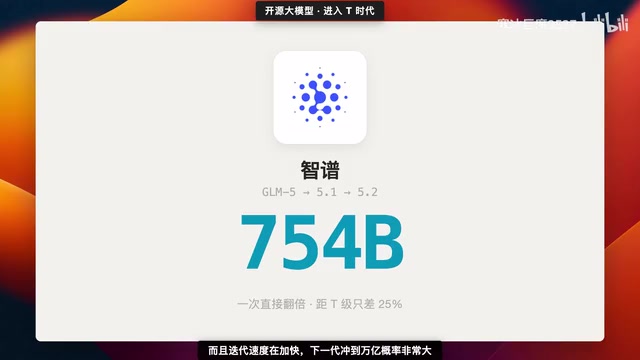
Spending multiple generations at the same parameter tier signals that 700B+ is Zhipu's current technical comfort zone. The accelerating iteration pace, however, strongly suggests that a push toward trillion-parameter scale is imminent. All things considered, Zhipu looks like the most likely candidate to enter the T-club next.
MiniMax: Fast-Paced but Still Catching Up
MiniMax has also been moving quickly: M2 at 229B, M3 jumping to 427B — nearly double — with rapid intermediate releases (M2.1, M2.5, M2.7) filling in the gaps before the full M3 leap. That said, based on current trajectory, MiniMax's odds of breaking into the T-tier in the near term appear slightly lower than Zhipu's.
Why the T Era Was Inevitable: Ecosystem-Level Maturity
Looking back across 18 months of parameter scaling — from a few hundred billion at the frontier, past the 1T threshold, to a current high-water mark of 2.8T — the most important observation isn't any single company's achievement. It's that Moonshot AI, Alibaba, DeepSeek, and Meituan all got there together.
This synchronicity points to a deeper truth: reaching trillion-parameter scale no longer depends on a single team's stroke of genius. It reflects the comprehensive maturation of the entire ecosystem — sufficient talent, sufficient compute, sufficient data, and a methodology that has fully come of age. When all of those elements are simultaneously in place, the T era stops being a question of "if" and becomes a matter of historical inevitability.
A Sober Look: The Deployment Gap Behind the Parameter Hype
That said, this parameter celebration warrants a dose of cold water. The models may be "open-source" — but how many can actually be deployed in practice?
There's a frequently overlooked "open-source gap" at play here. In the LLM context, open-source typically means model weights are publicly downloadable — but this is fundamentally different from traditional software open-source. A 1T-parameter model stored at standard BF16 precision requires approximately 2TB of GPU memory. Even with INT4 quantization compression, you still need 500GB or more. A single top-tier GPU (e.g., H100 80GB) maxes out at 80GB of VRAM, meaning deploying a trillion-parameter model requires a cluster of dozens of high-end GPUs, with conservative deployment costs exceeding several million RMB. The gap between "open-source" and "accessible to everyone" is enormous.
For the vast majority of small-to-medium teams and individual developers, these "open-source" models remain practically out of reach. The parameter arms race undeniably raises the capability ceiling for Chinese large models — but the true value of open-source lies in usability and accessibility, not in raw numerical labels. Genuinely democratizing open-source AI requires the parallel maturation of model distillation, quantized inference, cloud APIs, and supporting ecosystem tooling.
As the industry celebrates the arrival of the T era, perhaps the more important questions to ask are: Is there enough compute to actually run these models? Do capabilities truly scale in step with parameters? Can everyday users benefit from any of this? Trillion parameters is a meaningful milestone — but it's far from the finish line. The next phase of competition will likely shift from "who's biggest" to "who's most capable, most usable, and most cost-efficient."
Key Takeaways
Related articles
Deep Dive into vLLM Worker-Side GPU KV Cache Initialization
Deep dive into vLLM's Worker-side KV Cache GPU memory allocation, covering the full pipeline from KVCacheConfig generation to physical memory binding via ModelRunner.
Zepto Builds AI Customer Service with MLflow: An Evaluation-Driven Practice Guide
Deep dive into how Zepto built an evaluation-driven AI customer service system using MLflow and Databricks, achieving 60% faster responses and 40% less manual handling. From technical architecture to practical insights.

Iran Captures U.S. Underwater Drone in Strait of Hormuz: A Comprehensive Analysis
Iran announces capture of U.S. Navy underwater drone in Strait of Hormuz. In-depth analysis of the incident, strategic value of UUVs, U.S.-Iran geopolitical competition, and implications for global energy security and military dynamics.