The Title-Only "🧡💜" Post on Dev.to: Emotional Marketing or a New Content Trend?
A zero-text emoji post on Dev.to reflects the polarization of the tech community's content ecosystem.
The article starts from a zero-text post found in Dev.to's RSS feed, titled only "🧡💜" with just an image in the body, and analyzes how out of place this minimalist publishing form is in a technical writing community. The author notes that emoji titles may carry metaphors of diversity or emotional connection, and their appearance reflects the platform's audience expanding from in-depth technical sharing toward lightweight emotional expression. Such posts share the same feed and recommendation mechanism as thousands-of-words technical articles; while this shows a low publishing barrier, it dilutes information density for RSS readers and interferes with the content aggregation pipeline. The article ultimately reminds us that a platform's feed is not always sorted by information density, and understanding this is more valuable than criticizing an empty post.
When a "Zero-Content" Post Appears in a Tech Community
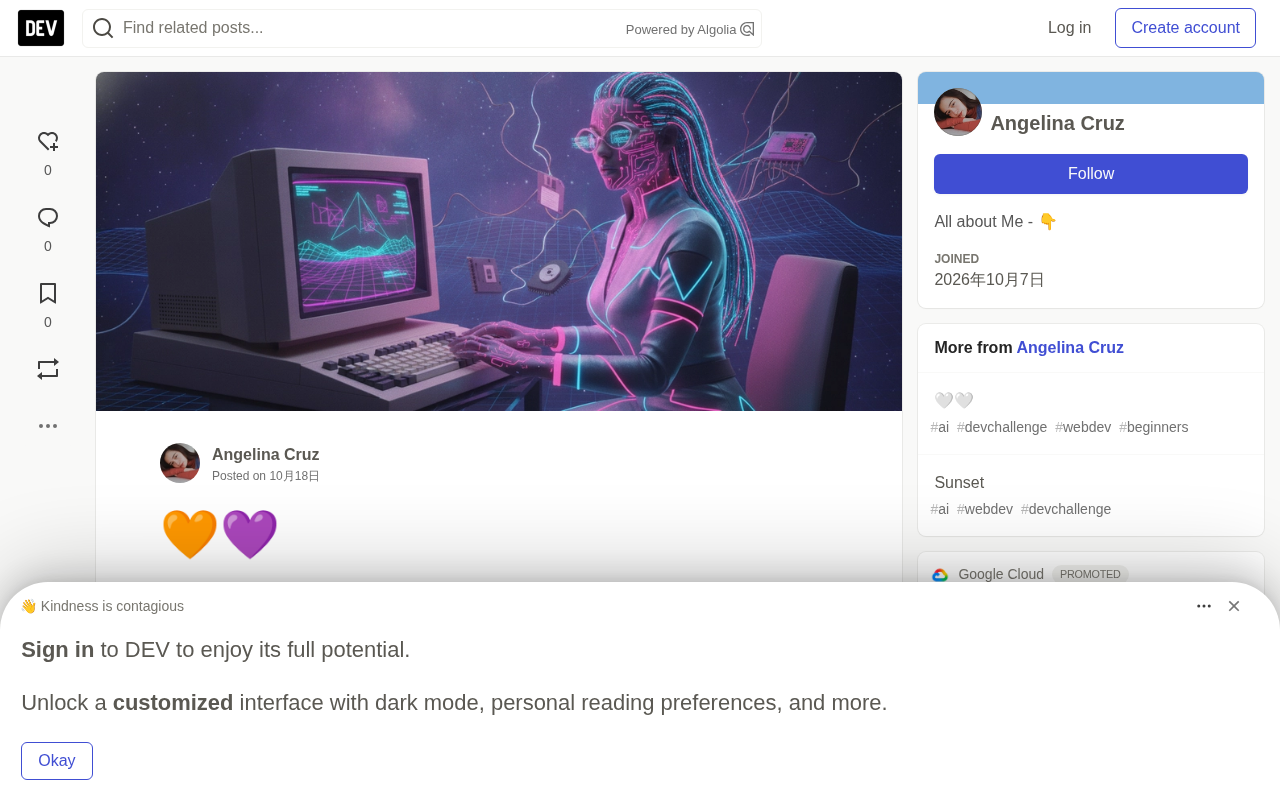
In the Dev.to RSS feed, an article appeared with a title consisting of just two emoji: "🧡💜". The body contained not a single line of code, no explanatory text—just a single image sized 480×600. This minimalist, almost "blank" form of publishing feels out of place in a technical writing community, yet it is precisely for that reason that it drew attention.
This is not an isolated case. The raw content captured via RSS shows that the page body is almost entirely made up of an image link, with no indexable body text whatsoever. For Dev.to, where code blocks, architecture diagrams, and long-form analysis are the standard, such a post seems like an oddity.
What It Means for Emoji to Serve as a Distribution Medium
The combination of "🧡💜" is not random. In visual design contexts, orange and purple are often used as strongly contrasting complementary colors, and on social platforms, sending two heart symbols of different colors in succession often carries the metaphor of "diversity" or "emotional connection."
The key question is this: when a tech community begins to see posts whose only title is emoji, it actually reflects a shift in the platform's audience structure. Dev.to was originally centered on in-depth technical sharing by developers, but as the community expanded, lightweight, emotional content gained equal exposure opportunities. The poster may not have intended to convey specific information at all, but rather used a low-barrier form of expression to test interactive feedback.
Complementary colors refer to color combinations at opposite positions on the color wheel, such as orange and blue, purple and yellow, red and green. Although orange and purple are not strictly opposing complementary colors (the complement of orange is blue, and the complement of purple is yellow), they are often juxtaposed in visual design because they are far apart on the hue wheel and can create high-contrast visual tension. This color strategy is widely adopted in brand design, UI interfaces, and emoji typography on social media, with the goal of quickly grabbing attention in an information stream. When a title consists solely of two heart symbols, orange and purple, the color contrast itself becomes the only visual information carrier, replacing the semantic function normally borne by a text title.
The Polarization of the Content Ecosystem
Such posts stand in sharp contrast to the typical long-form technical articles on Dev.to. At one end are tutorials of thousands of words accompanied by complete code repositories; at the other is a blank page with just a single emoji. Both share the same information stream and the same recommendation mechanism.
From a platform operations perspective, this coexistence is not inherently a bad thing—it shows that the barrier to publishing is low enough that users dare to experiment with different forms. But for readers who rely on RSS subscriptions to get technical news, zero-information posts dilute information density. When an RSS scraping tool receives content like this, it can extract almost no valid fields other than the image link, which in itself constitutes a kind of interference with the content aggregation pipeline.
The material itself does not provide the author information, publication time, or interaction data for this post, so it is impossible to determine whether it is a test behavior, a personal emotional expression, or some deliberate distribution strategy.
RSS (Really Simple Syndication) is an XML-based content aggregation format that allows readers to subscribe to website updates through a reader without visiting the source site one by one. RSS scraping tools typically rely on structured fields such as article title, body text, and publication time to generate entries. When a post's body contains almost only image links and lacks parseable text nodes, the fields that the aggregation side can extract are greatly reduced, causing the entry to appear in the reader as a nearly blank placeholder. This not only affects the reader's reading experience but may also interfere with search and recommendation systems that rely on text indexing—a weak link in the content aggregation pipeline that is easily overlooked.
What We Can Take Away From This
Setting speculation aside, the confirmable facts are limited: this is a post published on Dev.to with a title of two emoji, a body dominated by an image, and a lack of readable text. Its existence points to an issue worth noting—against the backdrop of an ever-richer supply of content in tech communities, "no content" has instead become a scarce form of attention.
For content creators, this is perhaps not an example worth emulating, but it reminds us that a platform's information stream is not always sorted by information density. Understanding this is more valuable than simply criticizing an empty post.
Related articles

A Single Prompt Triggers a Global PHP Security Storm: Is AI a Savior or a Hidden Risk?
A single AI prompt triggered a global PHP security crisis affecting Wikipedia and the Internet Archive. This article reviews the incident, analyzes the OpenAI-Amazon controversy, and explores the security paradox of lowered vulnerability discovery barriers in the AI era and developer response strategies.

When AI Is Taken Away: How Reliance on Shortcuts Undermines Your Problem-Solving Resilience
A study of 1,222 people found that after using AI to answer questions, once AI was removed, people gave up on more problems than a control group that never used AI. The article analyzes the impact of AI reliance on learning resilience and metacognition, and explores design implications for AI learning tools.

Carta and NewView Partner to Let Startup Employees Cash Out Equity Early
Carta and NewView Capital partner to simplify startup tender offers, helping employees sell equity early. Analysis of the mechanism, liquidity pain points, and impact.