The Truth About AI Writing Code: Can It Actually Program? A Complete Breakdown

AI writes code through pattern matching and probability prediction, not by truly understanding programming.
AI code generation is built on training with massive open-source code, using the Transformer architecture's pattern matching and probability prediction to generate code rather than genuinely understanding program logic. It excels at standardized tasks but is prone to errors with complex business logic and edge cases. Developers should treat AI as an efficient assistant, improve output quality through well-crafted Prompts, and maintain human code review alongside continuous skill development.
When you see AI tools like ChatGPT and Copilot instantly generate dozens of lines of code, you might get the impression that AI has learned to program.
In reality, the nature of AI writing code is far more nuanced than we might think. It's neither simple "copy and paste" nor genuine "understanding of programming." This article takes a deep dive into the underlying principles of AI code generation, helping you build an accurate mental model.
The Underlying Principle of AI Code Generation: Massive Memory + Pattern Matching
To understand why AI can write code, you first need to understand its training process.
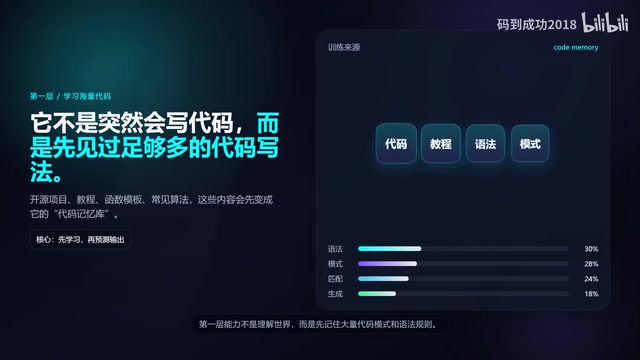
During training, AI models (such as the GPT series, Claude, and other large language models) "read" massive amounts of open-source code repositories, programming tutorials, technical documentation, and Q&A community content from around the world. Billions of lines of code on GitHub and tens of millions of Q&A posts on Stack Overflow all become AI's "textbooks." Take OpenAI's Codex (the underlying model for GitHub Copilot) as an example — its training data included over 54 million public code repositories on GitHub, covering dozens of programming languages. Subsequent models like GPT-4 were trained on even larger mixed datasets that include not only code but also technical blogs, API documentation, RFC standards, and more. This multimodal training data enables AI to not only write code but also understand the correspondence between code comments, docstrings, and natural language requirements. However, this has also sparked controversies around copyright and licensing — whether AI-generated code might inadvertently reproduce code snippets protected by open-source licenses like GPL remains a hot topic in legal and ethical circles.
Through this process, AI memorizes the coding patterns, syntax rules, and common design patterns corresponding to different programming needs. It doesn't "understand" why variables are declared a certain way or why loops are written a certain way the way human programmers do. Instead, it learns at a statistical level — "when this kind of requirement description appears, the output should most likely be this kind of code."
The core architecture of these large language models is the Transformer, proposed by Google in the 2017 paper Attention Is All You Need. The key innovation of the Transformer is the "Self-Attention" mechanism, which allows the model to attend to all other tokens in the input sequence when processing a given token, thereby capturing long-range semantic dependencies. In the context of code generation, this means that when AI predicts the next code token, it can "look back" at all preceding context — including function definitions, variable declarations, comments, and more — to generate syntactically and semantically coherent code. The model's parameter count (ranging from billions to hundreds of billions) is essentially a compressed storage of statistical patterns from the training data.

In simple terms, AI's programming ability is built on three foundations:
- Massive code corpus: Covering virtually all mainstream programming languages and common scenarios
- Syntax rule learning: Mastering the syntactic structures of various languages through extensive samples
- Requirement-to-code mapping: Establishing correspondences between natural language descriptions and code implementations
From Requirements to Code: The Complete AI Code Generation Process
When you input a programming requirement to AI, its workflow roughly proceeds as follows:
Step 1: Parse the requirement. AI first performs semantic understanding of your natural language description, extracting key information — what functionality you want to implement, what language to use, and what constraints exist.
Step 2: Match similar patterns. Based on the massive code experience accumulated during training, AI searches its "memory" for code snippets and implementation approaches most similar to the current requirement. This process is similar to an experienced programmer searching their mind for "I've seen a similar approach before."
Step 3: Assemble and adjust. AI assembles the matched code snippets, modifies syntax, adjusts parameters, and generates complete code that fits your specific requirements.
Fundamentally, this process is still "predicting the next most likely token" — that is, probability-based inference. Specifically, this technique is called Autoregressive Generation — the model calculates the probability distribution of each candidate token in the vocabulary based on all existing tokens, then selects the next token through sampling strategies (such as Top-K sampling, Top-P/Nucleus sampling, temperature scaling, etc.). In code generation, the temperature parameter is typically set low to ensure more deterministic output that better conforms to syntax rules. It's worth noting that code is processed by a Tokenizer before being fed into the model, which splits source code into subword units — a complete variable name or keyword might be split into multiple tokens, which is one reason AI occasionally produces spelling or naming inconsistencies.
AI doesn't construct a mental model of program execution the way humans do. It's more like a "code encyclopedia" with superhuman memory, generating code through pattern matching and probabilistic inference. There's an important distinction in cognitive science and AI research: AI possesses "syntactic competence" rather than "semantic understanding." When human programmers write code, they build a mental execution model — understanding how variables change in memory, how the call stack operates, and how state synchronizes in concurrent scenarios. AI is essentially performing mathematical operations in high-dimensional vector space, processing statistical correlations between tokens without possessing the ability to "mentally simulate" runtime behavior. This is why AI can generate code that looks correct while hiding subtle logical errors — such as race conditions, memory leaks, or boundary bugs that only trigger under specific inputs. These issues require developers with deep computational thinking to identify and fix.
AI Programming Capability Boundaries: What It Excels At and Where It Falls Short
Now that we understand how AI writes code, we can more clearly recognize its capability boundaries.
Scenarios Where AI Excels
- Common functionality implementation: Standardized tasks like sorting algorithms, file I/O, and API calls — AI can almost always produce correct code on the first try
- Code template generation: Quickly scaffolding project frameworks and generating boilerplate code, far more efficient than writing by hand
- Syntax translation: Translating code between different programming languages, or converting pseudocode into executable code
- Bug fix suggestions: For common syntax errors and logical issues, AI can quickly locate problems and offer fixes
Scenarios Where AI Is Error-Prone
- Complex business logic: Code involving multi-module interactions and specific business rules — AI tends to produce logical gaps
- Edge case handling: AI-generated code often neglects exception handling and boundary conditions
- Performance optimization: AI tends to produce code that "runs" rather than optimal solutions
- Latest tech stacks: Training data has a cutoff date, so AI's knowledge of the newest frameworks and APIs may lag behind
How to Properly Use AI Programming Tools: 3 Practical Tips
Since the essence of AI writing code is "advanced pattern matching" rather than "true understanding," we need to maintain clear-headed awareness when using these tools.
Current AI programming tools have formed a multi-layered product ecosystem. At the IDE integration level, GitHub Copilot, Amazon CodeWhisperer, Tabnine, and similar tools embed into developers' daily workflows as code completion plugins. At the conversational level, general-purpose large models like ChatGPT, Claude, and Google Gemini support code generation and debugging through natural language dialogue. At the professional platform level, next-generation AI-Native IDEs like Cursor, Windsurf, and Replit deeply integrate code generation, review, and refactoring into the development environment. According to GitHub's official data, developers using Copilot see an average 55% increase in coding speed, with a code acceptance rate of approximately 30% — meaning about 70% of AI-generated code still needs developer modification or rejection, indirectly confirming the necessity of human review.

First, treat AI as an efficient assistant, not a replacement. AI-generated code must always undergo human review to verify syntactic correctness and logical soundness. Blindly copying and pasting AI code is extremely dangerous, especially in production environments.
Second, learn to write good Prompts to improve code quality. The quality of AI code generation largely depends on your requirement description. The more specific and clear your Prompt, the higher the quality of AI's output. For example, instead of saying "write a login function," say "write a user login endpoint using Python Flask framework, with JWT authentication, including password encryption and error handling."
Prompt Engineering is a rapidly evolving practical discipline. In the code generation domain, effective Prompt techniques include: Few-Shot Prompting (providing several input-output examples for AI to learn patterns), Chain-of-Thought (asking AI to think step-by-step before writing code), and role setting (e.g., "You are a senior Python backend engineer"). Research shows that explicitly specifying programming language, framework version, code style conventions, and error handling requirements in Prompts can improve code generation accuracy by 30%-50%. This is the fundamental reason why the same programming requirement yields vastly different code quality when different people use AI tools.
Third, continuously improve your own programming skills. AI is a tool, but the ability to judge code quality, design system architecture, and handle complex debugging still requires solid programming fundamentals. Only when you possess sufficient technical judgment can you truly harness AI programming tools like Copilot and ChatGPT.

Conclusion: AI Can Write Code, But Doesn't Truly "Know" Programming
AI can write code, but it doesn't "know" programming — at least not in the way humans understand it. Its power comes from memorizing massive amounts of code and pattern matching capabilities, not from genuine understanding of program logic.
In real-world development, AI is an extremely efficient programming assistant that can significantly boost coding productivity, but ultimate code quality control still requires the developer's own professional judgment.
Rather than worrying about AI replacing programmers, learn how to collaborate with AI and make it your "super assistant" on the programming journey.
Key Takeaways
- The essence of AI writing code is pattern matching and probability prediction based on massive code training, not genuine understanding of programming logic
- The AI code generation workflow includes three steps: requirement parsing, similar code matching, and assembly/adjustment
- AI excels at standardized coding tasks but is error-prone with complex business logic and edge case handling
- Human code review is essential when using AI programming tools — blind reliance is dangerous
- Writing high-quality Prompts and maintaining your own programming skills are key to using AI programming tools effectively
Related articles
Deep Dive into AI Agent Skill Design: …
Deep Dive into AI Agent Skill Design: Engineering Practices from Anthropic and Perplexity
A deep dive into Skill design philosophy from Anthropic's Claude Code team and Perplexity's Agent team, covering the Tax Test, Gotchas Flywheel, progressive disclosure, and Eval-First practices for building high-quality AI Agent skill systems.
Deep Dive into OpenAI's Official GPT-5…
Deep Dive into OpenAI's Official GPT-5.6 Prompting Guide: The Shift from Manual to Automatic
A deep dive into OpenAI's official GPT-5.6 Sol prompting guide: conciseness-first, outcome-oriented design, autonomy boundaries, tool routing, and reasoning intensity tuning.
 Deep Dives
Deep Dive into How OpenClaw (Open-Source Crayfish) AI Agent Works
Deep analysis of OpenClaw AI Agent internals: System Prompt, tool calling, SubAgents, Skill system, memory, and Context Engineering explained.