The Truth About Making Money with Python as a Side Hustle: A Complete 2025 Analysis of Barriers, Income & Market Competition
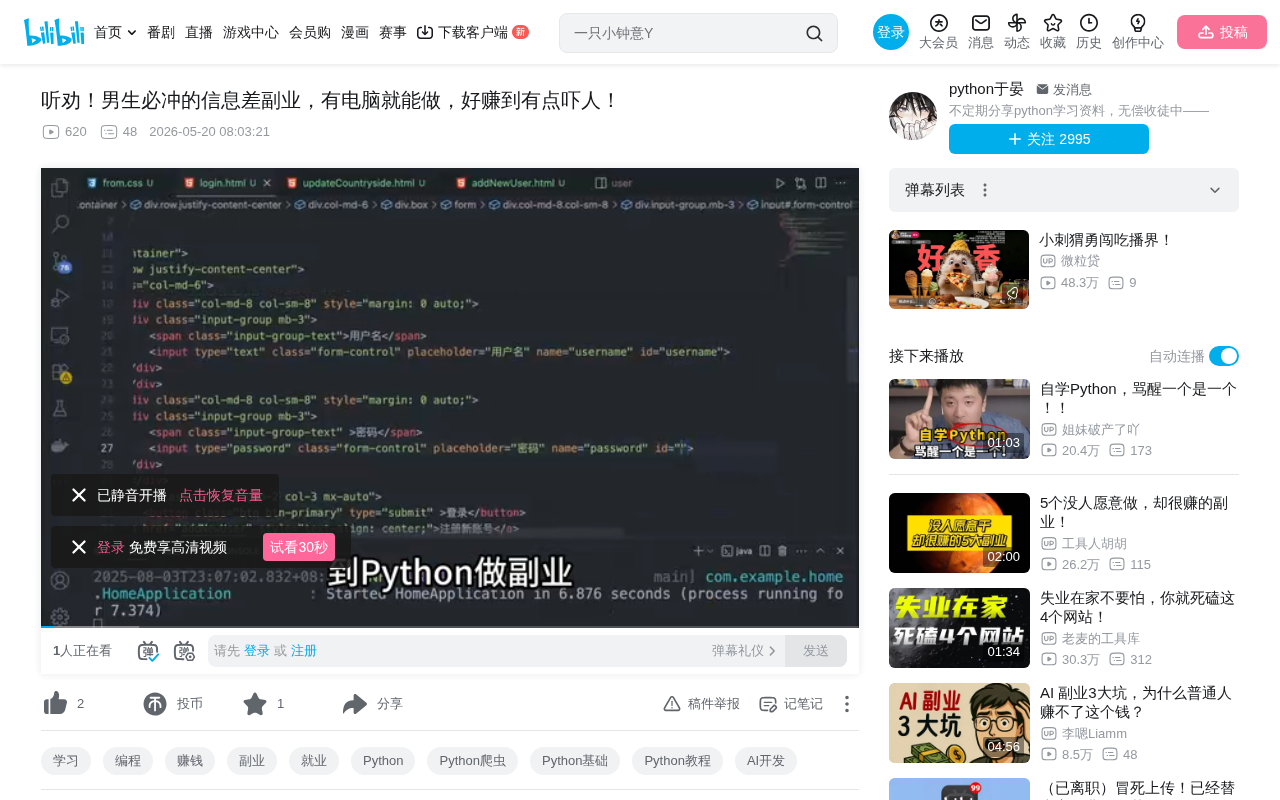
Python side hustles are viable but not quick wins—requiring long-term investment amid rising competition.
This article objectively analyzes the reality of Python side hustles: while Python's low barrier and broad applications make it the top choice, claims of earning $1,500+/month are mostly marketing hype—newcomers should expect $150-400/month initially. The 2025 market faces intensified competition from surging learners and AI tools, but high-value growth areas like LLM API integration, RAG systems, and Agent development offer significant opportunities. Python side hustles are fundamentally a long-term skill investment, not a shortcut to wealth.
The Hype and Controversy Around Python Side Hustles: Is "$1,500/Month" Real or Fake?
Recently, social media has been flooded with content claiming "earn over $1,500/month with Python side hustles." From YouTube to Instagram, the narrative template is almost identical: a protagonist escapes a low-paying job by learning Python programming and doubles their income. How credible are these claims? What's the real value of Python as a side hustle tool?
This article provides a relatively objective analysis from three dimensions: technical barriers, monetization paths, and market demand.
Why Has Python Become the Go-To Language for Side Hustles?
Low Syntax Barrier + Wide Application Scenarios
Python has become the top choice for side hustles primarily because of its combination of "versatility" and "low syntax barrier." Compared to languages like Java and C++, Python's syntax is closer to natural language, with a relatively gentle learning curve. More importantly, Python covers an extremely wide range of application scenarios—from data scraping and office automation to web development and AI model integration, almost every direction has clear commercial demand.
Language Ecosystem Background: Python was created in 1991 by Dutch programmer Guido van Rossum, with a design philosophy emphasizing code readability and simplicity. Python uses a dynamic type system and garbage collection, meaning developers don't need to manually manage memory—significantly reducing the cognitive burden of programming. Python's PyPI (Python Package Index) ecosystem contains over 500,000 third-party libraries as of 2025, covering virtually every domain from scientific computing (NumPy, Pandas) to web frameworks (Django, FastAPI). This "batteries included" ecosystem is a major reason it's become the top choice for side hustles.

However, it's important to emphasize that "low barrier" doesn't mean "no barrier." There's a massive capability gap between writing Hello World and independently completing a commercial project. To actually take on paid work, you need at least 3-6 months of systematic learning and project practice.
Main Monetization Paths and Pricing References for Python Side Hustles
Based on publicly available data from various freelancing platforms, Python-related project pricing roughly breaks down as follows:
- Simple web scraping scripts: $40-200/project
- Office automation tools: $70-400/project
- Small web projects: $400-1,100/project
- Data visualization/analysis: $140-700/project

Freelance Platform Market Structure: Zbj.com (founded 2006) is one of China's largest comprehensive outsourcing platforms, primarily focused on design and marketing needs, with tech projects accounting for about 20%-30%. Chengxuyuan Kezhan (Programmer Inn) is more vertically positioned, focusing specifically on tech outsourcing with relatively higher user quality but also more intense competition. Upwork and Fiverr are the mainstream international freelancing platforms, where Python-related project rates are generally 2-5x higher than the domestic Chinese market, though they require English communication skills. For beginners, it's advisable to first accumulate 3-5 complete project cases on domestic platforms to build a presentable portfolio, then consider expanding to international platforms for higher premiums.
Platforms like Zbj.com, Programmer Inn, and Nowcoder indeed have abundant demand of this kind. But the reality is that low-priced jobs are highly competitive, high-priced jobs require advanced technical skills, and newcomers should set initial income expectations at $150-400/month rather than casually expecting "$1,500+/month."
The Real Competitive Landscape of Python Freelancing in 2025
Time Costs Cannot Be Ignored
Videos commonly show cases like "received first job after three months of learning, earned $30 in two hours"—this in itself is reasonable. But if you factor in the upfront investment of three months at 2 hours daily (approximately 180 hours), the actual hourly rate isn't high. The real value of Python side hustles lies in long-term accumulation—as your skills improve and client base grows, both pricing and efficiency increase significantly.

Three Factors Intensifying Market Competition
The Python freelancing market in 2025 is far more competitive than a few years ago, for three reasons:
- Surge in learners: A flood of non-CS-background individuals has entered, creating oversupply in the low-end market
- AI tool disruption: Tools like ChatGPT and Cursor have further lowered the barrier for writing simple scripts
- Changing client expectations: Clients increasingly prefer using AI to generate simple code directly, meaning projects they're willing to outsource are growing more complex
Structural Impact of AI Tools: Cursor is an AI code editor built on VS Code, integrating large models like GPT-4 to generate, modify, and debug code directly from natural language descriptions. GitHub Copilot is Microsoft's AI programming assistant, used by over 1 million developers. The proliferation of such tools has driven the generation cost of standardized tasks like simple scrapers and data processing scripts close to zero, directly compressing demand in the entry-level Python outsourcing market. On the other hand, these tools also boost delivery efficiency for experienced developers, creating a "the strong get stronger" Matthew effect—developers who truly understand business needs and can leverage AI tools actually benefit from increased efficiency.
This means that simply knowing how to write basic scrapers or simple scripts is no longer sufficient to gain a competitive edge. The truly valuable capability is: understanding business needs + technical implementation + communication and delivery—a comprehensive skillset.
New Growth Areas for Python Side Hustles in the AI Era
Notably, Python has gained new strategic value in the AI era. Almost all mainstream AI frameworks (PyTorch, TensorFlow, LangChain, etc.) use Python as their primary interface language. This means the following directions are becoming high-value demands:
- LLM API integration and development: Helping businesses integrate GPT, Claude, and other large models
- Agent development: Building automated workflows and AI assistants
- RAG system development: Building enterprise knowledge base Q&A systems
- Backend services for AI applications: Providing data processing and API services for AI products
The Strategic Bond Between LLM Ecosystem and Python: LangChain is currently the most mainstream framework for LLM application development, providing modules for chain-of-thought calling, memory management, and tool integration, specifically designed for building LLM-based applications. RAG (Retrieval-Augmented Generation) is a technical architecture that combines external knowledge bases with large models, allowing enterprises to have AI answer questions based on private documents—it's one of the most mainstream approaches for enterprise AI deployment, with typical applications including internal knowledge base Q&A and contract review assistants. Agents refer to AI systems capable of autonomous planning, tool invocation, and multi-step task completion, such as AutoGPT and MetaGPT. Development in all three of these directions is almost entirely Python-based, forming Python's core moat in the AI era—and representing the highest-priced, relatively less competitive blue ocean areas in the freelance market.
These emerging demands command prices far higher than traditional scrapers and automation scripts, and represent the true growth point for Python side hustles going forward.
Who Is Suited for Python Side Hustles? A Rational Assessment Guide
Suitable Candidates
- Office workers with a stable primary job who are willing to invest 3-6 months in learning
- People with basic interest in programming who don't resist logical thinking training
- Those patient enough to start with low-priced jobs and gradually build a portfolio and reputation
- Those who want to combine Python skills with their current job (e.g., data analysis, office automation)
Not Suitable For
- Those expecting "master it in one week and monetize immediately"
- People with zero self-learning ability who need hand-holding instruction
- Those treating Python side hustles as a "lifeline" rather than "icing on the cake"
Conclusion: Python Side Hustles Are a Long-Term Investment, Not a Quick Fix
Python side hustles are indeed a viable path, but they're far from "passive income." At its core, it's about exchanging technical capability for compensation—like any skill monetization, it requires upfront investment, continuous learning, and market sensitivity. In the AI era, Python's value has actually increased, but the competitive landscape is also rapidly evolving.
Rather than being swept up by marketing rhetoric, it's better to calmly assess your own situation, develop a reasonable learning plan, and treat Python as a long-term investment.
The real "information advantage" isn't knowing that Python can make money—it's understanding what kind of Python capabilities the market needs, and how to efficiently acquire them.
Key Takeaways
- Python side hustles' core advantage lies in strong versatility and broad application scenarios, backed by a complete ecosystem of over 500,000 PyPI libraries
- Freelance market pricing ranges from tens to thousands of dollars per project; newcomers should expect initial monthly income of $150-400
- Competition in the low-end Python freelancing market has intensified in 2025, with AI coding tools like Cursor and GitHub Copilot further compressing outsourcing demand for simple scripts
- Python's new growth areas in the AI era include LangChain application development, RAG knowledge base systems, and Agent development—all high-value domains
- Python side hustles are fundamentally skill monetization requiring long-term accumulation rather than a get-rich-quick mentality; interested individuals should consider building a portfolio on domestic platforms first, then gradually expanding to international markets
Related articles
 Tutorials
ChatGPT Plus Subscription Guide: Are GPT-5.5, image-2, and Codex Worth the Upgrade?
A detailed look at ChatGPT Plus features — GPT-5.5, image-2, and Codex — with a Plus vs Pro comparison and a complete step-by-step subscription guide for users outside the US.
 Tutorials
Harness AI Engineering in Practice: Using Claude Code to Master Enterprise-Level E-Commerce Development
Deep dive into Harness AI Engineering: master enterprise e-commerce development with Claude Code using the Rules, Skills, Wiki, and Changes framework.
 Tutorials
Cursor + Codex Dual-IDE Collaboration: A Practical Methodology for Open-Source Project Customization
A complete methodology for open-source project customization based on real-world experience, detailing the Cursor+Codex dual-IDE workflow, seven-stage process, MVP validation, and AI source code reading techniques.