The Truth About Meta Muse: It Won't Run Your Ads Directly

Meta Muse is a consumer AI assistant — real ad capabilities live in Business Assistant, Advantage Plus, and the MCP connector.
Meta's Muse, launched in September, is a personal AI assistant whose official announcement never mentions advertising — it cannot directly operate Facebook ad accounts. Meta's actual advertising AI is split across three systems: the Business Assistant embedded in Ads Manager for account fixes and recommendations, Advantage Plus for delivery automation, and the Meta Ads AI Connector (an MCP server) that lets external agents like Claude and ChatGPT create and edit campaigns. Muse can indirectly access ad accounts by adding a custom MCP connector, but budget changes still require manual approval. Practical advice: use the free Business Assistant, keep Advantage Plus for delivery, and connect an API-based agent for cross-channel work with approvals enabled.
Meta launched Muse on September 8th, and half the advertising industry assumed it could take over Facebook ad campaigns directly. The reality: Muse can't do that out of the box. After going through all of Meta's official materials, here's a clear breakdown of what Muse actually is, which Meta AI systems genuinely touch your ads, and how to connect Muse to your ad account through a workaround.
What Muse Actually Is
Muse is Meta's personal AI assistant, powered by its Muse Spark model. Currently limited to the US, it's available on iOS, Android, web, and WhatsApp. It can browse the web, fill out forms, and book services — and it asks for your consent before performing sensitive actions like sending emails or completing purchases. There's a free tier, with paid plans at $20 and $100 per month.
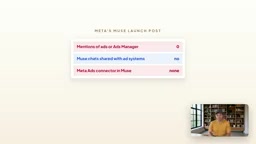
Here's the key point: Meta's launch announcement never once mentioned "ads," "advertisers," or "Ads Manager." Meta explicitly states that Muse doesn't share your conversations with its ad systems, and there's no official Meta Ads connector in its connector directory. In short, Muse is a purely consumer-facing product. Meta's real ad work happens elsewhere.
The Three Systems That Actually Touch Your Ads
If Muse doesn't touch ads, then Meta's advertising AI capabilities are spread across three distinct systems, each with a different role.
Meta AI Business Assistant
This assistant opened to all advertisers in April, embedded directly in Ads Manager and Business Suite. It can fix account-level issues — spending caps, payment errors — and offer budget and creative recommendations, though execution remains in your hands. Meta reports that advertisers who acted on these recommendations during beta testing saw a 12% drop in cost per result. One caveat: it still can't automatically build campaigns.
Advantage Plus
This is Meta's automation suite for delivery and creative, currently running at an annualized scale of $75 billion. In July, Meta promised to integrate the Muse image model into Advantage Plus Creative — the official wording was "in the coming weeks." As of early September, however, third-party trackers had yet to see it actually roll out.
Advantage Plus, launched by Meta in 2022, is a fully automated ad suite. Its core logic hands over variables that advertisers traditionally set manually — audience targeting, placement selection, creative combinations — to machine learning models for dynamic decision-making. Compared to manual campaigns, advertisers only need to provide a budget, a target conversion event, and a batch of creative assets; the system automatically tests combinations and concentrates budget on top performers. An annualized run rate of $75 billion means it's now the backbone of Meta's ad ecosystem, not a fringe feature. Integrating the Muse image model into Advantage Plus Creative is intended to let the system generate or variant ad creatives in real time during delivery, further reducing the need for human intervention — though the actual launch timeline remains uncertain.
Meta Ads AI Connector
This is the real game-changer. It's an official MCP server, in open beta since April, that allows external agents like Claude and ChatGPT to create and edit campaigns, ad sets, and ads, and pull reporting data. Since July, business portfolio owners can also set permission rules for these external agents — for example, "do not allow budget modifications."

MCP (Model Context Protocol) is an open protocol proposed by Anthropic in late 2024, designed to standardize how AI models communicate with external tools and data sources. Think of it as the "USB port" of the AI world — any agent that supports MCP (Claude, ChatGPT, etc.) can communicate with various servers through the same standard interface, without needing a custom integration for every platform. The Meta Ads AI Connector is exposed as an MCP server, meaning any MCP-compatible AI client can in principle use it to operate ad accounts. This is also why Muse can theoretically touch ads through a custom connector: as long as you provide an MCP-compliant endpoint, Muse can interact with that server — whether it's powered by Rise or any other third-party tool.
How to Connect Muse to Your Ads Indirectly
Since Muse has no official ad connector, the workaround lies in its support for custom connectors — any MCP endpoint you provide will work. That said, Meta doesn't vet these connectors, so you should only add sources you trust.
Using the third-party tool Rise as an example, the workflow is: connect your Meta Ads account in Rise using your Facebook login, then have Muse add Rise's connector and send you a login link. Even once connected, budget changes still require your manual approval — that safety gate is always there.
What External Agents Can Do Today
A real-world demo illustrates the current capability boundaries of external agents. The prompt: go to the Meta Ad Library, find Gymshark's active ads in the US, identify the three angles they run most, and suggest what a smaller athletic apparel store should test first.
It pulled 40 active ads and identified three angles: training identity (e.g., "show up, one rep at a time"), product and price (e.g., "athletic shorts from $39"), and bestseller social proof. It then outlined a test plan — run a vertical image of your actual bestseller being worn, with a price and one selling point, against a gym-scene shot of the same product, using cost per sale as the judge, not likes.
It also flagged something most tools would overlook: the fact that Gymshark keeps a particular ad running is a clue, not proof. That kind of restraint in interpreting data is exactly where ad decision-making tends to get oversimplified.

How to Choose Between These Tools
Once you understand what each system actually does, the decision becomes straightforward. Meta's own AI only sees metadata — it's useful, it's free, but it's fundamentally optimizing the ad inventory Meta itself sells. That's not a criticism; it's just its job.

Muse is a consumer-grade agent that can only touch your ads through connectors you explicitly add. External agents running via the Meta API, on the other hand, truly work for you — and can operate across Meta, Google, and your own owned channels.
The practical recommendation: turn on the Business Assistant (it's free and fixes account issues); keep Advantage Plus for delivery; and if you want an agent that can handle planning, execution, and reporting across all your channels, connect one via API and always keep approval confirmation on. Understanding the real boundaries of each system is worth far more than chasing the hype around "AI that automatically runs your ads."
Related articles

Should U.S. College Fraternities Be Banned? A Researcher's Incisive Observations
Why not just ban U.S. college fraternities? A researcher finds the key resistance comes from decision-makers' own fraternity identities and schools' "willful ignorance."

Microsoft Discovery: Accelerating Scientific Discovery with AI Agents
Microsoft's Discovery platform runs specialized AI agents to help researchers screen and prioritize the most promising compounds and experimental paths, reducing experiments and accelerating scientific discovery.

Cambridge Heavy Industries Secretly Develops Desktop-Scale Nuclear Fusion Device
Cambridge Heavy Industries is secretly developing a desktop-scale laser-driven nuclear fusion device, targeting the equipment supply market for fusion power plants. This article analyzes its miniaturization technology path, commercialization logic, and unique positioning in the fusion startup wave.