The Truth About Security Testing: Verify the Guarantee Itself, Not the Line of Code That Implements It

Three reviewers broke the same security test three ways, revealing why tests must verify properties, not code.
While enforcing a "dark memory must fail on import" guarantee in their AI Agent memory layer, the CogniCore team discovered their security test was silently broken three times — and stayed green each time. The failures covered three distinct classes: tripwires that only check source strings (bypassed by runtime patching), no-op injections that hit backward-compatible shims instead of real logic, and the absence of any guard on the chain's overall integrity. Together they point to one core principle: security tests must verify properties at runtime, not static text — and the injection harness itself must be able to observe its own faults.
A Test Broken Three Times — Exposing the Blind Spot in Security Testing
When you write a security test for an AI Agent's memory layer and confidently watch it go green — what have you actually verified?
The CogniCore team (MIT licensed, SQLite-based, no vector database) learned a hard lesson while enforcing a strict rule for their Agent memory layer. The rule was simple: a memory that imports cleanly but cannot be recalled must cause the import to fail — in other words, "dark memory" must fail in the same way as tampered memory.
To prove this guarantee held, they wrote a test. What followed was dramatic: three different reviewers broke it in succession — and each time, they broke the test, not the code. More critically, each failure belonged to a different failure category. The resulting fixes, when generalized, formed a set of principles the authors believe apply to any security test.
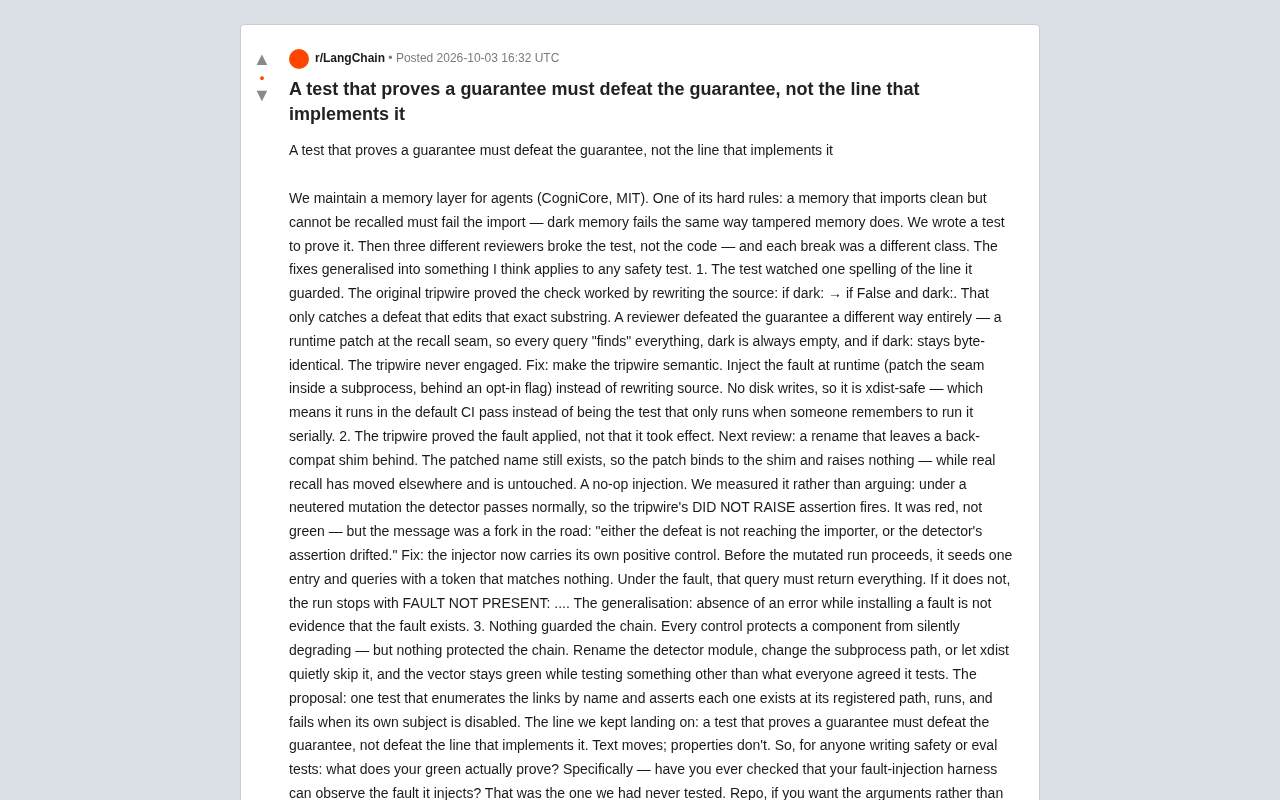
Three Failure Classes: How a Test Fools Everyone Under a Green Light
Class 1: The Test Was Watching the Line That Implements It
The original "tripwire" proved the check worked by mutating the source: rewriting if dark: as if False and dark:. The problem is that this approach can only catch breakage that edits that exact specific substring.
A reviewer defeated the guarantee using a completely different method — a runtime patch at the recall seam, making every query "find" everything. Dark was always empty, and the if dark: bytes were never touched. The tripwire never fired.
The fix was to make the tripwire semantic: inject the fault at runtime (inside a subprocess, patching the seam via an explicitly enabled switch) rather than mutating source. Because no disk writes are involved, it's xdist-safe (xdist-safe) — meaning it can run in the default CI pipeline instead of becoming one of those tests that only runs when someone remembers to pass the serial flag.
A runtime patch means dynamically replacing a function, method, or module attribute during program execution, without modifying any source file on disk. In Python, unittest.mock.patch is the most common approach: it redirects any importable name to a fake object within the test's scope, then automatically restores it afterward. This technique is widely used in testing to isolate external dependencies — but it can equally be used to "bypass" security checks by replacing whatever function the check depends on with one that always returns a "safe" result. This is the heart of Class 1 failures: a tripwire based on source-code strings is completely blind to runtime name-binding replacements, because it checks static text while the program executes dynamically bound logic.
Class 2: It Proved the Fault Was Applied, Not That the Fault Took Effect
The next review introduced a subtler issue: a rename had left behind a backward-compatible shim. The patched old name still existed, so the patch bound to the shim and raised nothing — while the real recall logic had moved elsewhere, completely unaffected. This was a no-op injection.
Rather than argue about it, the team let measurement speak: under a "neutered" mutation, the detector passed normally, triggering the tripwire's DID NOT RAISE assertion. It was red, not green — but that signal was itself a fork in the road: "Either the breakage didn't reach the importer, or the detector's assertion had drifted."
The fix was to give the injector a positive control. Before the mutation run starts, plant a record and query for it with a token that matches nothing. Under the fault condition, this query must return everything; if it doesn't, the run aborts with FAULT NOT PRESENT.
The principle that emerges: no error while installing the fault does not prove the fault is present.
A backward-compatible shim is a common transition pattern during refactoring: when a function or module is renamed or moved, the old name is kept and forwards calls to the new location, to avoid breaking existing callers. This is extremely common in large codebases but creates a hazard for test infrastructure — if the test patches the old name (the shim) while the actual logic has moved to the new location, the patch only modifies an empty forwarding wrapper, leaving the real execution path completely untouched. Positive control is a concept borrowed from experimental science: running a "known-positive" case alongside every experiment to verify that the detection mechanism itself is working. Applied to fault-injection testing, this means that before asserting "the fault was applied," you must first confirm with a predictable case that "the detection mechanism can actually sense the fault" — this is the critical barrier against no-op injections producing false greens.
Class 3: Nothing Guards the Chain Itself
The first two fixes addressed individual components, but the team found a more hidden vulnerability: every control mechanism protected some component from being quietly degraded, but nothing protected the entire chain.
Renaming the detector module, changing the subprocess path, or having xdist quietly skip it — any of these would keep the test vector green while what it actually tested had diverged from what everyone agreed it was supposed to test.
Their proposal: add a dedicated test that enumerates every link in the chain by name, asserting that each one exists at its registered path, actually runs, and fails when its own subject is disabled.
This echoes the phrase the entire discussion kept returning to:
A test that proves a guarantee must defeat the guarantee itself, not the line of code that implements it. Text moves; properties don't.
This class of problem is sometimes called the composition fallacy of test coverage: writing tests for each component individually and having them all pass does not guarantee those components work together as intended. For security guarantees, the problem is more severe — the attack surface may exist precisely at the seams between components, not inside them. The "chain integrity test" idea overlaps with integration testing and contract testing, but with a different emphasis: it doesn't just verify that all the links can produce correct output together — it verifies that each link is actually participating in execution under its registered identity and at its registered path. This is the last line of defense against a link being quietly swapped out or skipped without the test framework noticing.
Implications for Security and Eval Testing
This case has direct relevance for any developer writing security tests or eval tests. The core challenge is a single question: what does your green light actually prove?
More specifically: have you checked whether your fault-injection harness can observe the fault it injects? The authors admit this was precisely the one thing they had never tested.
From an engineering practice perspective, the three failure classes each correspond to a common fragile assumption:
- Assumption 1: Watching a specific line of implementation is the same as guarding the behavior. In reality, the same behavior can be implemented and bypassed in countless ways.
- Assumption 2: "No error" means "the fault took effect." A no-op injection lets you pass tests inside a false sense of security.
- Assumption 3: Testing every component is the same as testing the entire chain. Chain integrity needs to be guarded separately.
The value of this framework is shifting the focus of testing from the text level to the property level — not asserting what a piece of code looks like, but asserting whether a certain property holds. For AI Agent memory layers, safety guardrails, and evaluation systems more broadly, this shift in perspective from implementation to property may be the key to avoiding false greens.
The full argument and code are in the project repository (github.com/cognicore-dev/cognicore-env, MIT licensed, SQLite-based, no vector database).
Related articles

Should U.S. College Fraternities Be Banned? A Researcher's Incisive Observations
Why not just ban U.S. college fraternities? A researcher finds the key resistance comes from decision-makers' own fraternity identities and schools' "willful ignorance."

Microsoft Discovery: Accelerating Scientific Discovery with AI Agents
Microsoft's Discovery platform runs specialized AI agents to help researchers screen and prioritize the most promising compounds and experimental paths, reducing experiments and accelerating scientific discovery.

Cambridge Heavy Industries Secretly Develops Desktop-Scale Nuclear Fusion Device
Cambridge Heavy Industries is secretly developing a desktop-scale laser-driven nuclear fusion device, targeting the equipment supply market for fusion power plants. This article analyzes its miniaturization technology path, commercialization logic, and unique positioning in the fusion startup wave.