The Truth Behind 99% Accuracy: A Shortcut Learning Audit of Fake News Datasets

99% accuracy on the ISOT fake news corpus reflects source separability, not genuine truthfulness detection.
A systematic audit of the ISOT/Kaggle fake news corpus reveals that classifiers reporting F1 scores near 0.99 are exploiting structural dataset flaws, not learning to detect truthfulness. Three leakage channels were identified: subject metadata alone yields F1 = 1.000; 99.2% of real articles contain a newswire source tag; and 19.4% of test documents are duplicates. After removing all leakage, models still learned diffuse editorial style rather than truthfulness signals. Under topic-disjoint distribution shift, discriminative power fell 5.2 points for a linear model and 12.9 points for DistilBERT. Transfer to the independent LIAR benchmark reduced all models to near-random performance (ROC-AUC 0.54–0.57), confirming they never learned to identify fake news at all.
When High Accuracy Becomes Misleading
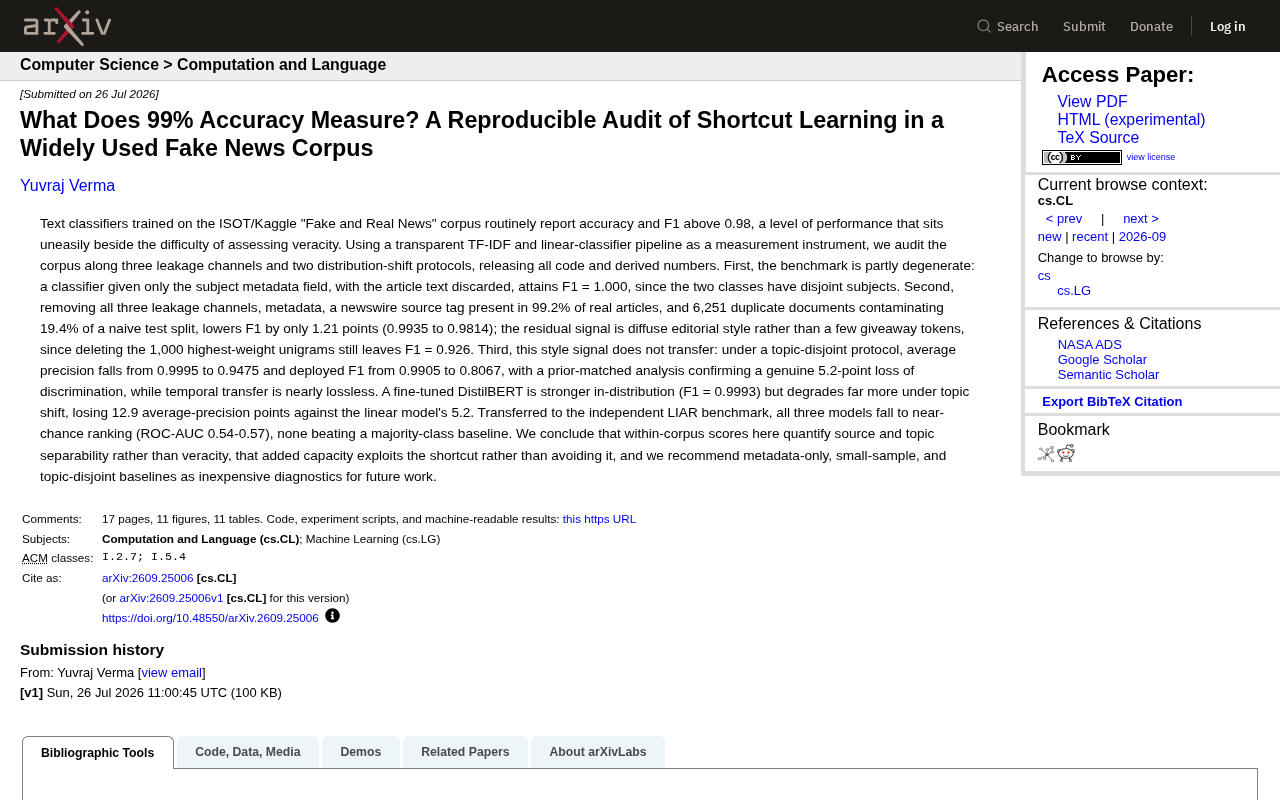
In fake news detection research, text classifiers trained on the ISOT/Kaggle "Fake and Real News" corpus routinely report accuracy and F1 scores above 0.98. These results look impressive — yet they sit in awkward tension with the inherent difficulty of judging whether a news article is truthful. A recent arXiv paper poses a sharp question: what exactly are these near-perfect scores measuring?
The researchers used a transparent TF-IDF plus linear classifier pipeline as a "measuring instrument," systematically auditing the corpus along three data leakage channels and two distribution-shift protocols, with all code and derived data made public. Their conclusion cuts to the heart of the matter — the so-called 99% accuracy is measuring source and topic separability, not the truthfulness of the news itself.
Three Leakage Channels: How Models "Cheat"
Metadata Fields That Directly Leak the Answer
The first issue uncovered by the audit is striking: if you feed the classifier only the subject metadata field — discarding the article body entirely — the model achieves a perfect F1 = 1.000. The reason is that the subject categories for real and fake articles are completely disjoint. In other words, the model doesn't need to "read" the news at all; it can classify perfectly just from the label. This is a partially degenerate benchmark.
Partially degenerate benchmark refers to a dataset where features unrelated to the actual task allow models to score highly by learning these shortcut features rather than the true target features. The very construction of the ISOT/Kaggle corpus embedded this flaw: real news is drawn heavily from mainstream wire services like Reuters, while fake news clusters around fringe sources covering specific political topics — making "source" and "true/false" labels almost perfectly collinear. This problem is not unique to NLP benchmarks. The well-known natural language inference dataset SNLI was similarly found to contain shortcuts where hypothesis sentences alone could predict labels, and image classification datasets have shown cases where background texture was more predictive than foreground objects. The danger of benchmark degeneration is that it creates a false impression that "the task has been solved," leading subsequent research to pile on model complexity starting from a flawed baseline.
Wire Service Source Tags and Duplicate Documents
The second channel involves cues hidden in the text itself. The researchers removed three sources of leakage: metadata fields, a newswire source tag that appeared in 99.2% of real news articles, and 6,251 duplicate documents that contaminated 19.4% of the naive test split.
Interestingly, after removing all these leakage sources, F1 dropped by only 1.21 percentage points (from 0.9935 to 0.9814). This shows the residual signal doesn't come from a handful of "giveaway" tokens — it is diffused throughout the overall editorial style. Even after removing the top 1,000 highest-weighted words, F1 remained at 0.926. The model learned a stylistic fingerprint, not any capacity to judge truthfulness.
Style Signals Don't Transfer: The Nature of Shortcut Learning
The distribution-shift tests are what truly expose the problem. Under a topic-disjoint protocol, mean average precision dropped sharply from 0.9995 to 0.9475, and deployment F1 fell from 0.9905 to 0.8067. Prior-matching analysis confirmed this represents a genuine 5.2 percentage-point loss in discriminative power.
By contrast, temporal transfer showed almost no degradation — further confirming that the model relies on topic and source separability rather than truthfulness features that generalize across topics.
Larger Models Just Exploit Shortcuts More Effectively
The study also compared a fine-tuned DistilBERT. While it was stronger under in-distribution testing (F1 = 0.9993), it degraded far more severely under topic shift — losing 12.9 mean average precision points, compared to just 5.2 for the linear model. This carries an important warning: increasing model capacity did not help the model avoid shortcuts; it only allowed the model to exploit them more thoroughly.
Shortcut learning is a systemic problem in deep learning, formally named by Geirhos et al. in their 2020 survey. The core mechanism: neural networks' inductive biases tend to prioritize the simplest, most stable predictive features in the training set rather than the features that are "correct" in a human cognitive sense. The larger the model capacity, the better it fits these shortcut features, yielding better in-distribution test performance while potentially hurting generalization. This is distinct from the classic bias-variance tradeoff — the problem isn't overfitting to noise, but overfitting to real-but-non-generalizable spurious correlations. DistilBERT's more severe degradation under topic shift is a direct demonstration of this mechanism: stronger contextual modeling allowed it to more precisely memorize the linguistic style of each source, making it more brittle when topics shift.
Switch the Benchmark, and Everything Collapses
The most convincing evidence comes from cross-dataset testing. When all three models were transferred to the independent LIAR benchmark, they all fell to near-random performance (ROC-AUC of only 0.54–0.57), and none could beat the majority-class baseline.
This means the "high-performing" models trained on the original corpus have no real ability to detect truthfulness the moment they leave the familiar source and topic environment. They never actually learned to identify fake news.
The LIAR benchmark, released by Wang in 2017, contains approximately 12,800 political statements from PolitiFact, each labeled with a six-way truthfulness rating (from "true" to "pants-on-fire") along with speaker background information. Unlike the ISOT corpus, the core challenge of LIAR requires understanding the content of the statements themselves — the same speaker may make both true and false claims, and topics span an enormous range. State-of-the-art supervised models on this benchmark still hover around 28–32% accuracy (six-class), far below the performance ceiling seen on ISOT-style tasks, more faithfully reflecting the inherent difficulty of automated fact-checking. The collapse to near-random performance when transferring ISOT-trained models to LIAR demonstrates that the two datasets are fundamentally capturing different signals: one is source separability, the other is content truthfulness.
Implications for Future Research
The value of this audit lies not only in debunking the inflated scores of a popular benchmark, but in providing a cheap and effective set of diagnostic tools. The researchers recommend that future work incorporate three baselines as diagnostic instruments:
- Metadata-only baseline: checks whether the model relies on label leakage
- Few-shot baseline: checks the true difficulty of the task
- Topic-disjoint baseline: checks whether stylistic signals transfer across topics
For the broader AI research community, this work is a wake-up call: before celebrating benchmark scores, we must first ask what those scores are actually measuring. Reproducible audits, open code, and public data are the foundations that make machine learning research stand up to scrutiny. Shortcut learning is pervasive — fake news detection is just one telling example.
Related articles

Should U.S. College Fraternities Be Banned? A Researcher's Incisive Observations
Why not just ban U.S. college fraternities? A researcher finds the key resistance comes from decision-makers' own fraternity identities and schools' "willful ignorance."

Microsoft Discovery: Accelerating Scientific Discovery with AI Agents
Microsoft's Discovery platform runs specialized AI agents to help researchers screen and prioritize the most promising compounds and experimental paths, reducing experiments and accelerating scientific discovery.

Cambridge Heavy Industries Secretly Develops Desktop-Scale Nuclear Fusion Device
Cambridge Heavy Industries is secretly developing a desktop-scale laser-driven nuclear fusion device, targeting the equipment supply market for fusion power plants. This article analyzes its miniaturization technology path, commercialization logic, and unique positioning in the fusion startup wave.