The Truth Behind Cheap Cursor Pro Services: Risks and Alternatives

Exposing the risks behind discounted Cursor Pro services and offering safer alternatives for developers.
This article dissects how cheap Cursor Pro services actually work—through bulk account pools, API relays, and multi-user sharing—revealing critical risks including account bans, source code exposure through man-in-the-middle architectures, and service exit scams. It recommends official subscriptions, free tiers, and open-source alternatives like Continue and Cline as safer options.
Introduction: A "Productivity Service" That Demands Caution
Recently, various video platforms have been flooded with promotional content claiming "Cursor official 75% off," "65% off legitimate Pro subscriptions," and "full power, no intelligence downgrade." These typically use selling points like "saving you money" and "crushing official pricing" while claiming to deliver the full Cursor Pro experience at roughly one-tenth of the official price.
As a technical analysis aimed at developers and AI tool users, this article does not endorse any such service. On the contrary, we'll dissect the actual operational logic behind these "cheap Cursor services" from three perspectives—technical principles, account compliance, and data security—to help readers make informed decisions.
How Is the So-Called "75% Off Legitimate Version" Actually Achieved?
The Contradiction Between Official Pricing and "Rock-Bottom Prices"
Cursor's official Pro subscription costs $20 per month, with the Business version being even higher. Yet these promotions claim that a ¥100 top-up equals approximately ¥1000 or ~$137 worth of official usage. Anyone who understands business logic would immediately question: if this is truly "official and legitimate," how can the service provider supply it long-term at one-tenth of official cost while still turning a profit?
The answer is often hidden in the details. The promotional language repeatedly emphasizes "bulk purchasing of official accounts," "massive official account resource pools," and "intelligent account rotation"—these descriptions themselves reveal the operating model: bulk account registration + multi-user sharing + automatic account switching. This is fundamentally no different from the "cheap shared accounts" they criticize—it's just more polished packaging.
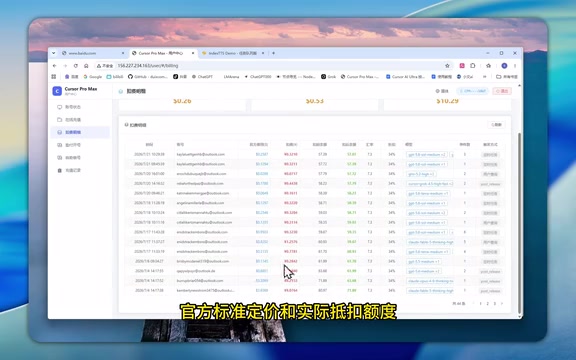
The Relay Logic Behind "Pay-Per-Use" Billing
The promotions emphasize "pay-per-use billing with visible token consumption details," which actually proves the service provider has the ability to meter and intercept every single model call. A normal official Pro subscription is subscription-based—users don't see per-request token charges. The ability to achieve "per-request metering" is typically implemented through API relay or client-side proxy—meaning user requests first pass through a third-party server before being forwarded to the model.
From a technical perspective, API relay (API Proxy/Relay) means inserting an intermediary server between the user and the target service—all requests first reach the intermediary server, which then forwards them to the actual model service endpoint. Client-side proxy works by modifying local network configuration or injecting custom certificates so that the client's HTTPS traffic passes through a designated node. Both approaches mean the intermediary can decrypt, log, and modify transmitted content. In a normal Cursor official subscription, the client communicates directly with Cursor's backend, with the data path protected by TLS encryption between two trusted parties. The relay model breaks this trust chain, creating a classic Man-in-the-Middle architecture.
This means: every line of code you input, every piece of business logic, every document theoretically passes through a third-party server outside official control.
The Underlying Economics of Token Billing
To understand the profit logic of these services, you need to understand the concept of tokens. Tokens are the basic units by which large language models process text—in English, each word corresponds to roughly 1-1.5 tokens, while in Chinese, each character is approximately 1.5-2 tokens. Model providers like OpenAI and Anthropic charge API usage by input and output token count, with prices varying dramatically between models—for example, GPT-4o charges $2.5 per million input tokens, while Claude 3.5 Sonnet charges $3. Cursor Pro's official subscription uses a monthly flat rate rather than per-token billing, which is precisely why when a third-party service claims to provide "per-request token billing details," it actually reveals that they're not using the official subscription channel directly, but rather calling models via API on a per-use basis and reselling at markup.
Three Core Risks: Hidden Dangers Users Must Recognize
Risk One: Account Bans and Terms of Service Violations
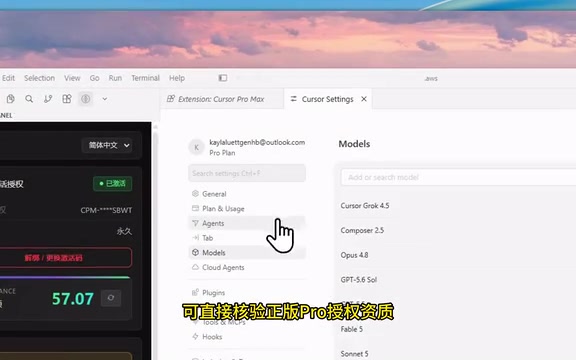
Regardless of whether it's packaged as "dedicated legitimate accounts" or "shared accounts," using Cursor through bulk registration, multi-user sharing, or remote login clearly violates its Terms of Service. Cursor and its underlying model providers (such as Anthropic and OpenAI) all have sophisticated anomaly detection mechanisms.
These detection mechanisms are far more sophisticated than ordinary users might imagine. Modern SaaS platforms universally deploy multi-layer risk control systems to detect account abuse. Common detection dimensions include: Device Fingerprint identification of whether a single account logs in from multiple devices, IP geolocation jump detection, usage pattern analysis (such as whether request frequency and time distribution match single-user characteristics), and behavioral consistency scoring. As a programming tool, Cursor can also analyze project context consistency to determine whether multiple users share an account—for example, the same account switching between completely different programming languages and project structures within a short time, which almost never happens in normal use. Once flagged, platforms typically apply rate limiting, degradation, or outright banning.
Ironically, the promotional content itself acknowledges that "cheap shared accounts have extremely high ban risks, potentially leading to account suspension or even device lockout," yet claims their service "perfectly circumvents" this. But technically, as long as it's a shared pool model, platform risk controls cannot truly be evaded—the only difference is whether the ban comes sooner or later.
Risk Two: Code Data Leakage and Security Threats
For developers, this is the most critical risk. When your code passes through a third-party relay service, the service provider is technically fully capable of recording, retaining, and even analyzing your:
- Project source code and business logic
- API keys, database connection strings, and other sensitive information
- Internal documents and business data
For enterprise developers, this could directly constitute trade secret leakage and compliance violations. Any claim of "no modification to underlying systems, absolutely secure" cannot change the objective fact that data passes through a third-party channel.
It's worth noting that even if the service provider claims "we don't log data," under a relay architecture, data is already decrypted and re-encrypted during transit—this process itself creates a window for data interception. For enterprises subject to compliance frameworks like GDPR or China's Multi-Level Protection Scheme 2.0, the mere fact that data passes through an unauthorized third-party node already constitutes a compliance violation, regardless of whether that third party actually reads the data content.
Risk Three: Service Unsustainability and "Exit Scam" Risk
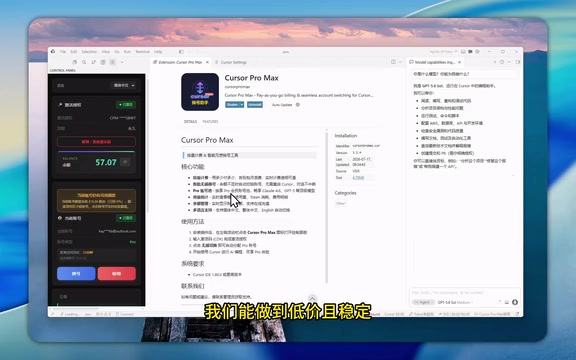
These gray-market services are highly dependent on a continuous supply of bulk accounts. Once the official platform strengthens risk controls and bans large numbers of accounts, or the service provider chooses to "take the money and run," users' prepaid balances instantly go to zero. The promotional emphasis on "credits permanently valid, never expire" is essentially a verbal promise with zero legal protection—the service provider could disappear at any time.
Looking at historical precedents, similar gray-market services in other domains (such as Netflix shared accounts, ChatGPT proxy top-ups) have repeatedly played out the same script: initial low-price customer acquisition, mid-stage price increases or quality degradation, and eventual collapse due to platform risk control upgrades or operator exit scams. Users' prepaid funds lack any third-party escrow or legal recourse.
Is "Full Power, No Intelligence Downgrade" Actually True?
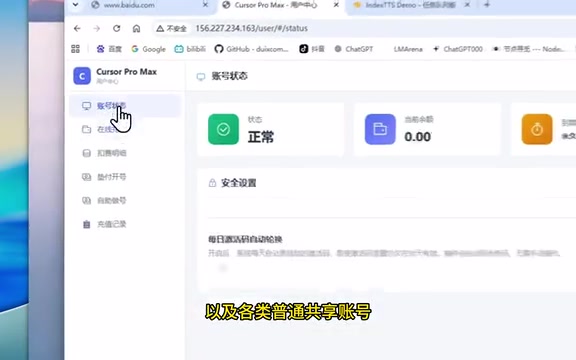
The promotions vigorously claim "full power, no intelligence downgrade" and "no parameter compression," while implying that other services on the market "secretly compress parameters and reduce output quality." There's a logical flaw here: if everything is achieved through relay/sharing, then whether there's any "downgrade" depends entirely on the service provider's conscience—users have virtually no way to independently verify this technically.
Under a relay architecture, the service provider has full capability to route user requests to different models on the backend. For example, users might think they're using Claude 3.5 Sonnet ($15 per million output tokens), but their requests could actually be forwarded to the much cheaper Claude 3 Haiku ($1.25 per million output tokens)—a 12x cost difference. Since large language model outputs are inherently stochastic, ordinary users can hardly determine the backend model version from a single conversation. More covert practices include: shortening system prompts to reduce token consumption, limiting maximum output length, and reducing the context window to cut input token costs. These operations have a gradual impact on user experience that's difficult to notice immediately.
So-called "viewable consumption details" only prove that tokens were consumed—they cannot prove the model wasn't swapped for a cheaper version, nor that the context window or reasoning depth weren't reduced. For ordinary users, "verifying authenticity" is a nearly impossible task.
Practical Recommendations: The Right Way to Use Cursor
If you genuinely need AI programming tools like Cursor, here are more reliable options:
Make Good Use of Official Free Tier
Cursor offers a free Hobby version that includes a certain amount of completions and request quota, sufficient for casual users and learners.
Subscribe to Official Pro as Needed
For professional developers, the $20/month official subscription offers excellent value relative to the productivity gains it provides. Stability, compliance, and data control are far more important than saving a few dollars.
Consider Open-Source Alternatives
If budget is limited, consider connecting your own API Key to open-source editor plugins (such as Continue, Cline, etc.) combined with model APIs through official channels. This controls costs while ensuring data flow remains under your control.
Specifically, Continue is an open-source AI programming assistant plugin supporting VS Code and JetBrains IDEs, where users can configure their own API Keys to connect various model services (OpenAI, Anthropic, local models, etc.) for code completion, chat, and editing features. Cline (formerly Claude Dev) is another open-source project focused on autonomous programming agent capabilities, supporting file operations and terminal command execution. The core advantage of these tools is: completely transparent data flow—requests go directly from the user's machine to the model provider without passing through any third party; users fully control their API Keys and usage quotas; and the open-source code is auditable with no hidden data collection behavior. Combined with pay-per-use official APIs, monthly costs for moderate-intensity users typically range from $5-15.
Enterprise Users Should Follow Proper Procurement
Team usage should be procured through the official Business plan with clear data processing terms, avoiding exposure of the entire team's code assets due to individual members using gray-market services.
Conclusion
Promotional claims like "75% off legitimate version" and "full power, no intelligence downgrade" fundamentally exploit users' resistance to expensive subscriptions, repackaging gray-market services that violate terms of service and carry data risks as "compliant productivity tools." For developers whose core asset is their code, chasing short-term savings may result in the compound losses of account bans, data leakage, and service disappearance.
The value of technical tools lies in stability and trustworthiness. Choosing official channels or legitimate open-source alternatives is the responsible approach toward your projects, data, and career.
Related articles

How Does Claude Call Tools It Has Never Seen? MCP and AI Agent Principles Explained
How does Claude call tools it was never trained on? This article breaks down the AI Agent tool-calling loop, Anthropic's three-layer MCP architecture, context bloat and context rot, and production-grade Agent safety design principles including timeout retries, prompt injection, and idempotency keys.

OpenAI Cracks Math Problems, Why Are Mathematicians Losing Sleep?
OpenAI claims to solve math problems — why are mathematicians anxious? Vergecast reveals the Eye of Sauron dilemma and the tension between AI answers and human understanding.

CSS Conditional Border-Radius Trick: Auto-Square Corners When Elements Touch the Edge
Pure CSS conditional border-radius: auto-square corners when elements touch the edge, rounded while floating. Use calc(100vw-100%) with clamp() to kill the transition band, and container query units cqi for non-fullscreen containers, plus a scrollbar offset workaround.