The "Typicality Bias" of AI Vision Models: When Objects Lose Their Familiar Neighbors

Research reveals pervasive typicality bias in vision models and proposes AAS sampling to mitigate it.
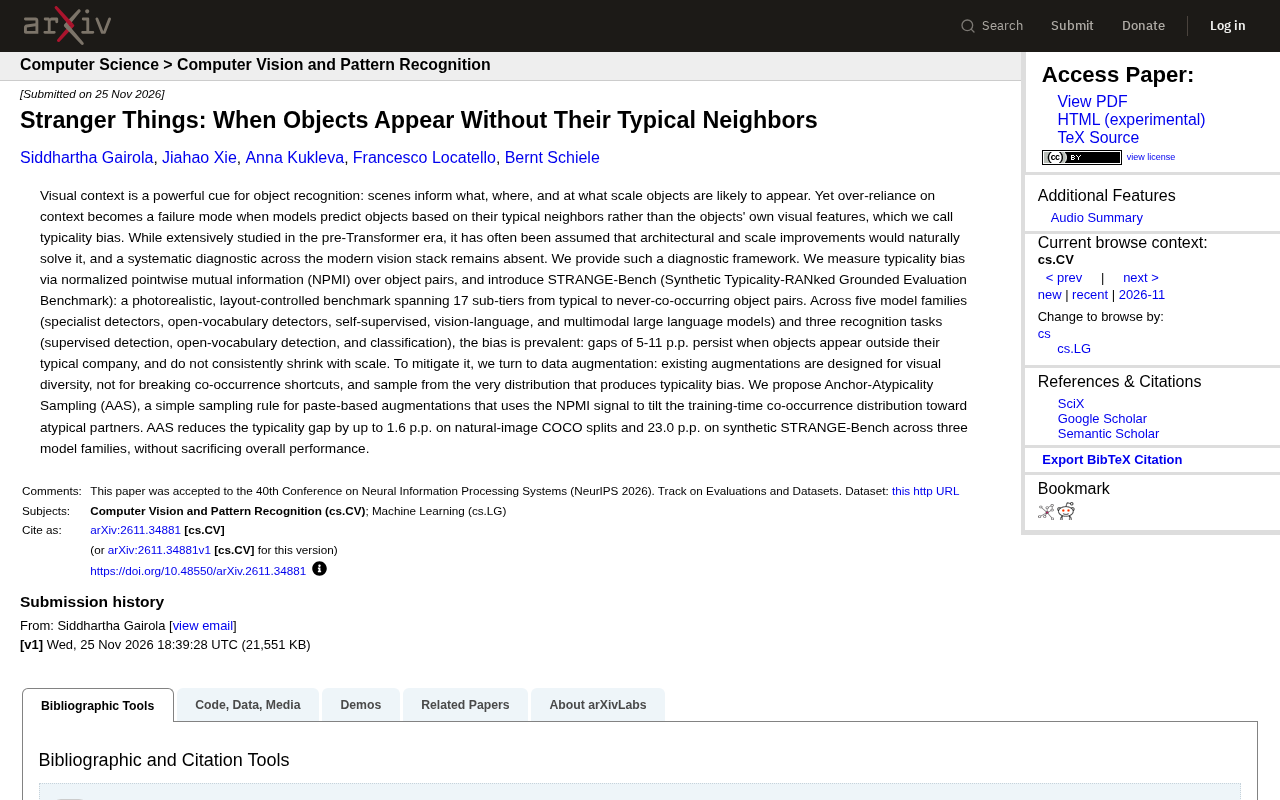
This paper systematically diagnoses typicality bias in modern vision models: when objects appear in atypical contexts, performance drops 5-11 percentage points, and the gap does not consistently shrink with model scale. Researchers use NPMI to quantify object co-occurrence typicality, build the STRANGE-Bench benchmark covering 17 sub-levels, and evaluate five model families across three recognition tasks. Finding that existing data augmentation fails because it samples from the same distribution, they propose Anchor-Atypicality Sampling (AAS), which uses NPMI signals to skew the training co-occurrence distribution toward atypical partners. Experiments show AAS narrows the gap by up to 1.6 points on COCO segmentation and up to 23.0 points on the synthetic benchmark, without sacrificing overall performance.
The Hidden Cost of Visual Context Dependence
When humans recognize objects, scene context is a powerful cue—an oven in a kitchen makes perfect sense, but an oven in a bedroom is confusing. This ability to rely on context is a hallmark of intelligence, but over-reliance becomes a flaw: when a model judges not by the object's own visual features but by "who it usually appears with," typicality bias emerges. A research paper from an rss source systematically diagnoses this problem and proposes mitigation strategies.
The paper notes that although typicality bias was widely studied before the Transformer era, the field generally assumed that improvements in architecture and scale would naturally resolve it. However, a systematic diagnosis targeting modern vision stacks has been missing. The researchers fill this gap.
How to Quantify "Bias": NPMI and STRANGE-Bench
The study uses Normalized Pointwise Mutual Information (NPMI) to measure typicality between object pairs—that is, how much more or less frequently two objects co-occur relative to random expectation. The higher the NPMI, the better the pair "matches" in the training data.
Building on this, the team constructed STRANGE-Bench (Synthetic Typicality-RANked Grounded Evaluation Benchmark): a photorealistic, layout-controllable benchmark covering object pairs ranging from typical to never-co-occurring, across 17 sub-levels. This provides a standardized tool for measuring context dependence under controlled conditions.
Normalized Pointwise Mutual Information (NPMI) is a standardized version of Pointwise Mutual Information (PMI). PMI measures the ratio of the probability of two events co-occurring to the product of their independent probabilities, given by PMI(x,y)=log[P(x,y)/(P(x)P(y))]. When two objects always co-occur, PMI is positive; when they are mutually exclusive, PMI is negative. However, PMI has no fixed range, making it difficult to compare across different object pairs. NPMI normalizes it to the [-1,1] interval by dividing by the negative joint entropy: NPMI=PMI(x,y)/-log P(x,y). Thus, NPMI=1 indicates complete co-occurrence, NPMI=0 indicates independence, and NPMI=-1 indicates never co-occurring. In this paper, the researchers use NPMI to compute typicality scores for object pairs from the training data, serving as the quantitative foundation for subsequent sampling and benchmark construction.
Bias Is Pervasive and Does Not Disappear with Scale
The diagnosis covers five model families—specialized detectors, open-vocabulary detectors, self-supervised models, vision-language models, and multimodal large language models—along with three recognition tasks: supervised detection, open-vocabulary detection, and classification.
The result: bias is pervasive. When objects appear next to atypical partners, the performance gap reaches 5–11 percentage points. More critically, this gap does not consistently shrink as model scale increases. This directly challenges the assumption that "bigger models are naturally more robust," indicating that typicality bias is a structural problem arising from both architecture and training data distribution.
Why Existing Data Augmentation Fails
The researchers' mitigation approach turns to data augmentation, but reveals a fundamental flaw in existing methods: mainstream augmentation methods are designed for visual diversity, not for breaking co-occurrence shortcuts. They still sample from the same distribution that produces typicality bias, and therefore cannot effectively correct the problem.
To this end, the paper proposes Anchor-Atypicality Sampling (AAS): a simple sampling rule for paste-based augmentation that uses NPMI signals to skew the training co-occurrence distribution toward atypical partners. In other words, during training, objects are deliberately paired with "mismatched" neighbors, forcing the model to rely more on the object's own visual features.
Paste-based augmentation is a classic class of data augmentation techniques whose core operation is to crop an object instance from one image and paste it onto another image at a random or specific location, thereby synthesizing new training samples. Common methods include CutMix, Copy-Paste, and others. These methods are typically used to increase the visual diversity of object appearances (e.g., scale, position, background), but the sampling process often ignores semantic co-occurrence relationships between objects. The key point this paper identifies is: if pasted object pairs are still selected according to the typical co-occurrence distribution in the training data (e.g., always putting a keyboard and mouse together), then the augmented data will still reinforce co-occurrence shortcuts and fail to break the model's over-reliance on context. The innovation of AAS is precisely to use NPMI signals to actively select atypical pairings, making paste-based augmentation serve the goal of debiasing.
Results and Implications
AAS reduces the typicality gap by up to 1.6 percentage points on natural-image COCO segmentation and by up to 23.0 percentage points on the synthetic STRANGE-Bench, across three model families, without sacrificing overall performance.
The value of this work lies not in any specific number, but in turning "context dependence" from a vague intuition into a measurable, intervenable engineering problem. For vision systems deployed in the open world, objects rarely always appear in textbook fashion—recognition capability needs to be built on the object itself, not on its neighbors.
Open-vocabulary detection refers to a model's ability to detect object categories not seen during training, typically achieved through text embeddings from vision-language models (such as CLIP). Unlike traditional closed-set detectors that can only recognize predefined categories, open-vocabulary detectors encode category names as text embeddings and match them against image region features, thereby generalizing to new categories. This capability makes models more reliant on language priors and co-occurrence statistics, and may therefore amplify typicality bias. The diagnosis in this paper covers the open-vocabulary detection task and finds that even models with open-vocabulary capabilities still suffer significant performance degradation in atypical contexts, indicating that scale and generalization ability do not automatically eliminate co-occurrence shortcuts.
Related articles

Nothing CMF Buds 2A Drops to $17.89 on Black Friday: A New Low for ANC Earbuds
Nothing CMF Buds 2A wireless earbuds Black Friday deal: just $17.89 on Amazon, about $11 off retail and a record low. ANC earbuds at an entry-level price.

When AI Creation Gets Accused of "Spitting": Hacker News Heats Up Over the Glaude Controversy
A Hacker News post, "Spitting in the Face of Glaude," sparks debate on AI creation transparency and attribution ethics. This analysis examines the blurred creator identity behind the controversy and offers practical advice for AI content production.

Akai Embraces Custom Firmware: MPC Sample 1.4 Lets Users AI-Program Their Sampler
Akai embraces the modding community with MPC Sample 1.4 firmware, supporting vibe-coded custom firmware and effects. We analyze the impact of this open strategy on music hardware and AI-assisted programming.