The Ultimate RAG Interview Guide: 204 Questions, 12 Architectures, and 6 Failure Modes Explained

An open-source RAG interview guide with 204 questions, 12 architectures, and 6 failure modes to help you prep for RAG engineer roles.
The open-source "Interview System" project provides 204 RAG interview questions, 12 system architecture approaches, and in-depth analysis of 6 failure modes. Covering vector retrieval, embedding models, Agentic RAG, GraphRAG, and evaluation with RAGAS, it offers a structured knowledge map for engineers preparing for Retrieval-Augmented Generation roles.
An Open-Source Interview Resource for RAG Engineers
As Retrieval-Augmented Generation (RAG) becomes a core technical pathway for deploying large language models in the enterprise, engineers who master RAG system design are increasingly in demand. Recently, an open-source project called "Interview System" drew attention on Reddit. The project offers, free on GitHub, 204 RAG interview questions and answers, 12 system architecture approaches, and in-depth analyses of 6 typical failure modes—providing a systematic review framework for developers preparing for related roles.
RAG Background: Retrieval-Augmented Generation originated from the 2020 paper Retrieval-Augmented Generation for Knowledge-Intensive NLP Tasks published by Facebook AI Research. Its core idea is to combine the parametric knowledge of large language models (LLMs) with external non-parametric knowledge bases, using dynamic retrieval to compensate for inherent LLM shortcomings such as knowledge cutoffs, frequent hallucinations, and the inability to access private data. "Parametric knowledge" refers to the implicit memory that a model encodes into its neural network weights by compressing vast amounts of corpus during pretraining; a "non-parametric knowledge base" is external storage that can be read from and written to at any time, independent of the model's weights—for example, an enterprise's internal document repository, product manuals, or real-time databases. Compared to fine-tuning, RAG can update knowledge without retraining the model, making it cheaper and faster to iterate—a full fine-tuning run often requires thousands of dollars in GPU compute and several days, whereas updating a RAG knowledge base usually only requires re-indexing documents and can be completed within hours. This is the fundamental reason it has become the preferred approach for enterprise-grade LLM deployment.
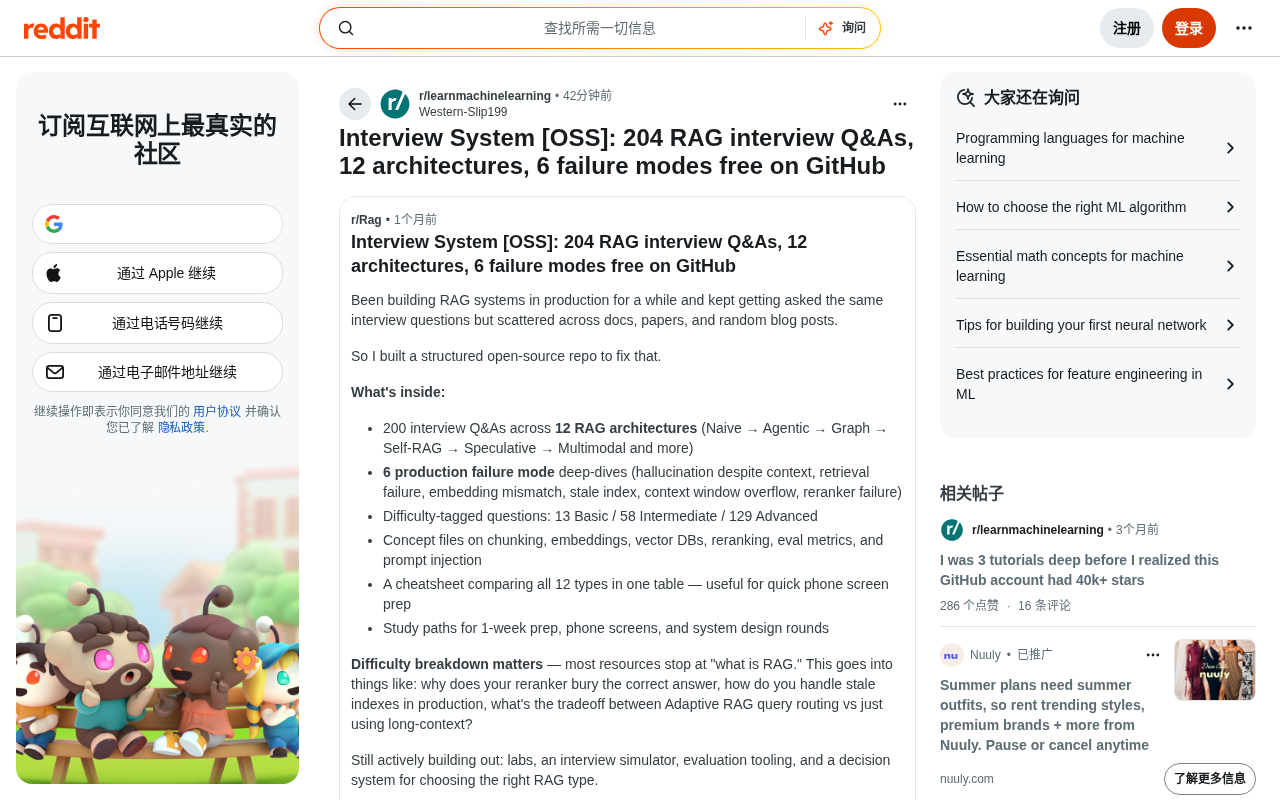
For practitioners transitioning from traditional machine learning or backend development to LLM application engineering, RAG is often the first unavoidable hurdle. It involves information retrieval knowledge such as vector search and embedding models, while also covering generation-side techniques like prompt engineering and context management. The value of this resource lies in the way it organizes knowledge scattered across many sources into structured content that can be tackled question by question.
What Core Knowledge Do the 204 RAG Interview Questions Cover?
Based on the project description, the 204 interview questions cover multiple layers of the RAG technology stack. Given the full landscape of RAG technology, these Q&As typically revolve around the following dimensions.
Retrieval Layer: Vector Databases and Embedding Models
Retrieval is the foundation of RAG. Common interview questions include: how to choose an embedding model, the trade-offs between dense retrieval and sparse retrieval (such as BM25), indexing strategies for vector databases (HNSW, IVF, etc.), and how to improve recall quality through hybrid search. This part directly determines whether the system can find relevant context passages.
In-Depth Analysis of Retrieval Techniques: Dense Retrieval relies on embedding models (such as text-embedding-ada-002, BGE, E5, etc.) to map text into high-dimensional vectors, measuring semantic similarity via cosine similarity or dot product, and can capture synonyms and semantically similar relationships. Such models are typically based on a Bi-encoder architecture, encoding queries and documents into separate vectors—supporting an efficient retrieval pattern where document vectors are precomputed offline and only the query needs encoding online. The representative of sparse retrieval, BM25 (Best Match 25), is an improved statistical model based on term frequency-inverse document frequency (TF-IDF). Its core parameter k₁ controls term frequency saturation and b controls document length normalization; it excels at exact keyword matching and performs well in professional domains such as legal and medical, where precise terminology is critical. HNSW (Hierarchical Navigable Small World) is currently the most mainstream approximate nearest neighbor (ANN) indexing algorithm in vector databases (such as Pinecone, Weaviate, Milvus, and Qdrant). By building a multi-layer graph structure from coarse to fine granularity, it achieves logarithmic retrieval complexity and can maintain millisecond-level response even at the scale of billions of vectors. Hybrid search typically fuses the two result sets using RRF (Reciprocal Rank Fusion)—its formula takes the reciprocal of each document's rank across each path and computes a weighted sum, effectively fusing results without parameter tuning, combining the dual advantages of semantic understanding and keyword matching.
Generation Layer: Context Construction and Prompt Design
After finding relevant documents, how to organize them into a prompt, how to control the context window, and how to handle conflicting information across multiple documents are all frequent exam points. Optimization techniques such as reranking and context compression are also important markers distinguishing junior from senior engineers.
It is worth noting that Reranking plays the role of a "fine filter" in the RAG pipeline. Unlike the bi-encoder used in vector retrieval, reranking models typically adopt a Cross-encoder architecture, concatenating the query with each candidate document and scoring them jointly—yielding higher precision but slower speed. Therefore, reranking is usually applied only to the retrieved Top-K results as a second-pass sort, rather than a full database scan. Context compression, on the other hand, denoises documents before stuffing them into the prompt using summarization models or extractive methods, effectively addressing the "Lost-in-the-Middle" problem—research shows that LLMs utilize information at the beginning and end of the context significantly more than in the middle.
Evaluation Layer: How to Quantify RAG System Performance
Evaluating a RAG system is a major challenge. Retrieval quality (recall, precision) and generation quality (faithfulness, relevance, hallucination rate) must be measured separately. How to use evaluation frameworks like RAGAS, and how to build offline evaluation datasets, are often areas that interviews probe deeply.
How the RAGAS Framework Works: RAGAS (RAG Assessment) is currently the most widely used open-source framework for evaluating RAG systems. Developed by the explodinggradients team, it has garnered over 7,000 stars on GitHub. It breaks RAG system evaluation into four core metrics: Faithfulness (whether the generated answer is supported by the retrieved content, used to measure the degree of hallucination), Answer Relevancy (whether the answer is on-topic, measured by reverse-generating questions and computing their vector similarity to the original question), Context Precision (the proportion of useful content in the retrieval results, measuring the level of retrieval noise), and Context Recall (whether all required information was retrieved, usually assessed against a reference answer). Notably, RAGAS itself relies on an LLM for scoring, so it faces the meta-evaluation problem of "using AI to evaluate AI"—biases in the evaluation model systematically affect the trustworthiness of the evaluation results. In practical engineering, it usually needs to be combined with human annotation to build a Golden Dataset for calibration, while tracking the version of the evaluation model to ensure experiment reproducibility.
The Practical Significance of the 12 RAG Architecture Approaches
The 12 architectures mentioned in the project correspond to different evolutionary forms of RAG, from simple to complex. This is precisely the most valuable part of current RAG engineering practice—"Naive RAG" often underperforms in real business scenarios, and engineers must understand the applicable scenarios for various advanced architectures.
Typical architectural evolution paths include:
- Naive RAG: The most basic "retrieve-concatenate-generate" flow, suitable for quick validation.
- Advanced RAG: Introduces optimization steps such as query rewriting, multi-path recall, and reranking.
- Modular RAG: Decouples modules like retrieval, routing, and memory to support flexible orchestration.
- Agentic RAG: Combines Agent capabilities, letting the model autonomously decide when and what to retrieve.
- GraphRAG: Uses knowledge graphs to enhance structured reasoning, suitable for handling complex relational queries.
In-Depth Analysis of Agentic RAG and GraphRAG: Agentic RAG represents the deep integration of RAG with Agent frameworks (such as LangGraph and AutoGen). Traditional RAG is a linear, single-pass "retrieve-generate" process, whereas Agentic RAG endows the model with autonomous planning capabilities: the model can judge whether the current information is sufficient, decide whether multiple rounds of retrieval are needed, choose which tool or data source to invoke, and even perform self-reflection and iterative correction. The key challenge of this architecture is latency control—each additional retrieval and reasoning loop accumulates response time, so in engineering it is usually necessary to set a maximum number of iterations and a confidence threshold to prevent infinite loops. GraphRAG was proposed and open-sourced by Microsoft Research in 2024. Its core innovation lies in the preprocessing stage: it first uses an LLM to perform entity extraction and relationship identification on the document corpus, building a structured entity-relationship knowledge graph, and further generates hierarchical summaries through community detection algorithms (such as the Leiden algorithm). During retrieval, the system can perform multi-hop reasoning along the graph structure—for example, answering complex queries that require crossing multiple knowledge nodes, such as "Is company A's CEO's former employer connected to competitor B through an investment relationship"—precisely the kind of scenario where traditional vector retrieval falls short due to a lack of structural awareness. The cost is that index construction is significantly more expensive than ordinary RAG, making it suitable for knowledge-intensive scenarios that demand deep reasoning and involve complex data relationships.
Understanding these 12 architectures is essentially about mastering the technology selection logic under different data scales, latency requirements, and accuracy goals. This is far more valuable than merely memorizing concepts, and it is precisely the capability that senior interviewers truly assess.
6 RAG Failure Modes: Distilling Engineering Experience from Failures
The most unique aspect of this resource is that it systematically summarizes 6 failure modes of RAG systems. RAG problems in production environments are often not "unusable" but "intermittently good and bad," making them extremely tricky to troubleshoot.
Common RAG failure modes include:
- Missing Retrieval: The correct answer was never retrieved at all. Possible root causes include: an improper chunking strategy that cuts off key information, a mismatch between the embedding model and the query language/domain, incomplete index coverage, etc.
- Ranking Errors: Relevant documents were retrieved but ranked too low and got truncated. This usually means there is a discrepancy between vector similarity and actual relevance; introducing a reranking layer is the most direct fix.
- Context Not Utilized: The model received the correct information but did not use it. This often stems from the "Lost-in-the-Middle" effect, or an improper prompt structure that causes the model to prioritize parametric memory over retrieved content.
- Formatting Errors: The output does not follow the required format. This is common in structured output scenarios and can be constrained using an Output Parser or Function Calling.
- Information Integration Failure: An answer synthesized across multiple passages fails to merge correctly. This places high demands on the model's multi-document reasoning ability; a Map-Reduce-style step-by-step generation strategy is a common countermeasure.
- Incomplete Answers: Only part of the question is answered. This is usually related to context window truncation or insufficient prompt constraints on completeness.
Being able to systematically identify and categorize these failures is the key leap for a RAG engineer from "being able to build" to "being able to tune." In an interview, offering diagnostic reasoning and solutions for specific failures often earns significant extra credit.
How to Use This Open-Source RAG Interview Resource Effectively
The value of such free, open-source interview resources to the entire developer community should not be underestimated. It lowers the barrier to learning RAG knowledge and helps more developers fill in their skill gaps in a structured way. However, the point of an interview question bank is to help build a knowledge framework, not to rote-memorize standard answers.
Real capability improvement still requires hands-on practice: building an end-to-end RAG system, personally stumbling into pitfalls of poor retrieval quality, trying different reranking strategies, and quantifying improvements with evaluation frameworks. This resource—containing 204 questions, 12 architectures, and 6 failure modes—is better suited as a "knowledge map" alongside practice, helping to fill gaps and organize your understanding systematically.
For engineers preparing for RAG-related roles, the following path is recommended: first read through the architecture section to build a global understanding, then focus on Q&As targeting your weak areas, and finally thoroughly master the troubleshooting logic of the 6 failure modes—this part best reflects engineering depth and is the hardest to improvise during an interview. On top of this, it's worth building your own evaluation pipeline with the RAGAS framework, turning what you've learned into quantifiable experimental results—which in itself is a highly persuasive interview portfolio.
Key Takeaways
Key Takeaways
Related articles
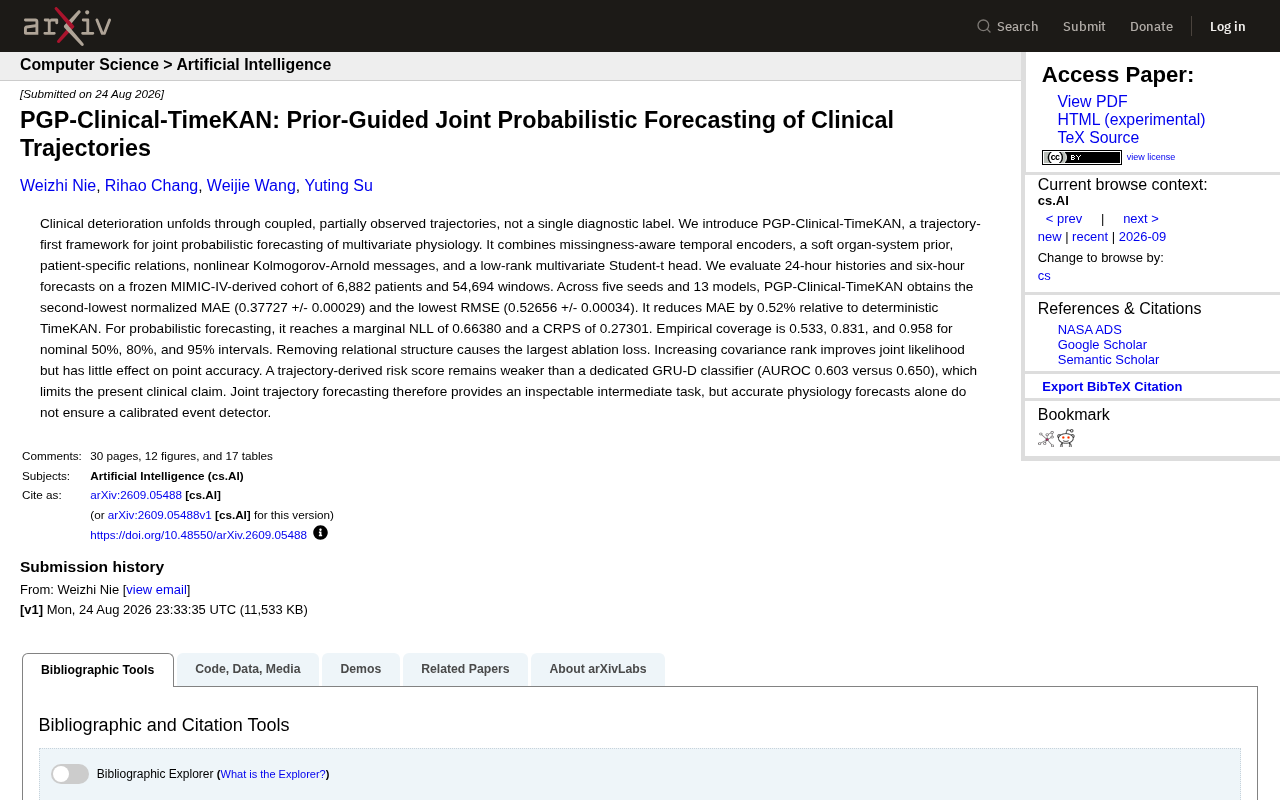
PGP-Clinical-TimeKAN: A Detailed Guide to the Multivariate Physiological Indicator Joint Prediction Framework
An in-depth analysis of the PGP-Clinical-TimeKAN framework for joint probabilistic prediction of multivariate physiological indicators, covering trajectory-first paradigm, KAN message passing, MIMIC-IV validation, and ablation studies.
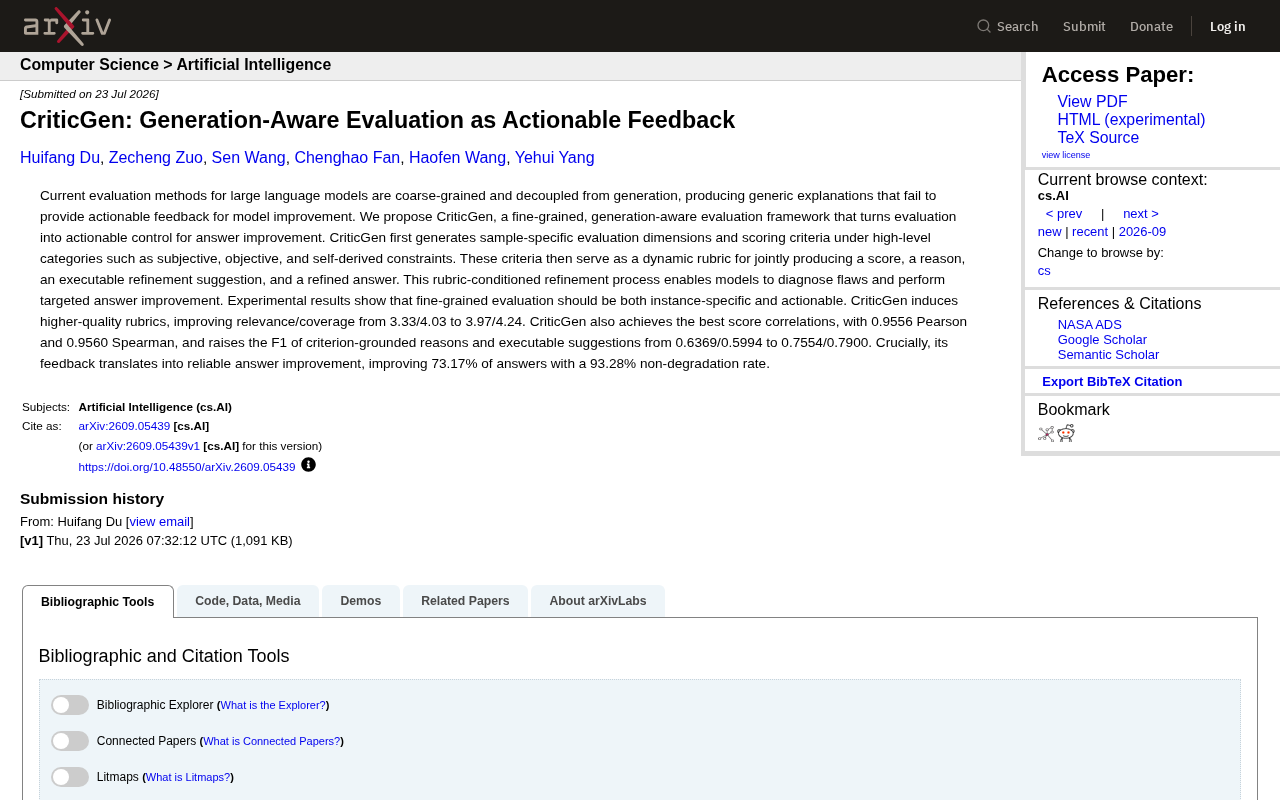
CriticGen: A New Framework That Transforms AI Evaluation into Actionable Improvement Feedback
CriticGen proposes a generation-aware evaluation framework that transforms AI assessment from passive scoring to an active optimization loop, achieving 73.17% answer improvement and 93.28% non-degradation rate.
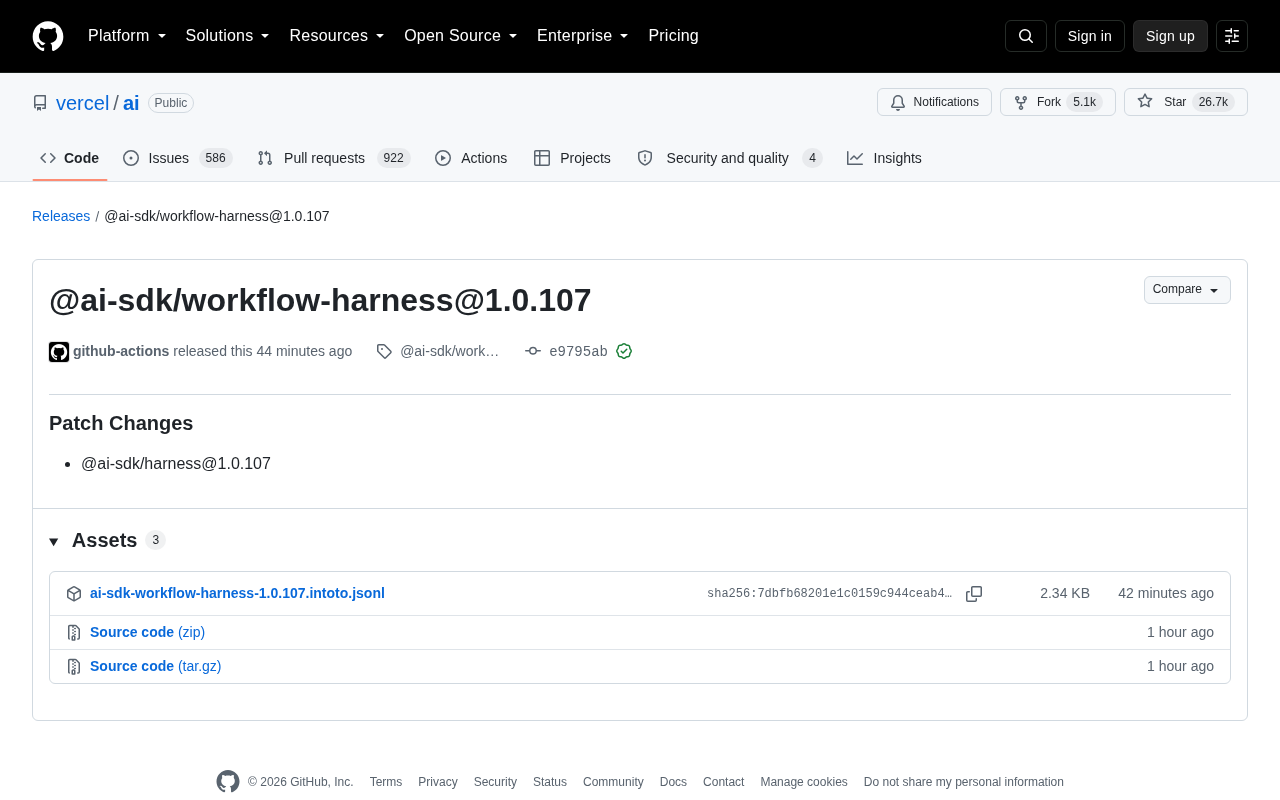
Vercel AI SDK workflow-harness Update Analysis
Deep analysis of Vercel AI SDK workflow-harness 1.0.107 update: architecture design, engineering practices, and developer value for building reliable AI apps.