The Wisdom of Artificial Deliberation: How Diverse Model Discussions Outperform Monolithic Judgment
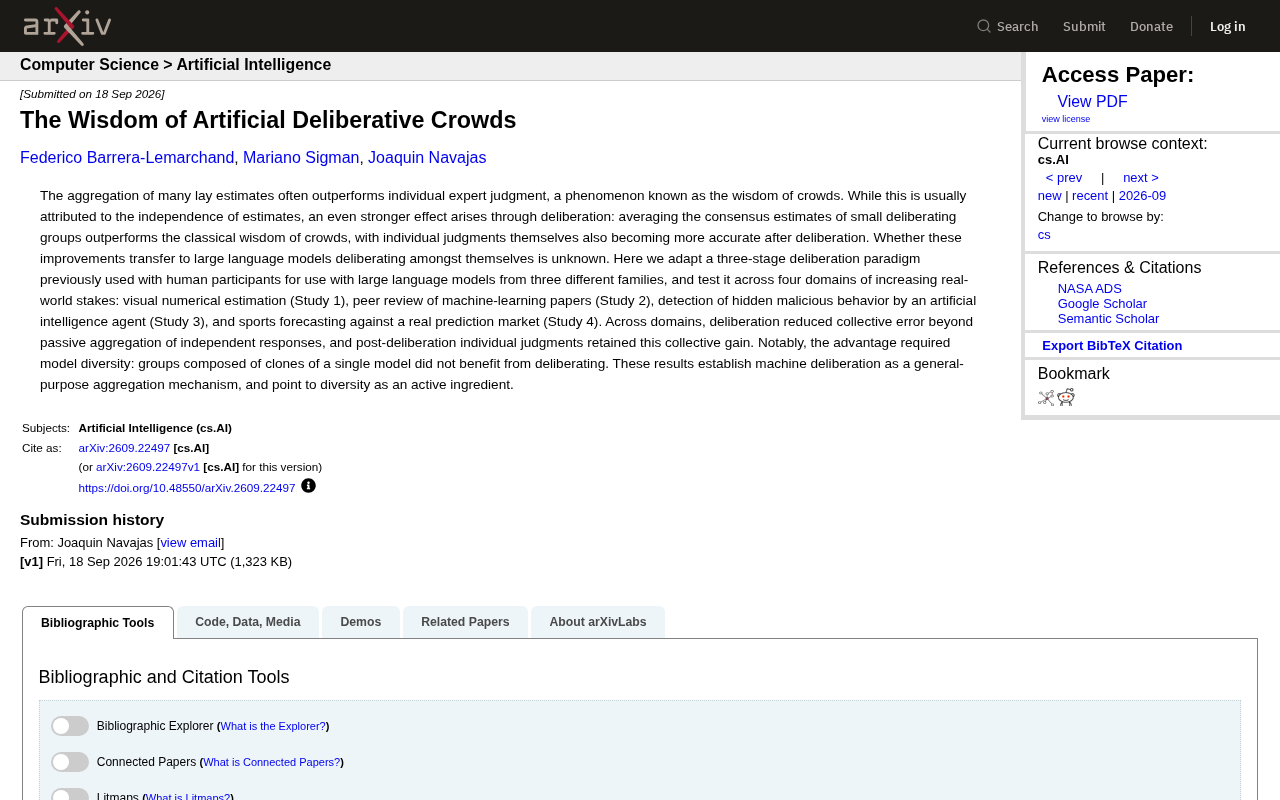
Diverse LLM deliberation beats passive aggregation; clone model discussion offers zero benefit.
This arXiv study transplants the human "deliberative crowd wisdom" paradigm to LLMs, systematically testing deliberation effects across four escalating-stakes scenarios: visual estimation, paper review, AI malicious behavior detection, and sports prediction. The core finding: diverse LLMs that discuss before judging outperform passive averaging of independent answers, and individual judgment quality improves too. Crucially, deliberation gains vanish entirely when all participants are clones of the same model — shared biases create an echo chamber. The implication for multi-agent system design is direct: use heterogeneous models, not homogeneous copies.
From "Wisdom of Crowds" to "Wisdom of Deliberation"
Averaging the estimates of many ordinary people often outperforms the judgment of a single expert — this is the classic "wisdom of crowds" phenomenon. The traditional explanation credits the independence of estimates: each person's errors are randomly distributed, and they cancel out when averaged.
But psychological research has revealed an even stronger effect: when small groups first engage in deliberation before their consensus estimates are averaged, the accuracy exceeds that of classic crowd wisdom. Even more intriguing, individual participants' judgments become more accurate after discussion. This means deliberation isn't just "aggregation" — it genuinely improves cognitive quality.
A new study published on arXiv (arXiv:2609.22497) poses a critical question: when the participants shift from humans to large language models (LLMs), does the accuracy gain from deliberation still hold?
The concept of the Wisdom of Crowds was first systematically described by statistician Francis Galton in 1907, when he found that the median estimate of nearly 800 fair-goers guessing the weight of an ox was within 1% of the actual weight. James Surowiecki popularized the idea in his 2004 book of the same name, outlining four conditions for crowd wisdom to work: diversity of opinion, independence of judgment, decentralization, and an effective aggregation mechanism. Independence is the most critical — once people influence each other and form "information cascades," individual errors no longer cancel out but accumulate in the same direction. The deliberative paradigm is a counterintuitive discovery built on this foundation: moderate discussion doesn't undermine independence and reduce accuracy; rather, by filtering and propagating high-quality information, it can purify judgment and, under certain conditions, surpass classic crowd wisdom.
Adapting the Three-Phase Deliberation Paradigm to LLMs
The researchers adapted a three-phase deliberation paradigm previously used in human experiments and applied it to large language models drawn from three different model families. The three phases typically involve: each model independently providing an initial judgment, then exchanging views within the group through discussion, and finally each model issuing a revised judgment.
This design simultaneously measures two things: the collective accuracy of each group's "consensus estimate," and how individual model judgments change after discussion. The former measures deliberation's effectiveness as an aggregation mechanism; the latter measures whether deliberation genuinely improves individual cognition.
Using models from different families is a crucial premise of this research — and it lays the groundwork for the central finding about "diversity" discussed later.
Four Test Scenarios With Escalating Stakes
To validate the generalizability of the deliberation effect, the study was conducted across four domains with progressively increasing real-world significance:
Visual Numerical Estimation (Study 1)
The most basic scenario — similar to the classic "guess how many candies are in the jar" task — used to examine deliberation's performance on low-stakes, quantifiable tasks.
Peer Review of Machine Learning Papers (Study 2)
Applying the deliberation mechanism to evaluating academic paper quality: a task that is more subjective and closer to expert judgment.
Detecting Hidden Malicious Behavior in AI Agents (Study 3)
This scenario directly touches on AI safety: having a group of models deliberate on whether a given AI agent exhibits hidden malicious behavior. As autonomous agents become more widespread, the importance of such oversight tasks is rapidly increasing.
Sports Prediction Against Real Prediction Markets (Study 4)
The highest-stakes real-world test — pitting deliberative groups against actual prediction markets. Prediction markets are generally considered a strong baseline for aggregating information; beating them demonstrates that the deliberation mechanism has practical value.
A prediction market is a tool that uses financial trading mechanisms to aggregate dispersed information. Participants buy and sell contracts tied to event outcomes to express probability judgments, and prices ultimately reflect the market's collective estimate of the likelihood of an event occurring. Because participants have real monetary incentives, prediction markets are believed to effectively suppress casual guessing and cognitive biases, and have consistently outperformed polls and expert consensus in areas such as political elections and economic forecasting. The track records of platforms like Iowa Electronic Markets and Metaculus have confirmed their strong predictive power. For this reason, prediction markets are often treated as the "gold standard" for information aggregation — achieving comparable or better performance against them means the tested mechanism has considerable practical value.
Core Finding: Deliberation Produces Genuine Collective Gains
The results were consistent across all four domains: deliberation reduced collective error beyond what passive aggregation of independent responses could achieve. In other words, having models "discuss things first" is more effective than simply averaging their individual answers.
Also noteworthy: individual judgments after deliberation retained the collective gains — single models improved in judgment quality after participating in group discussion. This closely mirrors what has been observed in human experiments, suggesting that the value of deliberation lies not only in the final aggregation, but also in the "educational" effect the discussion process has on each participant.
Diversity Is the Key: Clone Models Cannot Benefit from Discussion
The most important insight from this research is that the advantages of deliberation depend on model diversity. When a group consists of multiple clones of the same model, discussion provides no benefit whatsoever.
This finding has profound practical implications. It shows that deliberation gains do not stem from "saying things more times" or simple computational stacking, but from differences in perspective, knowledge distribution, and error patterns across different models. When all participants share exactly the same biases, discussion only reinforces existing views rather than correcting them. Diversity is therefore identified as the genuine "active ingredient" in the deliberation mechanism.
At the statistical level, this finding corresponds to the problem of "error correlation": the mathematical foundation of crowd wisdom requires that individual errors be independent of one another. Clone copies of the same model share nearly identical weights, training data, and inductive biases — their errors are highly correlated, and no amount of discussion can eliminate systematic bias through averaging. Researchers treat different model families (e.g., GPT series, Claude series, Gemini, etc.) as an operationalization of "cognitive diversity," analogous to ensuring participants in human experiments come from different backgrounds and domains of expertise. This also explains why simply increasing the number of calls to the same model (i.e., sampling multiple times with higher temperature settings) is generally not equivalent to genuine multi-model deliberation — the former introduces random variation, while the latter introduces structural difference.
Implications for Multi-Agent System Design
This work establishes machine deliberation as a general-purpose aggregation mechanism and provides empirical evidence for designing today's increasingly popular multi-agent systems.
For engineering practice, the conclusion is clear and direct: if you want to improve decision quality through multi-AI collaboration, you should not simply deploy multiple copies of the same model. Instead, you should deliberately introduce heterogeneous models from different families with different training backgrounds. A homogeneous "AI committee" may be nothing more than an echo chamber that wastes compute.
From an AI safety perspective, the scenario in Study 3 — detecting malicious behavior — is particularly thought-provoking. Deliberative oversight by diverse models could potentially become a viable tool in the alignment and oversight toolkit. Of course, these conclusions need further validation across more tasks and at greater scale, but the principle of "diversity over quantity" may well become an important design guideline for future multi-agent systems.
Related articles

A Single Prompt Triggers a Global PHP Security Storm: Is AI a Savior or a Hidden Risk?
A single AI prompt triggered a global PHP security crisis affecting Wikipedia and the Internet Archive. This article reviews the incident, analyzes the OpenAI-Amazon controversy, and explores the security paradox of lowered vulnerability discovery barriers in the AI era and developer response strategies.

When AI Is Taken Away: How Reliance on Shortcuts Undermines Your Problem-Solving Resilience
A study of 1,222 people found that after using AI to answer questions, once AI was removed, people gave up on more problems than a control group that never used AI. The article analyzes the impact of AI reliance on learning resilience and metacognition, and explores design implications for AI learning tools.

Carta and NewView Partner to Let Startup Employees Cash Out Equity Early
Carta and NewView Capital partner to simplify startup tender offers, helping employees sell equity early. Analysis of the mechanism, liquidity pain points, and impact.