THEATRON: Evaluating Persona Persistence in LLM Long-Horizon Decision-Making

THEATRON uses financial replay to test whether LLM personas persist across months of consecutive decisions.
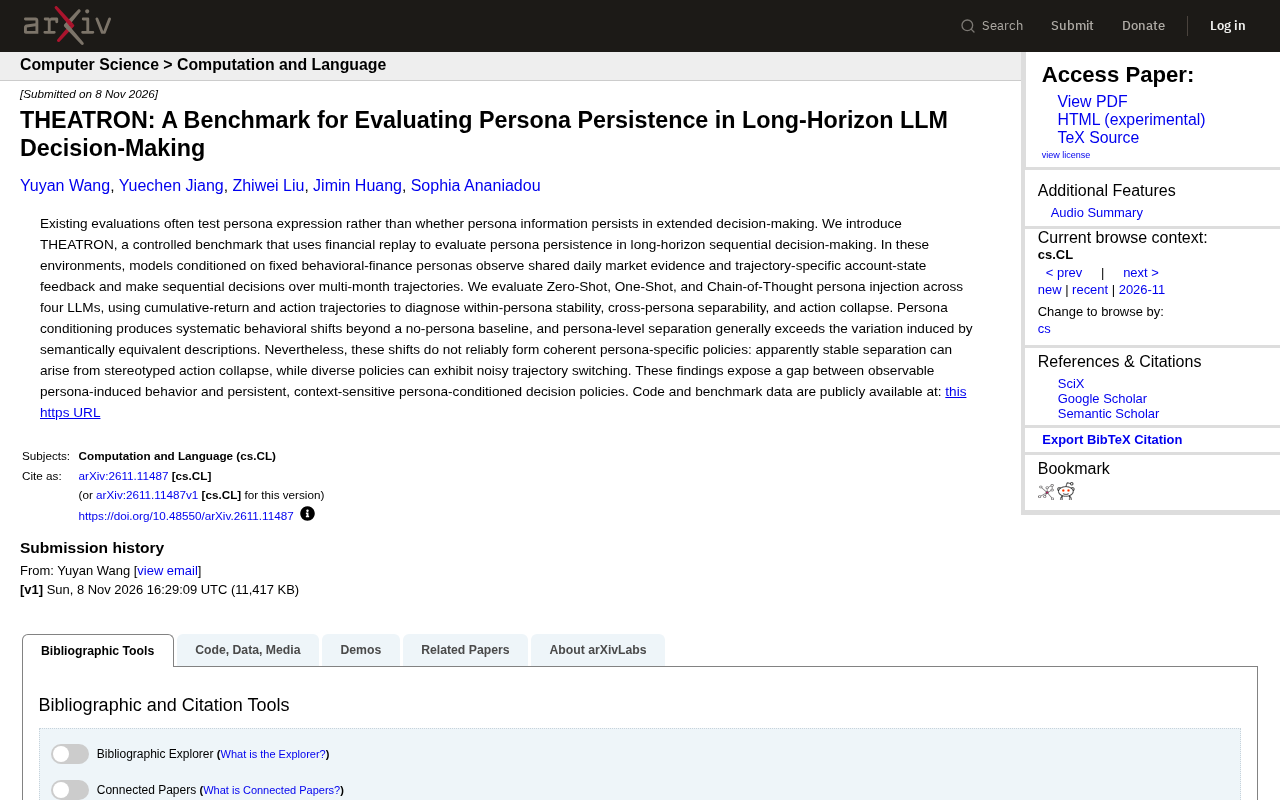
THEATRON is a benchmark for LLM persona persistence that argues existing evaluations only test tone mimicry in single-turn dialogue. Using financial replay, it assigns behavioral-finance personas to models making months-long decisions under shared market evidence, comparing Zero-Shot, One-Shot, and Chain-of-Thought injection across four models. Persona conditions produce systematic behavioral shifts, but these cannot reliably form coherent strategies—stable differentiation may stem from action collapse, and diverse strategies may come with noisy switching.
Can large models "remember who they are" across months of continuous decision-making? Most existing persona evaluations stop at tone mimicry in single-turn dialogue, and rarely test whether persona information can persistently shape behavior in long-horizon decisions. The THEATRON benchmark attempts to fill this gap.
Why "persona expression" is not "persona persistence"
Current persona evaluations typically have a model play a role and say a few lines, then check whether it "sounds like that person." But agents in real scenarios need to maintain consistent preferences, risk attitudes, and strategic style across many consecutive decisions. The original work notes that existing evaluations "test persona expression, not whether persona information persists across extended decisions." This is a key distinction: a model can mimic a certain tone while randomly switching strategies at every decision step—the surface-level persona traits are mere decorations at the level of wording.
THEATRON's starting point is to pull persona away from "manner of speaking" back toward "behavioral tendency," using quantifiable decision trajectories to judge whether a persona truly takes effect.
Financial replay: putting personas into a long-horizon decision sandbox
THEATRON uses financial replay as a controlled experimental environment. Models are assigned fixed behavioral-finance personas and, under shared daily market evidence, each receives account-state feedback tied to its own trajectory, making continuous decisions over trajectories spanning months.
This design controls two variables simultaneously: market information is identical for all models, avoiding information differences that would confound comparisons; account-state feedback is bound to each trajectory, so decision consequences accumulate realistically. The persona is no longer a single sentence in a prompt, but a stable tendency that must manifest in every step's trade-offs.
Behavioral-finance personas refer to a set of typical investor tendencies distilled from behavioral finance research, such as loss aversion (greater sensitivity to losses than to equivalent gains), overconfidence (overestimating the accuracy of one's own judgments), herd behavior (tending to follow market consensus), or the disposition effect (selling winners too early and holding losers too long). THEATRON parameterizes these tendencies into operational persona settings, so that every buy/sell and position adjustment a model makes can be mapped onto specific behavioral dimensions, rather than judging "whether it seems right" by tone alone. This turns persona from a qualitative description into a measurable, comparable structure of decision preferences.
Three injection methods and four models
The study compares three persona injection methods—Zero-Shot, One-Shot, and Chain-of-Thought—across four large language models. The evaluation metrics focus on two types of signals: cumulative return and action trajectories, from which three dimensions are diagnosed—within-persona stability, cross-persona separability, and action collapse.
The value of this evaluation framework lies in that it does not merely look at final returns, but checks whether the same persona makes stylistically consistent choices at different points in time, whether different personas produce distinguishable decision patterns, and whether the model degenerates into a "collapsed" state of repeatedly executing the same action.
Action collapse refers to a model repeatedly outputting the same or very few actions over long-horizon decisions—for example, always holding or always buying—making the action sequence appear highly stable. This "stability" does not stem from a consistent strategy but from degeneration of the strategy space and loss of exploration capability. It is easily confused with genuine persona consistency in metrics: both manifest as low-variance trajectories. THEATRON therefore also examines action diversity to distinguish "stably following a preference" from "stably repeating one action"—a key discriminating signal for judging whether a persona truly takes effect.
Key finding: behavioral shifts, but no coherent strategy
The experimental results present a subtle tension. Persona conditions do produce systematic behavioral shifts, clearly distinct from the baseline without persona settings; persona-level differentiation is also generally greater than the fluctuation induced by semantically equivalent descriptions. In other words, rephrasing does not significantly change behavior, but changing the persona setting does.
However, these shifts cannot reliably form coherent persona-specific strategies. The original work specifically points out two countervailing signals: seemingly stable differentiation may stem from stereotyped action collapse; while seemingly diverse strategies may come with noisy trajectory switching. This means the "persona consistency" observed in evaluation may be an illusion—the model is not stably following a strategy but stably repeating an action, or unstably oscillating at random.
This exposes a gap between observable persona-induced behavior and persistent, context-sensitive persona-conditioned decision strategies. For developers building long-lived agents, this is a direct warning: persona settings at the prompt level may not translate into reliable behavioral constraints in long-horizon decisions.
Cross-persona separability measures whether decision trajectories under different persona settings can be reliably distinguished, typically quantified by comparing the degree of difference in action distributions or return sequences across personas; high separability indicates that persona settings genuinely changed behavior. Within-persona stability measures whether the same persona maintains stylistic consistency across the entire timeline, focusing on variance and drift within the trajectory. The two metrics must be interpreted jointly: high separability without within-persona stability may mean the model merely gives stereotyped responses to different prompts; high within-persona stability with low separability may mean all models degenerate into similar safe strategies.
Implications for persona-driven agent development
THEATRON's significance goes beyond a benchmark score. It offers a diagnostic approach: when evaluating persona persistence, one must observe both trajectory stability and action diversity, avoiding misreading action collapse as consistency. The research team has released the code and benchmark data on GitHub (yuyan12138/theatron) for reproduction and extension.
For AI applications that need to run long-term and maintain character consistency—such as virtual advisors, companion agents, and simulated trading systems—this study suggests that the effects of persona injection need to be repeatedly validated across multi-step decisions rather than concluded from single-turn performance. Whether a persona can "persist" must ultimately be decided by trajectories.
Background notes
Chain-of-Thought injection means asking the model in the prompt to first explicitly write out reasoning steps before giving a decision, in the hope that the reasoning process carries and reinforces persona constraints; One-Shot injection provides a demonstration decision consistent with the target persona as an example for the model to imitate in style; Zero-Shot gives only a persona description without reasoning guidance or examples. The three represent persona conditioning applied from weak to strong; comparing them can reveal whether persona information enters the decision process through reasoning chains, example imitation, or mere description—and which path is more likely to form strategies consistent over time.
One-line Summary
THEATRON uses financial replay to test whether LLM personas persist across months of consecutive decisions.
Paragraph Summary
THEATRON is a benchmark for LLM persona persistence, noting that existing evaluations mostly stop at tone mimicry in single-turn dialogue, testing persona expression rather than whether persona information persists in long-horizon decisions. It uses financial replay as a controlled environment, assigns models behavioral-finance personas, and has them make consecutive decisions over months under shared market evidence and individual account feedback, comparing Zero-Shot, One-Shot, and Chain-of-Thought injection across four models. Results show persona conditions produce systematic behavioral shifts and cross-persona differentiation exceeds semantically equivalent rewrites, but these shifts cannot reliably form coherent strategies: stable differentiation may stem from stereotyped action collapse, and diverse strategies may come with noisy switching. The study suggests persona injection must be repeatedly validated across multi-step trajectories.
Related articles

Incident Response in the Age of AI Attackers: A 6-Month Retrospective and the Four Pillars
AI attackers are making attacks on AI infrastructure more frequent. This article explains MarkTechPost's four-pillar incident response playbook based on a 6-month retrospective, with Fireworks AI and Klue case studies on implementation.

Abnormal Error Rate Spike in Claude Mythos 5.2 and Fable 5.2
Claude Mythos 5.2 and Claude Fable 5.2 show an abnormal spike in request error rates, marked as investigating on the official status page. This article covers the incident overview, practical impact on developers, and recommended responses.

ReAct Runtime Context Trimming: Why Claude Code Acts at 70%
A deep dive into ReAct runtime context trimming: why Claude Code compresses at ~70% usage, why tool calls dominate, why messages must be dropped in pairs, and why codebases don't need RAG.