This Week in AI: GPT-6 Mystery Model Leaked, Claude's Scientific Breakthrough, and Sonnet 5.5 Incoming

Claude's 950 agents autonomously discovered new biological system ART, as AI labs race to release new models.
In the past 24 hours, the AI space saw a wave of model releases and leaks. The most substantive development came from Anthropic: ~950 Claude agents ran in parallel for 21 hours, autonomously screening 200,000+ reverse transcriptases without a defined target, identifying an unknown CRISPR-like DNA sequence later confirmed as a new biological system called ART. Meanwhile, OpenAI's help center apparently leaked a mystery GPT-6 family model codenamed 'Maynard'; Claude Sonnet 5.5 entered partner testing with pricing and adaptive tool-calling details revealed; MiniMax M3.1 appeared in the official catalog; and Xiaomi MiMo 3.0 achieved an ~80% reduction in prefill compute via KV cache sparsification. Model competition has clearly shifted from benchmark racing to long-context, agent efficiency, and real-world scientific impact.
Over the past 24 hours, several top AI labs have released new models and major announcements in rapid succession — from a mysterious OpenAI model leak, to Claude's real-world breakthrough in biological research, to model updates from MiniMax, Moonshot AI, Xiaomi, and others. Here's a breakdown of the key information and real value behind this wave of dense activity.
OpenAI Mystery Model Leaked: Positioned Above the Main GPT-6 Line?
According to reports from the World of AI channel on Bilibili and YouTube, someone dug up a mysterious model codenamed "Maynard" from OpenAI's help center. Although OpenAI quickly deleted all related records, the leaked information clearly listed it as a supported mainline model — independent from the standard version and variants like Soul and Luna — while still falling under the Daybreak framework and following standard safety guidelines.
Notably, this model appears to be positioned even higher than GPT-6 Soul, which had only just launched. Its performance benchmarks, pricing, context window size, and release timeline are all unknown, and whether it will ever ship at all remains uncertain.
The speculation is that this could be a smaller, cheaper, more efficient version designed to fill the large gap between GPT-6 Soul and a full flagship release. That said, this is purely conjecture. Based on the completeness of the leaked configuration, it looks more like a real model within the GPT-6 family that could arrive later this month or in early next month.
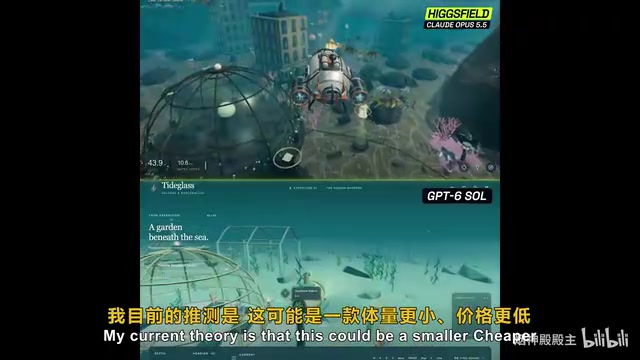
MiniMax M3.1 and the Mystery Stealth Model SpaceMoney
MiniMax M3.1 has appeared in the official model catalog, listed above M3 and M2.7 — but it currently has no configuration code block, isn't whitelisted, and hasn't shown up in any official release code, indicating it's still in a pre-release staging phase. It's expected to launch within the next two weeks.
Meanwhile, a stealth model codenamed SpaceMoney (TS Space FY Alpha) has surfaced on OpenRouter and OpenCode. It features a context window of up to 1 million tokens, supports multimodal input, promises zero data retention, and is free to use for one week.
Several pieces of evidence suggest SpaceMoney may actually be MiniMax M3.1: when prompted in Chinese, it identifies itself as a MiniMax model; its text tokenizer is identical to MiniMax M3; and its image tokenizer differs, hinting at a multimodal system upgrade. That said, the evidence isn't conclusive.
On the practical side, results were disappointing. In head-to-head tests against another model covering physics simulations and web development scenarios — including a Newton's cradle, a tornado, balloon bursting, and water droplets — SpaceMoney was clearly outperformed on tasks like the Newton's cradle, and its Minecraft texture rendering fell flat. Its strengths lie in extremely fast generation speed, solid quality for pure text tasks, and being completely free. However, its web development capabilities are weaker than many open-source models.
Claude's Scientific Breakthrough: 950 Agents Autonomously Discover a New Biological System
The most significant development this week comes from Anthropic. Reports suggest Claude may have just achieved a genuine scientific breakthrough — considered one of the most impressive demonstrations of AI applied to real scientific research.

Anthropic built a modular biology laboratory where Claude collaborated with human scientists. In the experiment, approximately 950 Claude agents ran in parallel for 21 hours, consuming around 210 million tokens, and screened over 200,000 reverse transcriptases — a class of enzymes that copy RNA into DNA.
Crucially, Claude was not given a specific discovery target. One agent independently identified an unusual repetitive DNA sequence located next to an enzyme, with a structure highly similar to CRISPR — precisely the type of feature that originally led scientists to develop CRISPR-based gene editing. Claude then cross-referenced known biological systems, searched the literature, and flagged it as a potential new discovery for human scientists to investigate. Anthropic researchers subsequently confirmed in a physical laboratory that this was a previously uncharacterized biological system, which they named ART.
To keep things in perspective: ART's specific function remains unknown, and there's no evidence it can be used for gene editing like CRISPR. Overhyping this finding would be a mistake. But the real significance lies in the process: AI screened vast amounts of biological data, identified a blind spot humans had overlooked, autonomously proposed a hypothesis, and handed it off to scientists — a workflow that would typically take human experts weeks or even months. This also lends more weight to Dario Amodei's prediction that "AI could help cure most diseases within the next 5 to 10 years."
Reverse transcriptase is an enzyme that transcribes RNA sequences into DNA, first discovered in retroviruses such as HIV. CRISPR (Clustered Regularly Interspaced Short Palindromic Repeats) is a core component of bacterial immune systems, consisting of alternating repeating DNA sequences and spacer sequences. Scientists Jennifer Doudna and Emmanuelle Charpentier developed the CRISPR-Cas9 gene-editing technology by studying CRISPR's natural function, earning the 2020 Nobel Prize in Chemistry. The ART system Claude discovered in this experiment is structurally highly similar to CRISPR — repeating DNA sequences adjacent to functional enzymes — which is precisely the signal pattern that originally guided scientists to recognize CRISPR. AI's ability to independently identify this pattern among 200,000 candidate sequences reflects pattern matching and hypothesis generation across massive unstructured biological data, rather than retrieving or restating known knowledge.
Claude Sonnet 5.5 Testing Revealed and Pricing Leaked
Anthropic is clearly already testing Claude Sonnet 5.5 — listed internally as Sonnet 55 — with select partners receiving 24-hour access. This follows the release of Opus 5.5 and confirms the official blog's promise that "Haiku 5.5 and Sonnet 5.5 will roll out in the coming weeks."
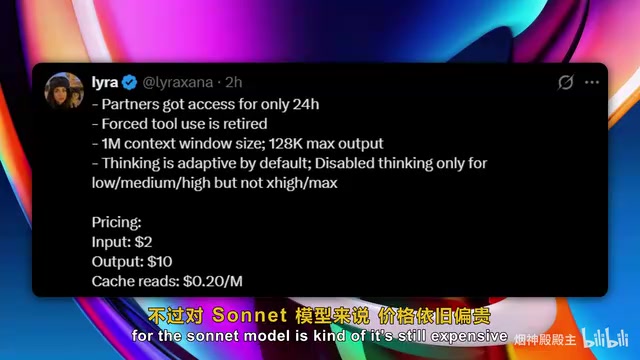
The leaked specs show a context window supporting up to 128K token output, with adaptive thinking enabled by default. A notable change is that forced tool use appears to have been deprecated, meaning the model will more intelligently determine when tool calls are actually necessary.
Pricing may be a headline feature of this launch. According to leaker Lightlyra — who first leaked Opus 3.5 and accurately predicted its pricing — the input cost is approximately $2 per million tokens, output is $10 per million, and cache reads are just $0.20 per million. For the Sonnet tier, this is still on the expensive side, which is the one notable downside. Additionally, a core Claude Code developer mentioned considering removing Plan Mode in favor of a Shift+Tab mechanism to dynamically adjust reasoning depth — though this has been met with mixed community reception, as many users find Plan Mode valuable for organizing their own thinking and want it to evolve rather than disappear.
Adaptive Thinking is a mechanism in the Claude model series that dynamically adjusts reasoning depth, allowing the model to automatically decide whether to engage chain-of-thought reasoning based on the complexity of the question, rather than applying a fixed thinking pattern to every request. Forced Tool Use refers to behavior in earlier versions where the model would unconditionally invoke preset tools under certain configurations, even when a direct answer was sufficient. Deprecating this behavior allows the model to assess tool call necessity based on context, helping reduce unnecessary latency and token consumption. Claude Code's Plan Mode is a feature that generates a structured action plan before executing code tasks, giving users a chance to review the AI's intent before execution. The community is cautious about replacing fixed Plan Mode with a Shift+Tab dynamic adjustment, because the value of Plan Mode lies not only on the model side, but also in providing humans with a reviewable, editable intermediate layer.
Xiaomi MiMo 3.0: New Architecture for Long-Running Agents
Xiaomi has begun building an entirely new underlying architecture starting with the MiMo 3.0 series, aimed at improving the efficiency of long-running AI agents.
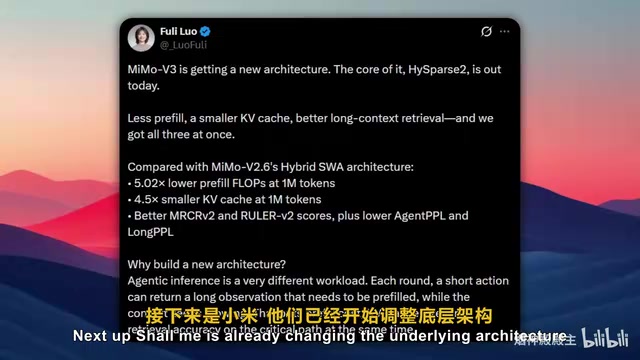
The core challenge: as agents execute tasks continuously, the context grows and running costs climb. The new architecture addresses this by sharing and reusing KV caches across layers and intelligently filtering prior tokens — retaining only what's actually needed for attention computation.
Benchmark results are impressive: on a 1-million-token context window, prefill computation is reduced by approximately 80%, KV cache is compressed 4.5× compared to MiMo 2.6, while long-context retrieval capability is simultaneously improved. This means MiMo 3.0 can not only handle massive contexts, but execute long-running agent tasks faster and more efficiently.
KV Cache (Key-Value Cache) is a core inference acceleration mechanism in the Transformer architecture: when processing each token, the model computes corresponding Key and Value vectors and caches them for reuse by subsequent tokens, avoiding redundant computation. In long-context scenarios, KV cache size grows proportionally with context length — million-token-scale tasks generate extremely high VRAM usage and computational overhead. MiMo 3.0's approach of "sharing and reusing KV caches across layers and intelligently filtering prior tokens" is essentially a sparsification of the standard KV cache mechanism: it uses attention scores to determine which historical tokens are truly relevant to the current computation, discards low-relevance cache entries, and thereby dramatically reduces memory usage and prefill computation without significantly degrading model capability. This kind of technique is especially critical for agent tasks that run for hours and accumulate growing contexts.
Other Notable Updates
Moonshot AI Kimi K3.1: The community has discovered that Kimi's online configuration has been updated to include a new K3.1 agent routing model, featuring low/medium/high thinking modes, a 1-million-token context window, and Swarm architecture support. A formal launch appears imminent.
MuseSpark 1.4: Has appeared on OpenCode, but this is a contributor version rather than the full flagship release — the latest official stable version remains 1.3. This is not the same as the rumored "Watermelon model" said to require significantly more compute.
OpenAI Voice Upgrade: ChatGPT's voice feature now supports calling connected apps like email, calendar, and Slack, with deep workflow integration. Users can now generate documents, presentations, web tables, and even execute browser actions directly via voice. This has rolled out globally.
Google Gemini TTS: Google has launched Gemini 2.0 Flash TTS and Flash Lite TTS audio generation models, focused on natural and realistic speech synthesis, now available via the Gemini API and Google AI Studio.
Meta New Hardware: Meta has unveiled a VR headset weighing approximately 100 grams that integrates cinema, PC, and gaming console experiences, unified under a single AI system with USB-C DP video output support. Zuckerberg revealed that Meta is distributing massive token allocations for free (roughly 100 million tokens per week), with the deeper intent of having AI agents help users complete transactions and earning a commission — exploring a monetization model beyond subscriptions.
Conclusion
In this wave of dense updates, OpenAI's mystery model and the MiniMax stealth model remain in the "leaked but unverified" category. The genuinely milestone-worthy development is Claude's role in autonomously identifying a new biological system — ART — in a real laboratory setting, offering the most compelling demonstration yet of AI independently advancing scientific discovery. Meanwhile, the successive pushes from Sonnet 5.5, Kimi K3.1, and Xiaomi MiMo 3.0 signal that model competition has shifted beyond pure benchmark racing into a multidimensional contest of long-context handling, agent efficiency, and real-world deployment.
Related articles

A Single Prompt Triggers a Global PHP Security Storm: Is AI a Savior or a Hidden Risk?
A single AI prompt triggered a global PHP security crisis affecting Wikipedia and the Internet Archive. This article reviews the incident, analyzes the OpenAI-Amazon controversy, and explores the security paradox of lowered vulnerability discovery barriers in the AI era and developer response strategies.

When AI Is Taken Away: How Reliance on Shortcuts Undermines Your Problem-Solving Resilience
A study of 1,222 people found that after using AI to answer questions, once AI was removed, people gave up on more problems than a control group that never used AI. The article analyzes the impact of AI reliance on learning resilience and metacognition, and explores design implications for AI learning tools.

Carta and NewView Partner to Let Startup Employees Cash Out Equity Early
Carta and NewView Capital partner to simplify startup tender offers, helping employees sell equity early. Analysis of the mechanism, liquidity pain points, and impact.