Thomson Reuters Builds Its Own Frontier LLM: Why Vertical AI Is Becoming the New Battleground

Thomson Reuters builds its own frontier LLM to leverage proprietary legal and tax data as a vertical AI moat.
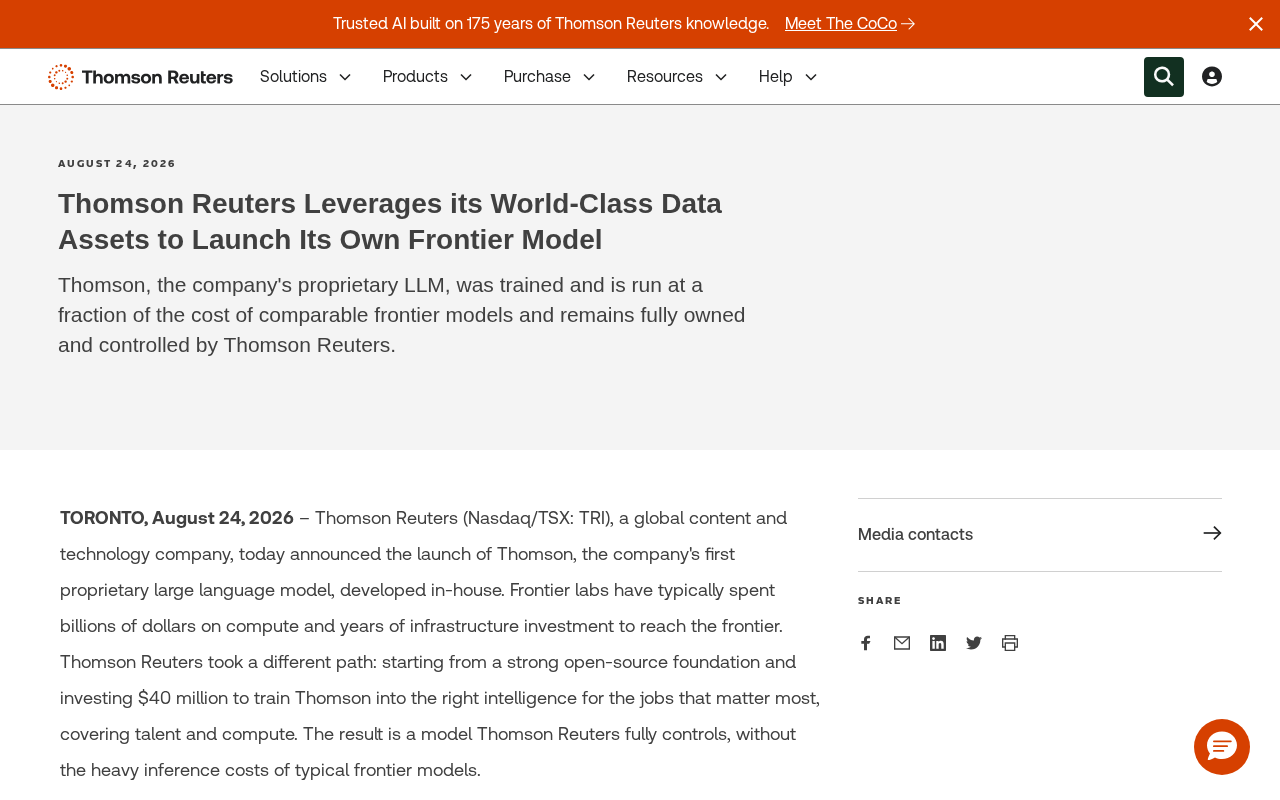
Thomson Reuters has announced a proprietary frontier large language model, leveraging decades of accumulated legal, tax, and compliance data to establish a deep AI capability moat in professional services. Rather than competing with OpenAI or Google on general AI, the company aims to deliver more accurate, trustworthy solutions for high-stakes professional domains where hallucinations are unacceptable, signaling that vertical AI specialization is becoming a key path to real commercial value.
Thomson Reuters Enters the Frontier Model Race: A Professional Information Giant's AI Ambition
As a globally leading professional information services provider, Thomson Reuters recently announced the launch of its proprietary Frontier Model. This move marks the formal entry of a traditional professional information services giant into the large language model race, and reveals a noteworthy trend: vertical AI models are becoming an important complementary force beyond general-purpose LLMs.
Thomson Reuters was formed in 2008 through the merger of Canada's Thomson Corporation and the UK's Reuters Group. With annual revenue exceeding $6 billion, the company serves professional clients in over 150 countries. Its core businesses span legal professionals (represented by Westlaw), tax and accounting (ONESOURCE, etc.), and corporate news information services. Westlaw, as one of the world's largest legal databases, contains millions of legal cases, regulations, and academic literature, making it an indispensable research tool in lawyers' daily work.
For a company known for legal, tax, compliance, and news information services, building its own frontier model isn't about competing head-to-head with OpenAI, Anthropic, or Google. Rather, it's about establishing a deep AI capability moat within its professional domain. Behind this strategic choice lies profound thinking about how AI should be deployed in practice.
It's worth noting that "Frontier Model" is a term used in the AI industry to describe the most advanced and powerful large language models — typically systems at the cutting edge in terms of parameter scale, training data volume, and capability performance. The term was popularized at the UK's AI Safety Summit in 2023 to distinguish high-capability models with potentially significant impact from ordinary AI systems. Frontier models typically require thousands or even tens of thousands of high-end GPUs for training, with training costs ranging from tens of millions to hundreds of millions of dollars. Thomson Reuters' use of this term indicates that its proprietary model is not merely a simple fine-tuned derivative in scale and capability, but possesses independent frontier-level capabilities.
Why Professional Companies Build Their Own LLMs
Proprietary Data as the Core Moat
Thomson Reuters possesses decades of accumulated high-quality professional data, including a vast legal case library, tax regulations, regulatory documents, and authoritative news content. These datasets constitute unique assets that general-purpose LLMs can hardly match. Compared to relying on third-party general models, building a proprietary model can more fully leverage the value of this exclusive data.
In fields like law, tax, and compliance where accuracy requirements are extremely high, the "hallucination" problem of general-purpose LLMs can be fatal. A legal AI assistant that cites non-existent case law could cause serious real-world harm to users. LLM "hallucination" refers to models generating content that appears plausible but is actually incorrect or fabricated — a problem that has already had real-world consequences in the legal field. In 2023, New York attorney Steven Schwartz was fined by a court for submitting a ChatGPT-generated legal brief that cited six completely fictitious cases. Similar incidents have occurred in multiple jurisdictions worldwide. The fundamental cause of hallucinations is that LLMs are essentially probabilistic text generation systems — they predict the next token based on statistical patterns rather than truly "understanding" factual accuracy. Professional models trained on proprietary authoritative data have an inherent advantage in reliability and traceability.
On the technical implementation level, Retrieval-Augmented Generation (RAG) is currently one of the mainstream approaches for deploying AI in professional domains. RAG works by retrieving relevant document fragments from an external knowledge base before the model generates an answer, then feeding these fragments as context to the model so that responses are "evidence-based." For Thomson Reuters, its decades of accumulated case law, regulatory databases, and news archives constitute ideal knowledge sources for a RAG system. The advantage of building a proprietary model is the ability to perform end-to-end optimization of both the retrieval and generation components, achieving better results than simply stitching together two independent systems.
From Tool Integration to Full Autonomy
Over the past few years, many enterprises have chosen to build applications on top of general-purpose LLM APIs. But this approach has clear limitations: costs are controlled by others, data security concerns exist, and model capabilities cannot be deeply customized for professional scenarios. Thomson Reuters' decision to build its own frontier model is precisely aimed at escaping this dependency, achieving autonomous control from foundational capabilities to upper-layer applications.
As a notable detail, Thomson Reuters had previously accumulated relevant technical teams and product experience through moves like its acquisition of AI legal startup Casetext (valued at approximately $650 million). Founded in 2013, Casetext was a Silicon Valley startup focused on AI legal research. Its core product, CoCounsel, was among the world's first AI legal assistants built on GPT-4, capable of automatically performing legal research, document review, contract analysis, and other tasks. The June 2023 acquisition was one of the largest in legal tech at the time, bringing Thomson Reuters an AI engineering team of approximately 100 people and invaluable product experience in deeply integrating LLMs with legal workflows. CoCounsel was later integrated into flagship products like Westlaw, becoming an important component of Thomson Reuters' AI strategy. The proprietary frontier model can be seen as a natural continuation and upgrade of this series of strategic moves.
The Strategic Significance of Vertical LLMs
The Division of Labor Between General and Specialized Models
As LLM technology matures, the industry is gradually forming a consensus: general-purpose LLMs provide foundational language understanding and reasoning capabilities, while vertical domain models deliver more precise and trustworthy services in specific professional scenarios. Thomson Reuters' move is a concrete manifestation of this division-of-labor trend.
Thomson Reuters is not the only information giant building proprietary AI capabilities in specialized domains. Bloomberg launched BloombergGPT in 2023, a 50-billion-parameter model specifically trained for the financial domain. In legal tech, LexisNexis (part of RELX Group) has launched its Lexis+ AI product. In healthcare, Epic Systems and Nuance (owned by Microsoft) are deeply integrating AI into clinical workflows. In accounting and auditing, all Big Four firms are deploying AI tools at scale. This trend shows that industry giants with unique data assets are treating AI as a new battleground for core competitiveness.
For heavily regulated, highly specialized industries like finance, law, and healthcare, AI deployment requires not only powerful model capabilities but also deep understanding of industry knowledge, compliance requirements, and business processes. This is precisely the core advantage of professional companies with years of industry accumulation — they understand not only the content of the data, but how data is used in actual workflows, and what kinds of errors are unacceptable.
Business Model Reconstruction
Thomson Reuters' core business is providing information services to professionals (lawyers, accountants, compliance officers). Embedding frontier AI models into existing products can significantly enhance tool value — shifting from passive information retrieval to proactive intelligent analysis and decision support. This not only promises to increase customer stickiness but also provides new justification for subscription service premiums.
Specifically, traditional legal research might require lawyers to spend hours searching case law, reading documents, and synthesizing analysis. AI-driven tools can compress this process to completing preliminary analysis within minutes, while lawyers focus on strategic judgment and quality control. This "AI-assisted + human decision-making" collaborative model is redefining how value is created in professional services.
Challenges of Building a Proprietary Frontier Model
Despite promising prospects, professional companies building their own frontier models face significant challenges:
- Cost pressure: Training and maintaining frontier-level LLMs requires massive computing investment and top-tier talent, making it an uphill battle for non-tech-native companies. Using GPT-4-class models as a reference, a single training run may cost between $60 million and $100 million, not including ongoing inference serving costs and model iteration expenses.
- Pace of technological iteration: General-purpose LLM capabilities are still evolving rapidly. How professional companies maintain the competitiveness of their proprietary models is an ongoing challenge. If paradigm shifts occur in underlying model architectures or training methodologies, the self-built approach may face the risk of starting over.
- Technical route selection: Should vertical companies build models entirely from scratch, or perform deep fine-tuning based on open-source models (like Llama, Mistral, etc.)? The latter may offer advantages in cost and iteration speed.
Regarding the open-source model route, the current ecosystem is quite rich. Meta's Llama series (latest being Llama 3, with up to 70 billion parameters), French startup Mistral AI's Mistral/Mixtral series, and Alibaba's Qwen all provide commercially usable open weights. Companies can fine-tune these models using their own domain data, with technical options including full-parameter fine-tuning, LoRA (Low-Rank Adaptation), QLoRA, and other methods — with costs potentially as low as tens of thousands of dollars, in stark contrast to the hundreds of millions required to train from scratch.
Thomson Reuters' choice of the "frontier model" label suggests it may have adopted a more aggressive self-built approach, meaning professional domain design considerations were incorporated at the model architecture and pre-training stages, rather than simply performing post-training on a general-purpose model. However, specific technical architecture details await further disclosure.
Conclusion: Vertical Depth May Be the Key to AI Commercialization
Thomson Reuters launching its proprietary frontier model is a landmark event in the professional information services industry's embrace of the AI wave. It reminds us that LLM competition occurs not only at the general capability level, but more importantly in who can combine AI capabilities with deep domain data and professional experience to create truly trustworthy, usable industry solutions.
In an era where general-purpose LLMs are becoming increasingly homogeneous, deep cultivation of vertical domains may be the key path for AI to create real commercial value. For other industry giants with unique data assets — whether electronic health record platforms in healthcare, trading data holders in finance, or equipment operations data owners in industrial sectors — Thomson Reuters' move deserves close attention and consideration. The scarcity and irreplaceability of professional data is becoming the new competitive high ground in the AI era.
Related articles

iPhone Duo Battery Life Tested: One Charge a Day Is Unavoidable, and the Large Screen Is the Culprit
iPhone Duo battery test: heavy use needs at least one charge a day, and about 30% remains after 6.5 hours of screen-on time. How often the large screen is unfolded is key; a MagSafe battery pack helps, and long-term degradation is also worth watching.

Kimi K3.1 Pro Open-Sourced: 2.8 Trillion Parameters Close In on Opus
Moonshot releases the open-source MoE model Kimi K3.1 Pro, with 2.8T total parameters and 104B activated, trailing Opus 5.5 by under 1 point on Terminal Bench 4.0.

Costco Tech Price Guessing: Are Monitors, Keyboards, Mice, and Bose Speakers Worth It?
A YouTube blogger guesses prices of Costco tech products: 2K 180Hz monitor, Logitech keyboard and mouse, Bose speaker, and CyberPower UPS, revealing warehouse-store selection and brand premium.