Three Gen-Z Founders Use Chinese Open-Source Models to Steal OpenAI's Customers, Hit $3.25B Valuation in 18 Months

Three Gen-Z former OpenAI founders use Chinese open-source models to train custom enterprise models, reaching a $3.25B valuation in 18 months.
Three Stanford classmates and former OpenAI employees founded Applied Compute, which doesn't build bigger general models but instead uses Chinese open-source models like Qwen, Kimi, and GLM as foundations, training custom models with enterprise data via reinforcement learning and deploying them on enterprise clouds at up to one-tenth the cost of top-tier models. DeepSeek R1's release was the turning point, showing the founders that open-source models were strong and cheap enough — what was missing was enterprise-grade infrastructure. In under 18 months, the company surpassed $100M in annualized revenue and reached a $3.25B valuation. Legal AI company Harvey trained an agent on GLM5.1 that beat GPT5.5 and Claude Opus4.8 on its own benchmark, and DoorDash, Nvidia, and Microsoft are also customers. The founders believe enterprises will mix expensive and cheap models by scenario, and the moat remains to be tested.
Why Did These Gen-Z Founders Leave OpenAI to Bet on Chinese Open-Source Models?
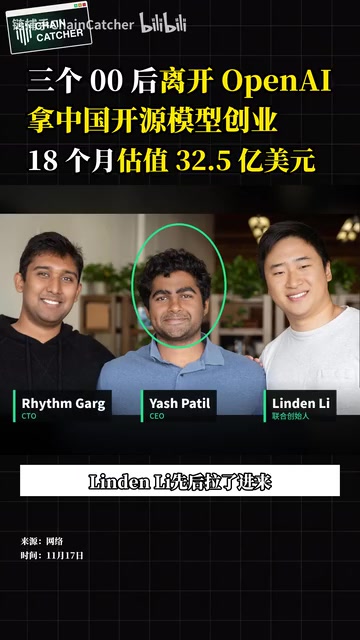
Three Stanford classmates and former OpenAI employees are using Chinese open-source large models as their foundation to train custom enterprise models. In under 18 months, they've surpassed $100 million in annualized revenue and reached a $3.25 billion valuation — this is the story of Applied Compute (also written as Obsidic Compute in source materials). The three founders are aged 25, 24, and 23. CEO Yash Patel was at Stanford when GPT launched and emailed Sam Altman directly to express his interest in joining. He entered OpenAI at age 20 and worked on what became Codex; classmate Rhythm Garg worked on the reasoning model OE; Lyndon Lee, who is Chinese-American, attended middle and high school in Shanghai.
The turning point came the day DeepSeekAd released R1. Source materials quote investor Mark Anderson calling it Silicon Valley's "Sputnik moment" — the U.S. was caught off guard. At the time, the three were skiing at Lake Tahoe and spent the entire day discussing DeepSeek. While others worried about Chinese models catching up, they saw an opportunity: Chinese open-source models were already strong and cheap enough — what was missing was infrastructure to fine-tune them into enterprise-specific models.
Not Building Bigger General Models, but Enterprise-Specific Ones
Five months later, the three left OpenAI to start their company. Their model is clear: instead of building a bigger general-purpose model, they take open-source models as a foundation — such as Alibaba's Qwen and Moonshot's Kimi — and use enterprises' own data and business processes to train custom models through reinforcement learning, deployed on the enterprises' own cloud.
Think of it this way: a general large model is like an external consultant who knows everything but doesn't understand your company; the models they train are more like an internal employee who works only for you.

This model's cost advantage is striking. Patel says that in some scenarios their models can be ten times cheaper than top-tier large models. Capital markets understood too: a $100 million valuation at seed round in June 2025, $1.3 billion by April 2026, and after this month's new $350 million funding round, $3.25 billion — a more than 30x increase in a year and a half. Revenue has grown even faster — $12.8 million annualized at six months, now over $100 million.

Reinforcement Learning and Custom Model Training
The article's mention of "training custom models through reinforcement learning" refers to post-training on top of pre-trained open-source base models using enterprise-owned data and business feedback signals. Common approaches include supervised fine-tuning (SFT) and reinforcement learning from human or rule-based feedback (RLHF/RLAIF): the former teaches the model enterprise-specific expressions and workflows, while the latter uses reward signals to guide the model toward optimizing output quality on specific tasks (such as contract review or menu generation). Compared to pre-training a general large model from scratch, this approach requires far less compute and can hone accuracy for vertical scenarios — which is the key reason it can be an order of magnitude cheaper than top-tier general models. At the same time, models are deployed on the enterprise's own cloud, keeping data within the domain, meeting the strict compliance and privacy requirements of industries like finance and law.
Chinese Open-Source Models Beat the Competition on an American Company's Test
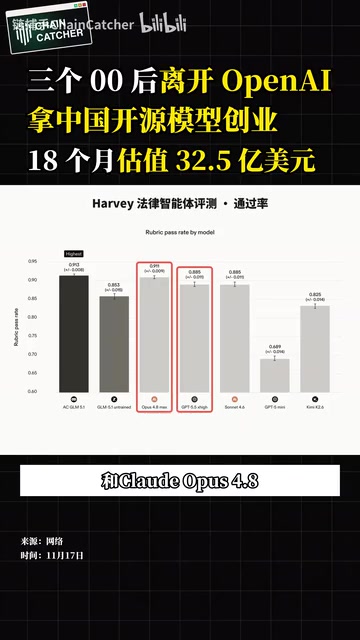
The most telling case is legal AI company Harvey. They used Zhipu's GLM5.1 as a foundation to train a legal agent that scored higher than GPT5.5 and Claude Opus4.8 on Harvey's own legal benchmark, becoming the best-performing model at the time. A Chinese open-source model, specially trained, beat the two top American large models on an American company's test.
Other customers are equally impressive: DoorDash uses it to automatically generate accurate menus when onboarding restaurants; Nvidia uses it for post-training its own open-source models; Microsoft is also a customer, with CEO Nadella having held a one-on-one conversation with Patel.
About the GLM Series and the Term "Open Source"
The GLM5.1 mentioned in the article comes from Zhipu AI, whose GLM series was among China's earliest product lines benchmarked against mainstream international large models, released progressively as open weights, allowing enterprises to download, deploy, and further train them. It should be noted that what the industry calls "open-source models" mostly refers to open-weight models whose weights are accessible and whose licenses permit commercial use and fine-tuning — not necessarily fully compliant with OSI's strict open-source definition. It's precisely because weights are downloadable that enterprises can do post-training in their own environments while retaining data control — this is the prerequisite that makes Applied Compute's model viable. The "test" in Harvey's evaluation refers to its own legal-domain benchmark, a specialized test for a vertical scenario; scores reflect performance on specific tasks, not comprehensive capability.
Mixing Expensive and Cheap Models
Patel is clear-eyed. He doesn't believe enterprises will abandon OpenAI and Anthropic; the future is more likely to involve mixing expensive and cheap models, choosing based on scenario. Open-source models are available to everyone — where their moat lies remains to be tested by time.
But what's most intriguing about this story is: three young people who came out of OpenAI, awakened by a Chinese model, are using Chinese open-source models to compete with their former employer for enterprise customers. Can Chinese open-source models become the foundation of global AI? The answer may lie in these "internal employees who work only for you."
(Note: Company and person names in source materials have transliteration variations; this article follows the source materials' wording.)
Background
The Origin of "Sputnik Moment"
The term comes from the Soviet Union's launch of humanity's first artificial satellite, Sputnik 1, in 1957, which made the U.S. realize it was behind in the space race and subsequently led to the creation of NASA and massive scientific investment. Since then, the term has been widely used as a metaphor for "a landmark event that alerts an entire industry and forces a reassessment of the competitive landscape." The investor in the article used it to describe the release of DeepSeek R1: a Chinese team launching a powerful reasoning model at a cost far below expectations, making Silicon Valley re-examine the cost structure and competitive dynamics of the open-source route. It should be noted that such metaphors emphasize psychological impact and strategic shifts rather than strict technical rankings; R1's significance lies more in proving that high-intensity reasoning capabilities can be achieved in a more open and cheaper way.
Related articles

Gemini 4 Neon Leak: A Potential Strong Contender Against Opus 5.5
A Hacker News thread suggests Gemini 4 Neon looks like an Opus 5.5 competitor. This article unpacks the product positioning behind this community signal, shifts in the top-model competitive landscape, and what it means for developers' model selection strategy.

Claude Fable 5.2's Self-Authored Short Film 'Fable' Sparks Discussion
A short film 'Fable,' credited to Claude Fable 5.2 for script, visuals, and directing, appears on Hacker News. This article analyzes the significance of full-pipeline AI creation, community reactions, and what it means for content creators.

Anthropic IPO Pricing: A Signal of AI Giants Going Public
Anthropic's IPO pricing draws attention. This article analyzes its potential impact on AI industry valuation, commercialization paths, and the competitive landscape, and highlights public-market expectations and challenges for AI companies.