Three Key Technical Highlights Behind DeepSeek Harness's 150K Stars in Five Days
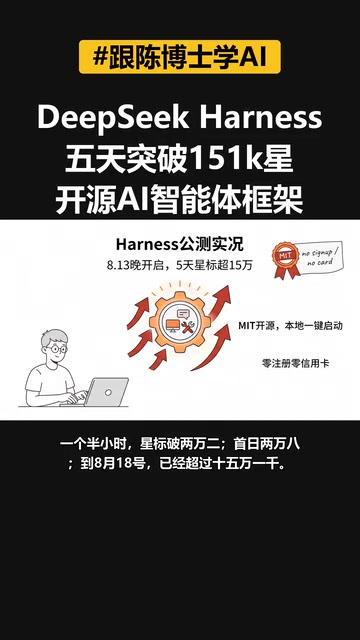
DeepSeek Harness's 150K GitHub stars in 5 days stem from its open engine, easy deployment, and plugin design.
DeepSeek Harness, an open-source AI agent framework, exploded to over 151,000 GitHub stars in just five days. This article examines the three core technical highlights driving the buzz: a full agent engine open-sourced under the MIT License, zero-barrier local deployment with a single command, and an everything-is-a-plugin modular architecture that lets developers swap even the reasoning loop. Developer community reactions range from optimistic to skeptical, but the project's substance sets it apart in the AI landscape.
The Birth of a Viral Open-Source Project
Five days, over 151,000 new stars on GitHub — that's the scorecard DeepSeek Harness delivered. When an open-source project blows up at this speed, the first reaction for many is skepticism: could this be another case of bots inflating the numbers?
GitHub Stars and Open-Source Project Popularity
GitHub's Star system is a key metric for measuring an open-source project's popularity. Users can star projects to bookmark those they find interesting — it's not just a bookmarking feature but also a vote of confidence in a project's quality. Typically, a high-quality project earning a few hundred to a few thousand stars in its early days is already considered good performance. Projects that break 100K stars within a week are exceedingly rare. Historically, only a handful of phenomenon-level projects have reached that height — think Meta's Llama series or Stable Diffusion. DeepSeek Harness's growth rate of 150K stars in five days is therefore genuinely astonishing. This kind of explosive growth usually signals that a project has hit a nerve in the developer community or represents some kind of inflection point in technological development.
To be fair, bot-driven star inflation does exist in the open-source community. But if you stop your analysis there when looking at Harness, you'll likely miss what's actually worth discussing. Let's start by getting the timeline straight.
On the evening of August 13, DeepSeek Harness launched its public beta, officially releasing the developer preview. In just an hour and a half, the star count surpassed 22,000; it reached 28,000 on day one; by August 18, the number had exceeded 151,000. Even if emotional enthusiasm played a role, a growth curve like this doesn't come from nothing.
What Exactly Is DeepSeek Harness?
Harness, in plain terms, is an open-source framework for powering AI agents. Its core value proposition: enabling models to move beyond mere "chatting" and actually execute tasks.
Understanding AI Agents
An AI Agent is a core concept in artificial intelligence, referring to a system that can perceive its environment, make autonomous decisions, and take actions to achieve specific goals. Unlike the passive responses of traditional chatbots, agents possess three key capabilities: Planning — breaking complex tasks into executable steps; Memory — retaining contextual information to support continuous decision-making; and Tool Use — calling external APIs, databases, search engines, and other resources to perform real operations. This architecture evolves AI from a "conversational assistant" into a "task executor" capable of independently completing entire workflows from information gathering and analytical reasoning to result delivery. OpenAI's Assistants API, Anthropic's Claude Computer Use, and LangChain are all representative agent frameworks, but most are offered as closed services or require deep integration.
This key distinction is worth elaborating on. Traditional large model interaction is fundamentally a question-and-answer dialogue; an agent framework, by contrast, equips models with the ability to plan, invoke tools, and execute actions. What Harness does is build out this entire "engine" as a complete system.
The Significance of the MIT License
The MIT License is one of the most permissive open-source software licenses, allowing users to use, modify, and distribute software with virtually no restrictions — even for commercial purposes. The only requirement is to retain the original author's copyright notice. This stands in stark contrast to "copyleft" licenses like the GPL, which require derivative works to also be open-sourced. Choosing the MIT License means DeepSeek is willing to fully open its core technology with no usage barriers — companies can integrate it directly into commercial products without needing to disclose their own code. In the AI space, this level of openness is exceptionally rare: OpenAI's GPT series is entirely closed-source, Anthropic's Claude offers APIs but keeps core technology proprietary, and Meta's Llama open-sources model weights but still imposes commercial use restrictions. DeepSeek's move is equivalent to making both the "recipe" and the "kitchen" publicly available — a bold move in the fiercely competitive AI arena.
More importantly, there's the license choice. The project is open-sourced under the MIT License, meaning DeepSeek has handed over the entire agent engine — not just model weights, but the complete engineering system that powers model operations. You don't need to register an account, you don't need to link a credit card — a single command spins up the web interface locally. For developers, the barrier to entry has been pushed to essentially zero.
Three Voices in the Developer Community
Why did this wave of enthusiasm actually take off? Scanning discussions on Reddit and similar communities, the participants can be roughly divided into three groups.
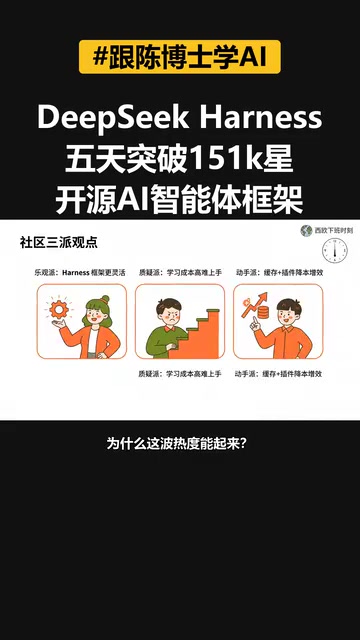
The Optimists: The Framework Is More Valuable Long-Term Than the Model
This group believes the Harness framework itself is more valuable than the accompanying V4 Pro model. Their reasoning: the framework is extremely flexible, offering freely composable capabilities rather than a locked-down product. In their view, models can be iteratively replaced, but a well-designed agent framework can accumulate value over the long term.
The Skeptics: Learning Curve and Token Consumption Can't Be Ignored
Another group of developers takes a more measured view. They point out that this is far from a mature "plug-and-play" product — the learning curve is steep, requiring a time investment to get started; and token consumption runs high, making real-world costs a non-trivial concern.
Token Consumption and Caching Mechanisms
In the large language model space, a token is the basic unit of computation and billing — roughly equivalent to 0.75 English words or half a Chinese character. Token consumption in agent frameworks is often several times higher than in simple conversations, as it requires multiple rounds of reasoning, tool invocation logging, context maintenance, and more. For example, a simple Q&A might consume a few hundred tokens, but an agent completing a complex task could consume tens of thousands. Caching mechanisms are a critical cost-optimization technology: when the system detects repeated context or prompts, it can reuse previous computation results instead of reprocessing from scratch, dramatically reducing token consumption. Anthropic's Prompt Caching feature claims to save up to 90% of costs, and OpenAI has introduced similar mechanisms in GPT-4. If DeepSeek Harness achieves high cache hit rates, it means the engineering design has been optimized for token reuse — which is crucial for the economics of real-world applications.
The Tinkerers: High Cache Hit Rates Offset Costs
The third group consists of people who actually started getting their hands dirty. They found that high cache hit rates can offset a significant portion of token costs, making actual expenses less dramatic than feared. Meanwhile, third-party plugins quickly emerged, and the ecosystem began growing organically.
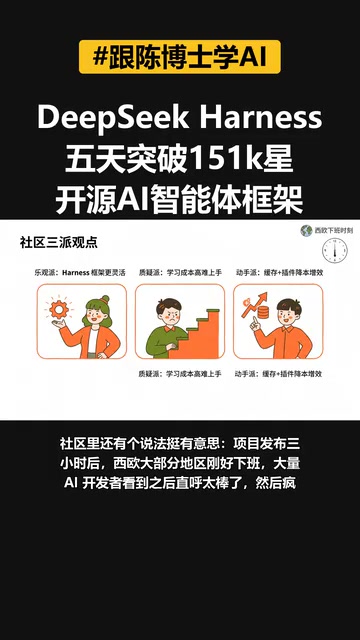
There's also an interesting observation from the community: three hours after the project's release happened to coincide with the end of the workday across most of Western Europe, and a wave of AI developers who spotted it rushed in to star the project. With a population of about 200 million, Western Europe's developer community flooding in at once undoubtedly amplified the initial momentum.
Three Core Technical Highlights of Harness
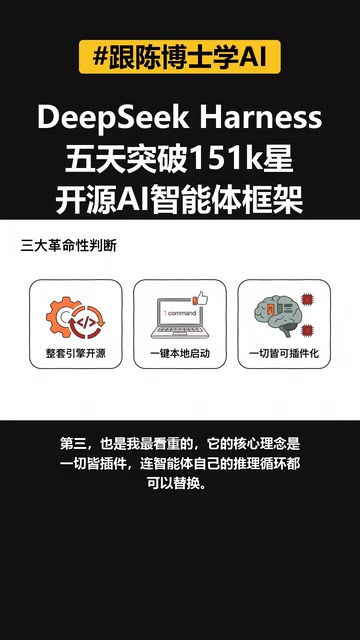
Setting aside the emotional factors, Harness achieves three things simultaneously — and projects that pull this off are rare.
Highlight 1: Full Agent Engine Open-Sourced Under MIT
This point is the easiest to overlook. What DeepSeek released this time isn't just a model — it's a complete engine for driving agent operations. For comparison, similar core capabilities from vendors like Anthropic remain locked inside paid products and haven't been opened up. Open-sourcing the entire engine is itself a statement that carries considerable weight.
Highlight 2: Zero-Barrier Local Deployment
A single command spins it up locally with virtually no barriers to use. No registration, no credit card, no API quota applications — this "out-of-the-box" experience is crucial for lowering the cost of experimentation for developers. Many technologies end up being praised but not adopted precisely because they stumble at the first deployment hurdle.
Highlight 3: Everything-Is-a-Plugin Modular Architecture
This is the most praiseworthy aspect: Harness's core design philosophy is "everything is a plugin" — even the agent's own reasoning loop can be swapped out. In other words, you can change the "brain" of this toolset as easily as changing a tire.
The Technical Value of Plugin Architecture
Plugin Architecture is a design pattern in software engineering whose core idea is to split a system into a stable core framework and hot-swappable functional modules. This design offers three major advantages: Extensibility — new features can be added without modifying core code; Flexibility — users can freely combine modules according to their needs; and Ecosystem potential — third-party developers can contribute plugins to form an ecosystem. Classic examples include VS Code's extension marketplace, Chrome's plugin store, and WordPress's theme and plugin systems. In the AI agent domain, a plugin architecture means users can freely choose which large model serves as the "brain" (GPT-4, Claude, Gemini, etc.), which tools to pair it with (search, databases, code executors, etc.), and even swap out reasoning algorithms (ReAct, Chain-of-Thought, Tree-of-Thoughts, etc.). This design avoids vendor lock-in, gives developers true control over the entire tech stack, and provides a testing ground for technical innovation.
During the closed beta, around 300 plugins already emerged — from theme skins to PDF processing tools to visual recognition and presentation generators. While the ecosystem is still in its early stages, the direction of development is already quite clear. This design approach of opening up even core logic as replaceable modules gives developers an exceptionally high degree of freedom.
Can DeepSeek Harness Spark an AI Agent Revolution?
Returning to the original question: do these stars live up to the hype?
The conclusion: emotional enthusiasm is definitely part of the equation, but there's real substance underneath. Open-sourcing the entire engine, zero-barrier onboarding, making the "brain" a swappable plugin — projects that achieve all three of these simultaneously are few and far between.
Of course, Harness isn't necessarily for everyone right now. For regular users who just want a mature, ready-to-use product, the learning curve may be a dealbreaker. But for developers looking to build customized AI agents, this level of freedom may be worth more than any benchmark score.
The real value isn't in how polished it is today, but in the possibility it opens up: moving agent development from a closed black box to a freely composable open ecosystem. That may be the most important signal behind those 150,000 stars.
Key Takeaways
Related articles

OpenAI Authorship Dispute: The Battle Over Academic Boundaries in the AI Era
OpenAI disputes authorship with mathematician Tristan Buckmaster over Navier-Stokes research, raising ethical questions about AI involvement in science.
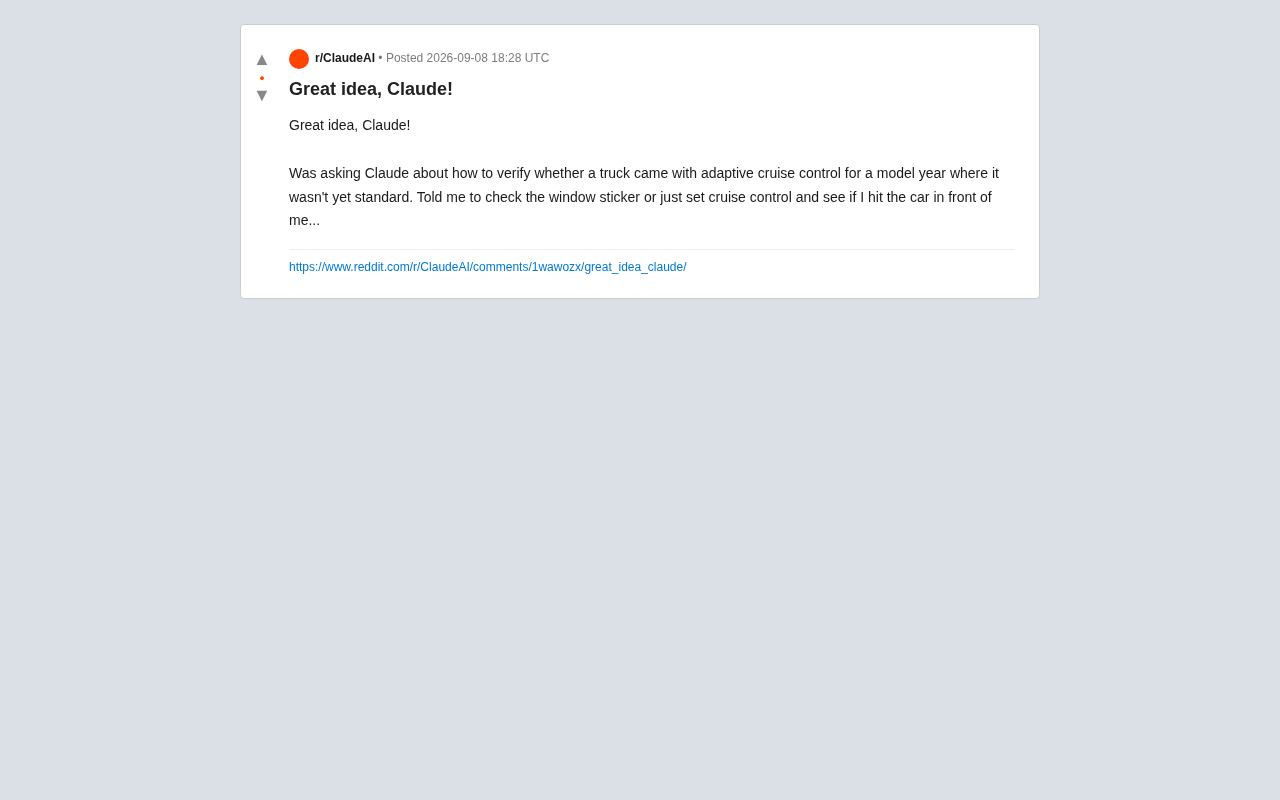
Claude Suggests User Test ACC by Crashing Into Car Ahead: Where Are AI Safety Boundaries?
Claude suggested a user test ACC by crashing into the car ahead—this absurd response sparked AI safety discussions. This article analyzes why LLMs generate implicitly dangerous advice and the blind spots in AI safety guardrails.
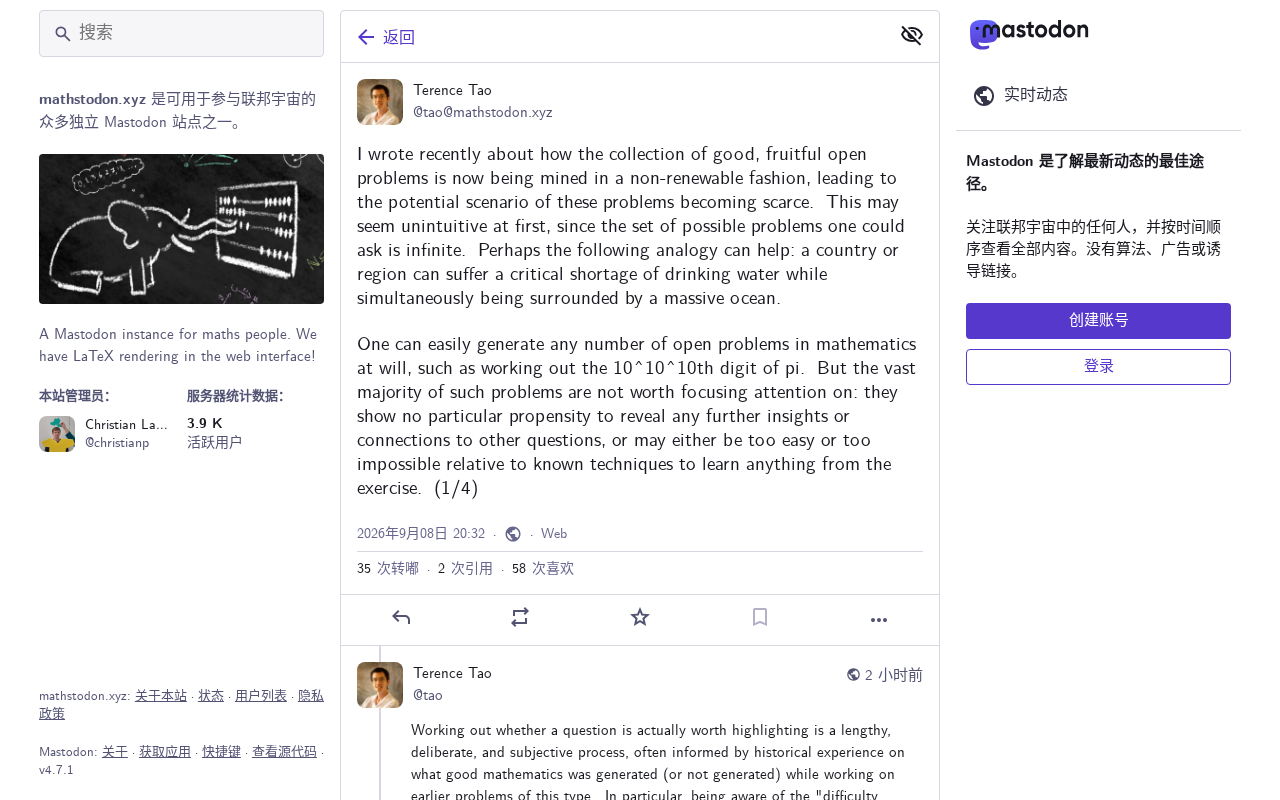
Terence Tao's Warning: AI Is Depleting the Non-Renewable Resource of Mathematical Problems
Fields Medalist Terence Tao warns that AI is mining mathematical problems in a non-renewable way. Exploring sustainability of math research in the AI era, the evolving role of human mathematicians, and balancing AI power with human creativity to maintain academic ecology.