Three Top AI Models Build Luxury Watches in Blender: Who Won?

Three top AI models generate luxury watches in Blender and create ads; GPT wins on topology, Gemini on cost, Claude on depth.
A YouTube creator tasked GPT-6 Astra, Gemini 4 Argon, and Claude Opus 5.5 with generating ultra-luxury watches from scratch in Blender and writing ad prompts to produce videos via Higgsfield Ad Studio. The test covered time, cost, geometry topology, and prompt ingenuity. GPT-6 Astra was fastest (2h23m) with the highest quad ratio at 98% and a token cost of about $55.35; Gemini 4 Argon was cheapest (about $2.11) with the fewest triangles (220,512) and the lightest scene; Claude Opus 5.5 was the most expensive (about $65.46) and slowest (3h27m) but produced the most detailed report and most specific ad creative, with the lowest quad ratio at 70%. None output a GLB file, so the test evaluated scene-building rather than asset delivery. The competitive dimension is shifting from "can it generate" to efficiency, cost, topology maintainability, and sub-agent orchestration.
A Cross-Model 3D Generation Showdown
A YouTube creator ran an ambitious test: three top AI models — GPT-6 Astra, Gemini 4 Argon, and Claude Opus 5.5 — were tasked with generating an ultra-luxury wristwatch from scratch in Blender, then writing ad prompts for their own creations and producing ad videos through Higgsfield Ad Studio. The evaluation went beyond the final visuals to include time spent, resource consumption, geometric topology quality, and the ingenuity of the prompt design.
What makes this showdown worth a closer look is that it pushes "AI writing code to build 3D scenes" from the lab into engineering reality: the models must understand Blender's Python API, manage scene hierarchies, handle materials and lighting, and maintain task coherence over long runs. The three models delivered markedly different results.
Efficiency and Cost: GPT-6 Astra's Blitz
GPT-6 Astra, in "ultra code" mode, completed its final review in 2 hours 23 minutes 34 seconds, of which animation rendering accounted for 2 hours 6 minutes 29 seconds. The log recorded 328 completed requests, processing about 41.16 million tokens, of which roughly 98% were cached input, with only 149,000 output tokens (including reasoning). At official standard API rates, the model token cost is estimated at about $55.35.
Its Blender file is only 1.4 MB, containing 889 mesh objects and 42,848 polygon faces, about 98% of which are quads. After applying modifiers and converting curves and text to mesh, the scene's triangle count is 555,002. Topology cleanliness is the highest of the three, with a near-perfect quad ratio — extremely friendly for subsequent rigging and animation.
The ad prompt GPT designed for Higgsfield required preserving the template's host, shot order, treatment, and pacing while replacing the watch, dialogue, lip-sync, and soundtrack. The scene is set in a "salon after closing," with a navy blazer, a slight British accent, and an annotation explaining "this is a constant."
Quads and Triangles: In 3D modeling, a polygon mesh is made of faces; a quad is a face bounded by four edges, and a triangle is bounded by three. Quads behave more stably in subdivision surfaces, UV unwrapping, and character rigging because their edge flow better matches ergonomic and animation deformation needs; triangles are the final computational unit of real-time rendering engines (such as game engines), and all models are triangulated before import. Therefore, the quad ratio is a key metric of topology quality — the higher the ratio, the easier the model is to edit and animate later. GPT-6 Astra's 98% quad ratio means its mesh can be used in production with almost no cleanup, whereas Claude Opus 5.5's 70% may require more manual retopology.
The Cost Killer: Gemini 4 Argon's Lightweight Route
Gemini 4 Argon, estimated at Google's official introductory API rates (valid until November 30), has a known token cost of only about $2.11 — the lowest of the three. Some cache fields are missing, making the statistics incomplete, but the cost advantage remains significant. Its Blender file is 1.25 MB, with 681 mesh objects and 112,112 polygon faces, about 95% quads, and 220,512 triangles after triangulation — the fewest faces and the lightest scene.
Gemini's ad prompt transformed the template into a "private Geneva vault showcase," replacing the watch and dialogue, specifying a salon director, charcoal clothing, watchmaker's gloves, and a looping shot, even directing hand movements, requiring a French-Swiss or Mayfair accent, opening on scarcity and closing toward collectors.
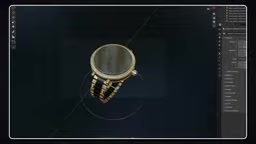
Cached Input and Token Cost: LLM API billing typically distinguishes between input and output tokens, and cached input refers to the model caching and reusing repeated or previously processed content when handling long contexts, thereby reducing the billing rate (usually 10%–25% of the normal input price). Of GPT-6 Astra's 41.16 million tokens, about 98% were cached input, which explains why its $55.35 cost is far lower than a full-price estimate. Gemini 4 Argon's $2.11 cost likewise benefits from caching, but missing cache fields make the statistics incomplete. Understanding caching helps assess the real economics of models on long tasks (such as multi-hour Blender scene generation).
Depth and Cost: Claude Opus 5.5's Heavyweight Answer
Claude Opus 5.5 took 3 hours 27 minutes, producing a multi-page report including a full page review, recording 6 sub-agents, 387 assistant messages, and about 185.2 million processed tokens (182.51 million cache reads, 1.84 million cache writes, 848,800 output including thinking). At official standard rates, the estimated cost is about $65.46 — the highest of the three. The report also includes 1 hour 1 minute of GPU rendering. However, the cache-write duration used in the estimate cannot be independently verified.
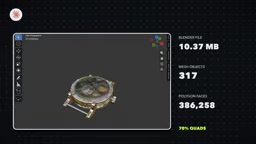
Its Blender file is 10.37 MB, the largest, but with only 317 mesh objects and 386,258 polygon faces, about 70% quads, reaching 665,522 triangles after triangulation. The quad ratio is notably lower than the other two, so topology cleanliness is somewhat inferior, but the object count is small, suggesting a more concentrated scene structure.
Claude's ad prompt preserved the template's host, vertical format, sequence, and pacing, replacing the watch and dialogue, setting a private Geneva client specialist, white gloves, a soft Parisian accent, and six timed lines, with audio requiring a mechanical ticking and a single chime, and no music or subtitles.
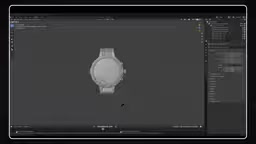
Sub-agent Orchestration: A sub-agent is a working mode in which the main model decomposes a complex task into multiple subtasks and dispatches multiple specialized agents to execute them in parallel or in sequence. Each sub-agent has its own context window and tool permissions, and the main model coordinates dependencies and aggregates results. Claude Opus 5.5 recorded 6 sub-agents, indicating it used a multi-agent collaboration architecture to handle different stages such as Blender scene building, ad prompt writing, and report generation. This mode can increase task depth and report completeness, but it also raises token consumption and coordination overhead — one reason Claude is the most expensive. Sub-agent orchestration is becoming an important dimension for evaluating how AI models handle long-cycle, multi-step engineering tasks.
Who Won? It Depends on How You Define Victory
If judged by efficiency and topology quality, GPT-6 Astra wins: 98% quads, middle-of-the-pack cost, and the shortest time. If judged by cost, Gemini 4 Argon crushes its rivals at about $2.11, with the lightest face count. If judged by narrative depth and report completeness, Claude Opus 5.5 offers the most detailed sub-agent collaboration record and ad creative details, at the price of the highest cost and a lower quad ratio.
You may not have noticed that none of the three output a GLB file; all geometry data comes from the Blender scene and includes the environment. This means the test evaluated "scene-building capability" rather than "asset-delivery capability." For workflows that truly need portable 3D assets, this remains a gap to be filled.
The showdown reveals a deeper trend: competition among AI models in 3D creation has shifted from "can it do it" to "how fast, how cheap, and how maintainable." Topology quality, cache efficiency, and sub-agent orchestration are becoming new scoring dimensions. And tools like Higgsfield Ad Studio link 3D generation with marketing content production into a chain — models don't just build watches; they also need to sell them.
As for who won, the video creator left the question to the audience. But the data has already produced category champions: GPT wins on craftsmanship, Gemini on cost, and Claude on depth. The real winners may be the teams that are starting to use these models to compress 3D content production cycles.
GLB Files and Asset Delivery: GLB is the binary version of glTF (GL Transmission Format), an open standard designed for efficient transmission and loading of 3D scenes, widely supported on the web, in game engines, and in AR/VR applications. A GLB file can package meshes, materials, textures, animations, and scene hierarchies, making it a universal container for 3D asset delivery. The article notes that none of the three output a GLB file, meaning the test evaluated the models' ability to build scenes inside Blender rather than generate portable, reusable 3D assets. For workflows that need to import AI-generated content into Unity, Unreal, or the web, the lack of GLB export is a practical gap and a key area future AI 3D tools need to address.
Related articles

14 Core Concepts of Reasoning Models: From Chain of Thought to GRPO Explained
A systematic breakdown of 14 core concepts of reasoning models: chain of thought, test-time compute, verifiers, RLVR and GRPO, distillation, and reward hacking, plus rules for controlling thinking-token costs to help you decide when reasoning is worth paying for.
OpenAI's Claimed Refutation of ETH Sparks Debate, Meta Bets Big on AI Infrastructure
OpenAI claims an AI-assisted discovery that challenges the Exponential Time Hypothesis (ETH) and launches the mid-tier GPT-6.1 Tera. Cloudflare discloses a cross-customer data leak postmortem, and Meta plans $95B in AI infrastructure financing.

Data Scraping, AI Proofs, and Open Source Contracts: This Week's Deep Dive into the Tech World
From the 3D model crawler controversy and OpenAI's Lean formal proofs to AI agents challenging Brooks' Law and Debian rejecting LLM review, this week's tech discussions center on openness and verifiability.