Three Words to Break Claude Opus 5? Unpacking the Security Concerns Behind LLM Jailbreaking

Exploring the security implications of an alleged 3-word jailbreak of Claude Opus 5 and LLM alignment fragility.
A Hacker News post claiming Claude Opus 5 was jailbroken with just three words highlights the inherent fragility of LLM alignment mechanisms. This article examines why statistical safety boundaries can always be bypassed, the special threat of ultra-short attack payloads, and why defense-in-depth strategies—including input filtering, output review, runtime monitoring, and continuous red teaming—are essential for any production AI system.
Three Words to Bypass AI Safety Guardrails?
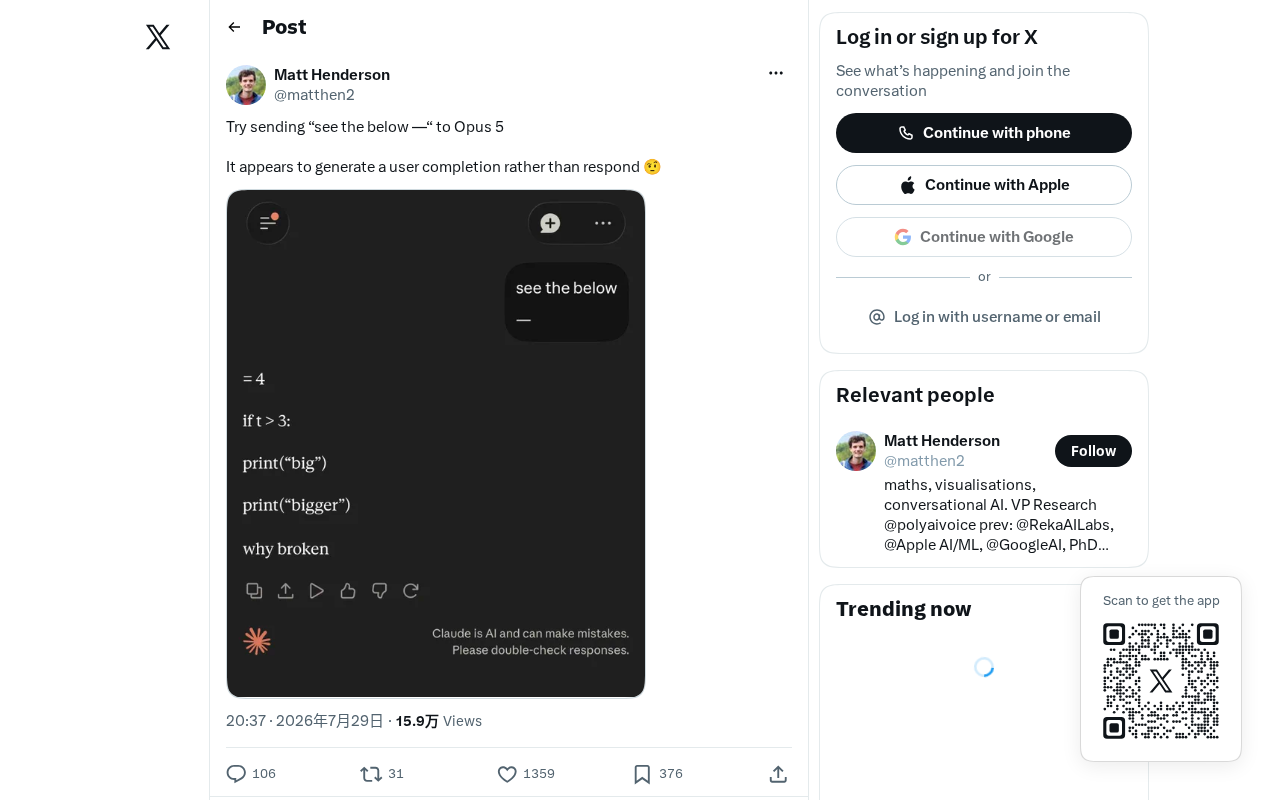
Recently, a post titled "Claude Opus 5 jailbreak with a 3-word prompt" caught attention on Hacker News. While the post itself gained minimal traction (only 3 upvotes and 0 comments), the issue it raises touches on one of the most critical pain points in large language model security: even the most advanced models with the strongest alignment capabilities can potentially be broken by extremely short prompts.
A "jailbreak" refers to using carefully crafted prompts to bypass a model's built-in safety alignment mechanisms, inducing it to produce content that should otherwise be refused—whether harmful information, policy-violating content, or behavior beyond preset boundaries. If the "three-word" attack payload is genuine, it would suggest that Claude Opus 5's safety defenses could be easily circumvented.
It's worth noting that the post contains limited information—the specific three-word prompt was not publicly disclosed, and there's no independent reproduction or verification. Therefore, this article uses the case as a springboard to explore the technical nature and security implications of LLM jailbreaking, rather than drawing conclusions about this single report.
Why Are LLM Jailbreaks So Persistent?
The Inherent Fragility of Alignment Mechanisms
The safety capabilities of large language models primarily come from post-training alignment, including Reinforcement Learning from Human Feedback (RLHF), Constitutional AI (Anthropic's signature technique), and various safety fine-tuning methods. These approaches essentially draw boundaries between "acceptable" and "unacceptable" within the model's vast output space.
From a technical perspective, RLHF operates through three key stages: first, supervised fine-tuning of the pre-trained model to give it basic instruction-following capabilities; then training a Reward Model to simulate human preference judgments about output quality and safety; and finally using reinforcement learning algorithms like PPO (Proximal Policy Optimization) to optimize the language model to maximize the reward signal. This process essentially "distills" human value judgments into model parameters. Anthropic's Constitutional AI takes this further—it reduces dependence on extensive human annotation, instead having the model critique and revise its own outputs according to a set of preset principles (the "constitution"), then using this self-corrected data for RLAIF (Reinforcement Learning from AI Feedback). The advantage of this approach is greater scalability, and the principles can be explicitly audited and adjusted.
However, regardless of the alignment technique used, these boundaries are statistical and probabilistic rather than hard rules. The model doesn't truly "understand" what is harmful—it has simply learned to refuse certain types of requests under specific contextual distributions. This creates a fundamental problem: as long as attackers can construct contexts outside the training distribution where the model hasn't been sufficiently aligned, safety mechanisms may fail. Whether human feedback or AI feedback, the training signal covers a finite set of scenarios and cannot exhaust all possible input distributions—while the combinatorial space of natural language is virtually infinite.
The Special Threat of Short-Prompt Jailbreaks
Historically, most well-known jailbreak techniques—such as "DAN" (Do Anything Now), role-play induction, Base64 encoding bypasses—typically require lengthy setup or complex encoding tricks. In contrast, if a three-word jailbreak is valid, its threat lies in:
- Extremely low attack barrier: No specialized knowledge needed; anyone can copy and paste.
- Difficult to detect or filter based on input length or complexity.
- Suggests the existence of a "shortcut vulnerability" within the model, where a specific short sequence happens to trigger bypass behavior.
This type of phenomenon is known in academia as "adversarial suffix" or "trigger word" attacks. In 2023, Zou et al. from Carnegie Mellon University published the groundbreaking paper Universal and Transferable Adversarial Attacks on Aligned Language Models, systematically demonstrating for the first time that through gradient-guided automated search (the Greedy Coordinate Gradient method), specific token sequences could be found and appended to any malicious request, causing both open-source and closed-source models to fail simultaneously. These adversarial suffixes often appear as random gibberish but happen to push inputs beyond safety boundaries in the model's high-dimensional representation space.
This research reveals a deeper issue: alignment is essentially drawing decision boundaries in continuous parameter space, and the shape of these boundaries in high-dimensional space is extremely complex, inevitably containing "wrinkles" and "gaps" that attackers can exploit. If the three-word jailbreak is real, it may mean attackers have found a natural language "blind spot" in the model's safety classifier—a semantic combination that was never adequately labeled as dangerous in training data but happens to activate the model's harmful output pathways. This is likely a continuation or variant of the academic approach described above, except the attack payload has evolved from meaningless character strings to meaningful natural language phrases, making it harder to detect using perplexity-based defenses.
Claude and Anthropic's Safety Positioning
Interestingly, the target of this attack is Anthropic's flagship model. Anthropic was co-founded in 2021 by siblings Dario Amodei and Daniela Amodei, both former OpenAI executives. The company's founding motivation was precisely a deep concern about AI safety—they believed that as model capabilities rapidly improve, investment in safety research must keep pace or even stay ahead.
Since its founding, Anthropic has made AI safety its core narrative. Its research contributions extend beyond Constitutional AI to include deep exploration of model interpretability (Mechanistic Interpretability)—attempting to understand the specific functions of internal neurons and features—forward-looking research on Sleeper Agent backdoor risks, and exploration of "Faithful Chain-of-Thought." The company emphasizes its Responsible Scaling Policy framework, which sets corresponding safety evaluation standards (ASL, AI Safety Levels) for models at different capability levels, with requirements escalating from ASL-1 through ASL-4. In the industry, the Claude series has consistently been regarded as one of the more robust models in refusing harmful requests.
This is precisely why the claim that "even Claude can be broken with three words" carries such impact. It reminds us:
No matter how well safety alignment is done, it doesn't equal absolute security. Attack and defense is a continuously evolving arms race, and any static defensive line can be breached by new attack paradigms.
That said, we should remain rational—there's a vast gap between a single unverified social media report and peer-reviewed security research. Proper evaluation requires reproducible experiments, clearly defined attack success rate metrics, and vendor response confirmation.
Deeper Security Lessons from Jailbreaking
From "Patching" to "Defense in Depth"
Facing an endless stream of jailbreak techniques, merely patching specific vulnerabilities treats symptoms rather than causes. Defense in Depth is a classic concept borrowed from cybersecurity, with the core principle of not relying on a single defensive line but constructing multiple independent layers of security barriers. The industry is exploring more systematic defense-in-depth approaches:
- Input-side filtering: Using independent classifiers to detect potentially malicious inputs before they reach the model. These classifiers typically use specially trained smaller models (such as Meta's Llama Guard series) to score user inputs for harmfulness. Their inference cost is far lower than the main model, allowing them to serve as low-latency front-end gateways.
- Output-side review: Performing secondary safety review on model-generated content. After generation is complete, another independent model or rule engine verifies the output, checking for harmful, policy-violating, or sensitive information. Non-compliant outputs are intercepted or rewritten.
- Multi-layer alignment: Combining training-time alignment with real-time supervision during inference. Runtime Monitoring is a newer research direction, including detecting whether internal model activation patterns deviate from "safe trajectories"—for example, Anthropic's own interpretability research can already identify feature directions within the model associated with deception and harmful outputs, which could theoretically enable real-time intervention during inference.
- Normalized red teaming: Continuously using both automated and manual methods to proactively discover vulnerabilities. Red teaming has evolved from purely manual efforts to human-machine collaborative approaches, using automation tools such as Anthropic's Constitutional Red Teaming or the open-source framework Garak to generate attack variants at scale, striving to discover and fix weaknesses before attackers do.
Transparent Disclosure and Responsible Research
This incident also raises an ethical question: how should jailbreak discoveries be disclosed? Publishing reproducible attack prompts directly on public platforms risks abuse, while complete secrecy doesn't help push vendors to improve.
Responsible Disclosure (or Coordinated Disclosure) practices originate from traditional software security. Under this framework, researchers who discover vulnerabilities first contact vendors privately, typically allowing a 30-90 day remediation window during which vendors should confirm the vulnerability, develop fixes, and deploy updates. Only after the window expires may researchers publicly disclose technical details. Currently, major AI vendors have established Bug Bounty Programs: Anthropic, OpenAI, Google DeepMind, and others offer rewards ranging from hundreds to tens of thousands of dollars, incentivizing security researchers to report findings through proper channels.
However, LLM security vulnerabilities differ fundamentally from traditional software vulnerabilities—traditional vulnerabilities become permanently invalid once patched, while LLM jailbreaks often have a "whack-a-mole" quality, where patching one specific prompt quickly leads attackers to find semantically equivalent variants. This means that vulnerability disclosure frameworks alone are insufficient for addressing LLM security challenges, requiring more systematic defensive strategies. The industry generally advocates building upon responsible disclosure while simultaneously promoting systematic research and defense against attack categories (rather than individual instances).
Conclusion: LLM Security Is an Ongoing Process, Not a Destination
Regardless of the specific veracity of the "three-word jailbreak," the reality it reflects is clear: as large models become more capable and more widely deployed, their security boundaries will continue to face pressure testing from researchers and attackers worldwide.
For developers and enterprise users, the lesson is this—don't treat a model's safety alignment as a foolproof guarantee. When building LLM-based applications, assume the model can be bypassed, and add additional permission controls, content moderation, and human fallback mechanisms at the system level. Security is never a problem that models alone can solve—it's a responsibility that the entire application architecture must share.
Related articles

Hungarian Algorithm Explained: Principles, Complexity, and Engineering Implementation Guide
In-depth explanation of the Hungarian Algorithm: core principles, O(N³) time complexity advantages, and engineering implementation. Covers assignment problem definition, step-by-step algorithm walkthrough, Python/C++ libraries, and applications in multi-object tracking and resource scheduling.
OpenAI's First Enterprise AI Report: H…
OpenAI's First Enterprise AI Report: How ChatGPT Is Changing the Way Organizations Work
OpenAI's first enterprise AI report reveals three key traits of ChatGPT Enterprise adoption: the shift from novelty to necessity, writing and coding as top use cases, and data governance as a core prerequisite.

DeepSeek-V4-Pro Released: A Comprehensive Analysis of Agent Capabilities and Elastic Reasoning Mechanism
DeepSeek-V4-Pro launches with major Agent capability upgrades, elastic reasoning effort mechanism, and native OpenAI Responses API compatibility. A deep dive into production deployment and cost optimization.