TikTok Bans Musk Documentary Account: A Platform Battle on the Eve of Release

TikTok permanently banned the Musk documentary's account ahead of its wide release, sparking debate over platform governance transparency.
TikTok permanently banned the social media account of Alex Gibney's Musk documentary on the eve of its wider release, with distributor Bleecker Street notified on Friday. The ban decision lacked specific violation clauses and was communicated only verbally, raising questions about platform governance transparency. Documentary marketing relies heavily on social platforms, and losing TikTok directly affects the film's ability to reach young audiences. Musk's business relationship with ByteDance and the competitive backdrop with X add complexity. The distributor has not announced appeal plans or marketing strategy adjustments, and TikTok's silence leaves the event at a one-sided statement stage.
Event Overview: A Ban on the Eve of Release
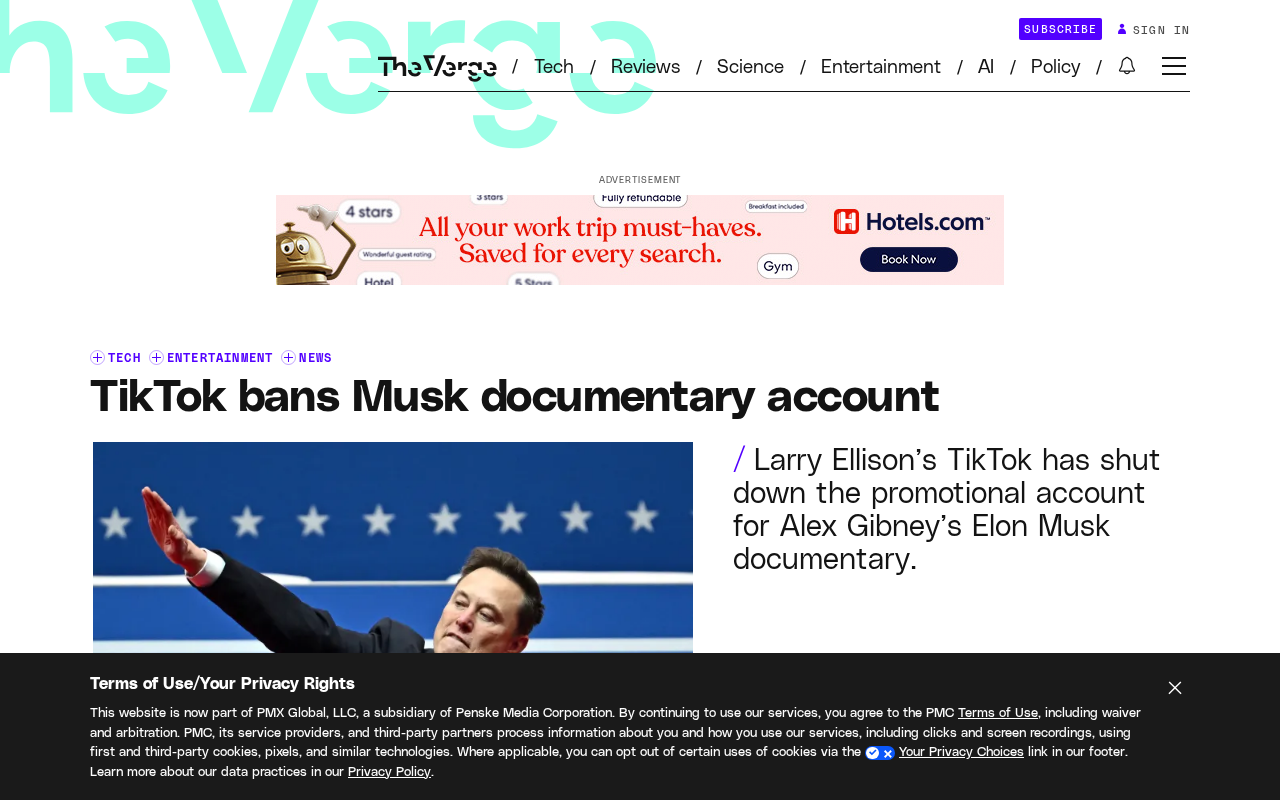
According to The Hollywood Reporter, just as Alex Gibney's documentary about Musk was about to be widely released, TikTok banned the film's social media account. The film's distributor, Bleecker Street, was notified on Friday afternoon that the account would face a "permanent ban." TikTok did not immediately respond to a request for comment.
The timing is intriguing—the ban occurred on the eve of the documentary's expansion to a wider release, rather than during an earlier promotional phase. For a documentary that relies on social media buzz, losing TikTok—a channel where young users congregate—directly impacts its ability to reach potential viewers.
Alex Gibney is one of the most renowned investigative documentary filmmakers of our time, known for deep dives into the inner workings of institutions and abuses of power. In 2007, he won the Academy Award for Best Documentary for Taxi to the Dark Side, which investigated the abuse of prisoners by U.S. forces in Afghanistan. Since then, he has released Enron: The Smartest Guys in the Room (exposing Enron's financial scandal), Going Clear (focusing on Scientology), and The Inventor (dissecting the Theranos blood-testing fraud), among others. Gibney's style leans toward constructing systemic critiques through extensive interviews, internal documents, and archival material; his films often spark widespread public debate after release and push related issues into the mainstream. This Musk documentary continues his focus on the power dynamics of tech giants.
Revisiting Platform Power and Content Boundaries
The core controversy surrounding TikTok's action is: on what grounds did the platform make a permanent ban decision? Currently, the only public information is the verbal notice received by the distributor, with no specific violation clauses provided. This lack of transparency is precisely the focus of recent debates on platform governance.
From a platform operations perspective, TikTok has the right to manage accounts according to its community guidelines. But when the target of a ban is a documentary on a public issue involving the world's richest person, the nature of the decision escalates from routine content management to an editorial judgment with public impact. Especially considering the complex relationship between Musk himself and TikTok's parent company ByteDance—Tesla's interests in the Chinese market, Musk's public comments on TikTok's fate—the coincidence of the ban's timing inevitably invites speculation.
According to a single-source report by The Hollywood Reporter, Bleecker Street was "informed" rather than "consulted" about the ban decision. This detail suggests the platform took unilateral action rather than communicating with the content provider.
TikTok's Community Guidelines are the core document for its content governance, covering categories such as violence, hate speech, harassment, misinformation, and protection of minors, and stipulating tiered penalties including warnings, content removal, feature restrictions, and account bans. The platform typically cites specific clauses when banning accounts and allows users to appeal through in-app channels. However, enforcement of the Community Guidelines has always been mired in transparency controversies: the text itself is broad, and specific judgments often rely on the discretion of the platform's internal review teams, making it difficult for outsiders to verify consistency. For content involving public issues or public figures, platform decisions also face additional public pressure—avoiding the appearance of political censorship while maintaining consistency in community standards. This tension makes the decision-making process and information disclosure of platforms like TikTok when handling high-profile accounts a key case study in platform governance research.
Distribution Challenges and Strategy Adjustments
For Bleecker Street, the loss of the TikTok account means the distribution strategy needs to be restructured. Documentary marketing relies heavily on social media clip sharing and buzz generation; TikTok's recommendation algorithm has helped several political figure documentaries gain unexpected attention.
Gibney's previous works such as Going Clear (about Scientology) and The Inventor (about Theranos) both leveraged social platforms to spark widespread discussion. This Musk documentary faces a more complex communication environment: on one hand, Musk himself has X as a direct channel to respond instantly to the film's content; on the other hand, TikTok's ban cuts off the film's natural diffusion path in the short-video ecosystem.
The distributor has not yet announced whether it will appeal the ban or whether it will adjust the allocation of its digital marketing budget.
Bleecker Street is an American independent film distribution company founded in 2014, specializing in theatrical and streaming releases of narrative films and documentaries. It has distributed films such as The Girl on the Train and The Death of Stalin. In documentary distribution, independent distributors typically employ a "limited theatrical + streaming window" strategy: first release in a few theaters in New York, Los Angeles, and other cities to qualify for reviews and media exposure, then gradually expand the release, and finally launch on streaming platforms. Social media marketing plays a key role in this chain, especially TikTok's short video clips and hashtags, which can reach young audiences at very low cost. For documentaries about political figures or tech giants, distributors often rely on social platforms to generate controversial topics that drive attention. Therefore, losing the main social channel means reallocating budget and effort to other channels such as YouTube, Instagram Reels, or traditional media interviews.
Unresolved Questions and Points for Follow-up
The lack of transparency leaves several key questions: Will TikTok provide specific reasons for the ban under pressure? Is the decision related to specific content in the film? Will Bleecker Street seek legal recourse or public pressure?
As of reporting, TikTok's silence leaves the event at the stage of a one-sided statement. For observers concerned with platform governance, the boundaries of content moderation, and the relationship between tech giants and the media, this case offers new material for discussion—when a platform is both a content channel and a commercial entity, how do its management decisions withstand public scrutiny?
The subsequent development of the event will depend on the distributor's response strategy and whether TikTok provides additional explanation for the ban.
Related articles

A Single Prompt Triggers a Global PHP Security Storm: Is AI a Savior or a Hidden Risk?
A single AI prompt triggered a global PHP security crisis affecting Wikipedia and the Internet Archive. This article reviews the incident, analyzes the OpenAI-Amazon controversy, and explores the security paradox of lowered vulnerability discovery barriers in the AI era and developer response strategies.

When AI Is Taken Away: How Reliance on Shortcuts Undermines Your Problem-Solving Resilience
A study of 1,222 people found that after using AI to answer questions, once AI was removed, people gave up on more problems than a control group that never used AI. The article analyzes the impact of AI reliance on learning resilience and metacognition, and explores design implications for AI learning tools.

Carta and NewView Partner to Let Startup Employees Cash Out Equity Early
Carta and NewView Capital partner to simplify startup tender offers, helping employees sell equity early. Analysis of the mechanism, liquidity pain points, and impact.