TitleArt: One-Click 1997-Style Retro Text Art

TitleArt recreates 1997 web title art with a minimalist web tool, sparking nostalgia on Hacker News.
TitleArt is an online text art generator that applies iconic late-90s gradients, strokes, shadows, and retro fonts to user text, quickly producing visual titles reminiscent of web banners from that era. It earned 208 points and 28 comments on Hacker News's Show HN, showing real community interest in retro-style tools. The article analyzes its viral appeal: it precisely taps digital nostalgia, and as a single-point function product, its output is naturally suited for screenshot sharing — sharing itself drives customer acquisition.
Beyond the design trends of minimalism and flat design, a retro nostalgia wave is quietly resurging in the tech community. Recently on Hacker News, a small tool called TitleArt drew attention with its promise to "Make text like it's 1997" — turning ordinary text into the iconic web title art of that era.
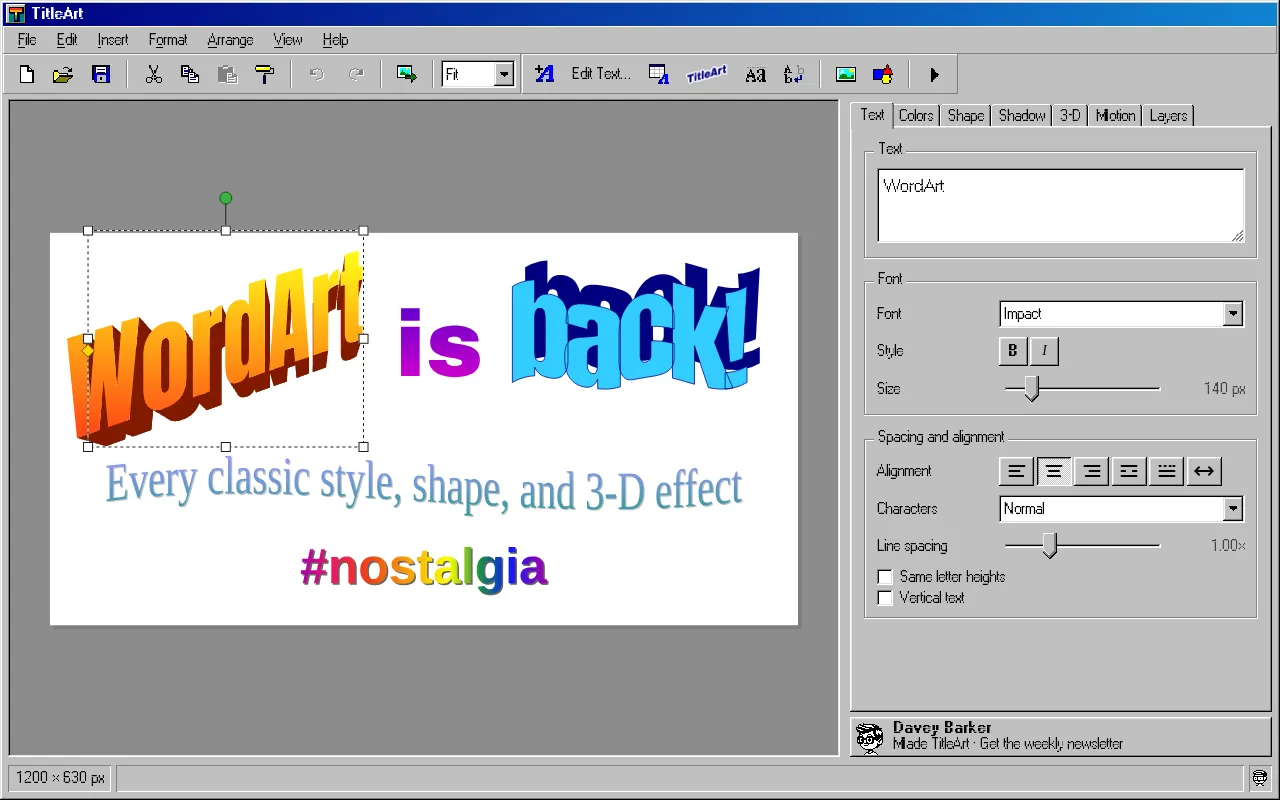
What Is TitleArt?
TitleArt is an online text art generator. After users input text, the tool applies era-flavored fonts, gradients, strokes, and shadow effects, outputting visual text reminiscent of late-90s web banners. It requires no design software — just open the webpage and go. Its core selling point is one word: fast.
The project earned 208 points on Hacker News and attracted 28 comments. While the discussion volume isn't explosive, the ratio of upvotes to comments shows that many users have genuine interest in this precisely positioned little tool.
Why Is 1997 Text Style Back?
The web design language of the late 90s was characterized by exaggerated gradients, multi-layered strokes, glowing shadows, and Comic Sans-style fonts. Today, these elements seem crude or even "tacky," but it's precisely this strong visual memory that makes them part of digital nostalgia culture.
TitleArt captures exactly this emotional value. It doesn't solve efficiency problems or offer productivity — instead, it lets users recreate a collective memory with an extremely low barrier to entry. For creators who need to make retro-style posters, podcast covers, indie game assets, or social media memes, this type of tool fills a niche but real demand gap.
Late-90s web design was constrained by the technical conditions of the time, which paradoxically gave rise to a highly recognizable visual language. Take personal homepages around 1997 — creators often used HTML's <font> tag, <marquee> scrolling text, and 3D titles generated by WordArt — the latter being a built-in text art feature in Microsoft Office that could apply gradients, 3D rotation, and metallic textures with one click. These effects seem crude today, but because of their low technical barrier and exaggerated style, they became a collective memory for a generation of netizens. The so-called "digital nostalgia" refers precisely to users' emotional projection onto early internet visual symbols. It often stands in contrast to today's overly refined, homogenized flat design, which is why retro styles are often used as a conscious aesthetic rebellion.
The Product Thinking Behind the Tool
From a product perspective, TitleArt is a typical "single-point function" tool: it doesn't try to be a comprehensive design platform, but solves one specific problem. This approach is increasingly common in the indie developer community — entering with a lightweight, shareable, recognizable feature and relying on community spread to acquire initial users.
The Show HN section on Hacker News has always been a touchstone for such projects. Projects that earn over 200 points typically either solve a real developer problem or have strong viral potential. TitleArt clearly belongs to the latter: its output is naturally suited for screenshot sharing, and sharing itself is the best customer acquisition channel.
Hacker News's Show HN section is a regular feature where indie developers launch new projects and gather early feedback, with projects submitted under the title format "Show HN: Project Name." Community users express approval through upvotes (points) and comments, and the point count directly affects how long a post stays visible on the homepage. Since Hacker News attracts a large number of engineers and entrepreneurs, evaluations tend to focus on technical implementation, practical value, and originality — so projects earning 200+ points usually have some topicality or address a real need. For single-point tools, appearing on Show HN is not only a traffic gateway but also a low-cost market validation — questions and suggestions in the comments are often used directly by developers for subsequent iterations.
Who Should Use TitleArt?
- Content creators: Quickly generate retro titles for video thumbnails and podcast images.
- Indie game developers: Create 90s-style UI assets or promotional images.
- Social media users: Generate images with nostalgic memes and join retro-themed discussions.
- Designers: Use as inspiration reference to quickly explore retro typography directions.
It should be noted that the source material does not disclose the tool's specific feature details, tech stack, or whether it's paid, so the above use cases are inferred from its "1997 text style" positioning.
The Viral Logic of Niche Tools
TitleArt's path to popularity isn't complicated: a clearly positioned name, a time label that evokes resonance (1997), and a ready-to-use web interface. Together, these three lower the cost of user understanding and trial.
In an era flooded with AI generation tools, a small tool that doesn't rely on models, doesn't emphasize intelligence, and focuses solely on style recreation seems refreshingly lightweight. It reminds us that a tool's value doesn't have to be measured by technical complexity — sometimes, precisely hitting an emotion is enough.
If you're interested in retro design, or just want to add some era flavor to a piece of text, head over to titleart.dvy.io and give it a try.
One-line Summary
TitleArt recreates 1997 web title art with a minimalist web tool, sparking nostalgic attention on Hacker News.
Paragraph Summary
TitleArt is an online text art generator that lets users input text and apply iconic late-90s gradients, strokes, shadows, and retro fonts to quickly produce visual titles reminiscent of web banners from that era. The project earned 208 points and 28 comments on Hacker News's Show HN section, demonstrating genuine community interest in retro-style tools. The article analyzes its viral success: first, it precisely hits digital nostalgia; second, it's a typical single-point function product whose output is naturally suited for screenshot sharing — and sharing itself drives customer acquisition. Use cases include video thumbnails, podcast images, indie game assets, and social media memes. In a landscape flooded with AI tools, this type of lightweight stylized tool offers an alternative product approach that wins through emotional value.
Related articles

A New Paradigm for Text Editing in Compose: TextFieldState Replaces the Old API
Jetpack Compose introduces the TextFieldState API to fix dropped characters and cursor jumps from async input. The old value/onValueChange callbacks will be deprecated in 1.13. This article covers InputTransformation, OutputTransformation, four state hoisting patterns, and new formatted text editing capabilities.

Remote Compose: A New Document-Driven Paradigm for Cross-Platform UI on Android
Remote Compose transmits compact binary documents instead of screen pixels, enabling efficient UI rendering on remote surfaces like Wear OS and widgets. This article covers its document creation API, expression animations, size optimization techniques, and Wear OS progress.

How Crashlytics Eliminates Android Memory and Responsiveness Issues
Through the Chroma Clip case study, this article explains how Firebase Crashlytics uses Application Exit Info, Profiling Manager, GWP ASAN, and ARM MTE to pinpoint ANRs, OOMs, memory limit terminations, and native memory corruption—solving the challenge of stack traces that don't point to the real culprit.