Tokenization: A Deep Dive into the Most Underrated Component of Modern NLP

32 researchers deliver the most comprehensive NLP tokenization survey, covering algorithms, multilingual challenges, and future alternatives.
Tokenization is a long-underrated foundation of large language model pipelines, directly shaping how models perceive language. A new survey by 32 researchers, completed over roughly eight months, fills a critical gap in structured literature review. It covers mainstream algorithms (BPE, WordPiece, Unigram), multilingual and encoding challenges, and theoretical foundations, while also introducing latent and visual tokenization as potential future replacements. Practical topics including constrained generation, token healing, and tokenizer security are also addressed, making this an essential reference for anyone working in large-scale NLP.
The Overlooked Foundation of Language Models
As large language models continue their rapid advance, most attention has been focused on model architecture, training data scale, and reasoning capabilities — while tokenization, the foundational preprocessing step, has long languished at the edges of research. Yet tokenization's influence runs through the entire NLP pipeline: from multilingual support to generation quality, from computational efficiency to security vulnerabilities, it is nearly everywhere.
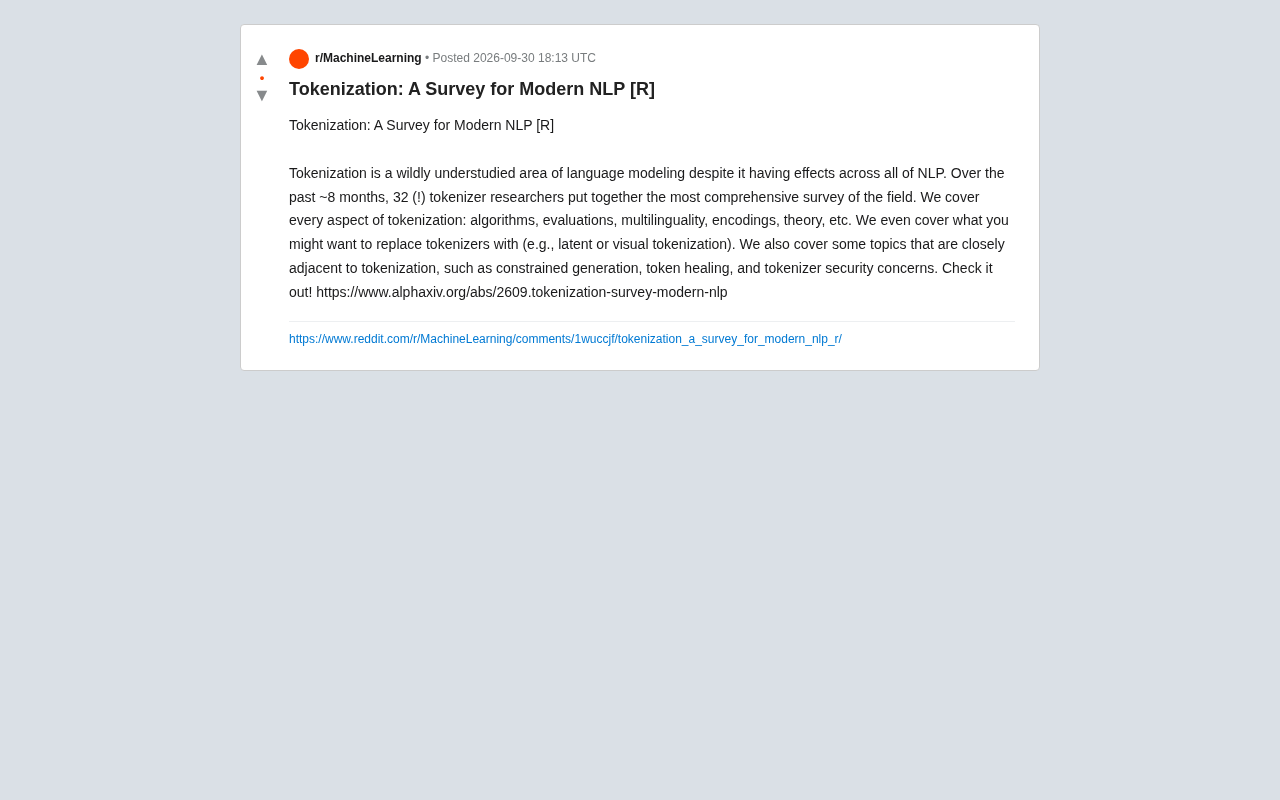
Recently, a team of 32 tokenization researchers spent roughly eight months completing what is being called the most comprehensive survey of tokenization to date. According to the authors' post on Reddit, the work aims to systematically organize a field that has been "wildly understudied," filling a long-standing gap in structured literature review.
Core Dimensions Covered by the Survey
One of the survey's defining characteristics is its extraordinary breadth, touching on virtually every layer of tokenization research:
Algorithms and Evaluation
The survey systematically reviews mainstream tokenization algorithms — such as BPE (Byte-Pair Encoding), WordPiece, and Unigram — and explores how to rigorously evaluate the quality of a tokenizer. Quality evaluation has long lacked a unified standard; tradeoffs between compression ratio, vocabulary size, and downstream task performance represent one of the field's most persistent pain points.
BPE (Byte-Pair Encoding) was originally a data compression algorithm, introduced into NLP by Sennrich et al. in 2016. Its core idea is to iteratively merge the most frequently occurring adjacent byte or character pairs in a corpus until the vocabulary reaches a preset size. The GPT series of models widely uses a variant of BPE. WordPiece, proposed by Google and adopted by BERT, differs from BPE in its merging criterion: it maximizes language model likelihood rather than simply counting frequencies, and therefore tends to preserve more semantically meaningful subword units. The Unigram language model approach is a third mainstream path, proposed by Kudo in 2018. It starts from a large vocabulary and progressively prunes it, retaining the subword set that minimizes corpus likelihood loss; the SentencePiece library provides a full implementation. The choice among these three algorithms involves different tradeoffs between vocabulary size, rare word coverage, and cross-lingual generalization — which is the fundamental reason why evaluation standards remain difficult to unify.
Multilingual Support and Encoding
Multilingual scenarios present one of the greatest challenges for tokenization. The morphological structures of different languages vary enormously; a tokenizer that performs well on English may be highly inefficient for morphologically rich languages (such as Finnish or Turkish) or non-Latin writing systems. The survey dedicates specific attention to multilinguality and character encoding strategies.
Theoretical Foundations
Beyond engineering practice, this work also engages with the theoretical dimensions of tokenization, attempting to lay a more rigorous theoretical foundation for a field that has been primarily driven by empirical results.
Beyond Tokenization: Alternative Paradigms for the Future
The survey doesn't stop at existing technologies — it also looks ahead to new paradigms that may eventually replace traditional tokenizers:
- Latent Tokenization: Rather than relying on explicit discrete tokens, representations are constructed in a continuous latent space.
- Visual Tokenization: Text is rendered as images before processing, bypassing traditional character segmentation logic entirely.
These directions reflect a fundamental question the research community is beginning to ask: do we actually need tokenizers at all? As model capabilities grow, processing inputs directly at the byte or pixel level is becoming increasingly viable.
The idea behind visual tokenization draws inspiration from multimodal models: since large vision-language models can already process text directly from images, why not render all text as pixels and let the model handle it uniformly? The PIXEL model (2022) was an early implementation of this approach, rendering text as image patch sequences fed into a ViT encoder — completely bypassing vocabulary design and OOV (Out-of-Vocabulary) problems. Latent tokenization is closely tied to research on "tokenizer-free models," with representative works including byte-level approaches like ByT5 and MegaByte. These methods push sequence modeling granularity down to individual bytes; while they eliminate the artificial boundaries introduced by tokenization, the computational cost from dramatically longer sequences remains the primary bottleneck. Both directions converge on the same question: to what extent is current tokenization design a legacy engineering compromise rather than the optimal choice for language understanding?
Practical Topics Adjacent to Tokenization
The survey also incorporates several application-focused topics closely related to tokenization, which are particularly valuable for engineering practice:
- Constrained Generation: How to force a model during decoding to produce output conforming to specific formats (such as JSON or regular expressions), which is intimately tied to token-level processing.
- Token Healing: Addressing generation anomalies caused by tokenization boundary artifacts to improve output coherence.
- Tokenizer Security: Examining the attack surface that tokenization can introduce — such as adversarial inputs constructed using special tokens — an often-overlooked issue with far-reaching security implications.
Token Healing is a concept introduced by Microsoft's Guidance framework, targeting a subtle generation defect: when a model encounters an incomplete token boundary at the end of a prompt, greedy decoding "anchors" the probability distribution at that position to a suboptimal prefix, causing unexpected repetition or truncation in subsequent generation. For example, if a prompt ends with " http", the model may produce abnormal continuations because the space and "http" are split into two tokens. The fix is to roll back the last token and re-sample from the complete boundary while preserving the text content. Tokenizer security encompasses a broader range of issues: special control tokens (such as
<|endoftext|>) injected through user input can bypass the safety boundaries of dialogue systems; certain token combinations can cause a model's output probability distribution to collapse; and differences in how different tokenizers segment the same string can undermine the effectiveness of rule-based content filtering systems.
Why This Work Deserves Attention
Tokenization may appear to be a minor "preprocessing" step in the NLP pipeline, but it fundamentally determines what a model can "see" and the granularity at which it understands language. A poorly designed tokenizer will persistently constrain model performance in areas like vocabulary bloat, long-text processing, and rare word representation — and these effects are often impossible to fully compensate for through subsequent training.
The collective collaboration of 32 researchers itself signals that this field is finally beginning to receive the attention it deserves. For practitioners working on large model development, multilingual NLP, or controllable generation, this survey provides a rare and comprehensive reference map. Interested readers can access the full paper on the alphaxiv platform.
Related articles

Should U.S. College Fraternities Be Banned? A Researcher's Incisive Observations
Why not just ban U.S. college fraternities? A researcher finds the key resistance comes from decision-makers' own fraternity identities and schools' "willful ignorance."

Microsoft Discovery: Accelerating Scientific Discovery with AI Agents
Microsoft's Discovery platform runs specialized AI agents to help researchers screen and prioritize the most promising compounds and experimental paths, reducing experiments and accelerating scientific discovery.

Cambridge Heavy Industries Secretly Develops Desktop-Scale Nuclear Fusion Device
Cambridge Heavy Industries is secretly developing a desktop-scale laser-driven nuclear fusion device, targeting the equipment supply market for fusion power plants. This article analyzes its miniaturization technology path, commercialization logic, and unique positioning in the fusion startup wave.