Tomo for ChatGPT: Turn Any Question into a Game, Duolingo-Style Learning

ChatGPT plugin Tomo instantly turns any topic into a Duolingo-style level-based game.
Tomo for ChatGPT is a ChatGPT plugin that ranked #12 on Product Hunt's daily chart, turning any topic into an interactive Duolingo-style quiz with a hearts mechanic embedded in chat. It offers teacher personas like Professor or Pirate and requires no registration. Its gamification forces active recall and content is generated instantly at near-zero marginal cost, but quality varies by model output, making it better for concept introduction than systematic learning.
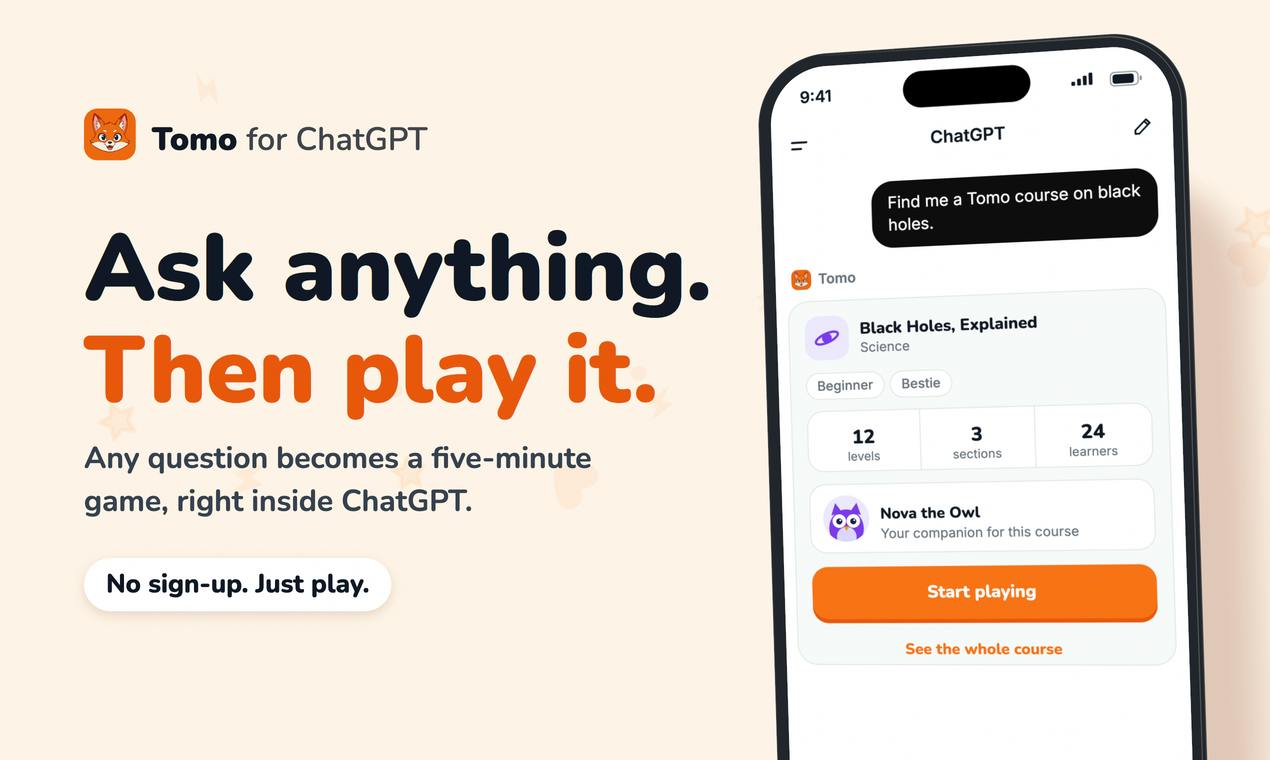
ChatGPT can answer any question, but the answer is often a big block of text. What if you turned it into a mini-game? Tomo for ChatGPT, ranked #12 on Product Hunt, tries to do exactly that—you ask it what a black hole is, and it hands you a Duolingo-style level-based game.
From Q&A to Game: What Is Tomo
Tomo is a ChatGPT plugin, and its core idea can be summed up in one tagline: "Ask anything. Then play it, Duolingo-style." You raise any topic with ChatGPT, and Tomo generates an interactive lesson embedded in the conversation in the form of a game.
According to its Product Hunt page, the game mechanics include rapid-fire Q&A and a "hearts" system—wrong answers cost a heart, similar to Duolingo's level-based experience. There's no limit to the range of topics; you can even use "the current conversation" itself as learning material.
This design targets the attention problem in learning scenarios: reading long explanations makes it easy to zone out, while gamified Q&A forces you to actively recall and judge, potentially improving learning efficiency.
ChatGPT Plugin mechanism: Plugins are an extension system OpenAI introduced for ChatGPT in 2023, allowing third-party services to connect to conversations via API. Users need to manually enable plugin functionality in settings and check the target plugin for each conversation. A plugin is essentially a standardized interface: ChatGPT calls the plugin based on user intent and displays the structured content it returns (text, images, interactive cards, etc.). For developers, plugins lower the distribution barrier—reach ChatGPT's massive user base without a standalone app; for users, plugins expand ChatGPT from "pure text Q&A" into a platform that can execute specific tasks. Tomo leverages this mechanism to package model-generated content into an interactive game interface embedded in the conversation flow.
Gameplay Breakdown: Teacher Personas and Zero Barrier to Entry
One interesting design in Tomo is "choose your teacher." The page mentions selectable characters ranging from "The Professor" to "The Pirate," with different personas potentially bringing different tones and question styles, adding role-playing fun to the learning process.
The onboarding flow is also deliberately lightweight: add Tomo in ChatGPT's Plugins and start without registration. For plugin products, lowering the first-use barrier is key—users don't have to leave the chat window or fill out forms; they can play right after asking a question.
Looking at product data, Tomo earned 70 votes and 3 comments on Product Hunt, ranking #12 for the day, with category tags Education, Artificial Intelligence, and Games. This shows it hits the intersection of "AI + education + gamification," though community discussion is still in its early stages.
"Hearts" mechanism: Hearts are a common negative incentive mechanism in gamified learning products, most typically used by Duolingo—a wrong answer costs a heart, and when hearts run out you must wait for them to recover or pay to refill. Its design principle comes from "loss aversion" in behavioral psychology: compared with rewards for correct answers, players care more about losing existing resources, so they answer more carefully and actively review weak points. At the same time, limited hearts create moderate tension and pacing constraints, avoiding mindless trial and error. In instantly generated Q&A games like Tomo, hearts also serve as a "difficulty regulator": questions are generated on the spot by the model with varying quality, and hearts keep users alert to wrong answers while indirectly encouraging them to read explanations carefully rather than quickly skipping through.
The Value of Gamified Learning in the AI Era
Turning knowledge into a game is not a new concept; Duolingo has already validated that gamification mechanisms improve retention in language learning. Tomo's difference is that the content is not preset but generated instantly by a large model. This means any obscure topic can immediately become a lesson, with marginal cost close to zero.
However, instant generation also brings quality fluctuation. The accuracy of game questions and whether the difficulty curve is reasonable both depend on the stability of the model's output. The Product Hunt page does not disclose a question review mechanism, which may be a point to watch in actual use.
Another noteworthy direction is "turning the conversation itself into a game." If a user is discussing a complex project with ChatGPT, Tomo can generate questions based on context to test understanding, which is more interactive than simply reading an answer.
Quality fluctuation of instantly generated content from large models: In traditional educational games, questions are pre-written, reviewed, and difficulty-calibrated by curriculum teams, whereas Tomo's questions are generated instantly by a large language model during conversation. Large models suffer from "hallucinations" and may generate questions with factual errors, logical contradictions, or jumps in difficulty; repeated generation on the same topic may also be inconsistent, leading to an unstable learning experience. In addition, the model lacks continuous modeling of the learner's knowledge level, making it difficult to dynamically adjust question difficulty like an adaptive learning system. Therefore, the advantages of instant generation (broad coverage, low marginal cost) coexist with disadvantages (accuracy, consistency, difficulty control). In actual use, users need a certain ability to discriminate and should still cross-verify key knowledge points.
Who Tomo Is For
Based on the available information, Tomo suits three types of people: first, users who want to learn new concepts in fragmented time—the game format lowers the activation barrier; second, educational content creators, who can quickly generate interactive courseware prototypes; third, learners who enjoy role-playing and lightweight games—the "Professor" or "Pirate" personas provide emotional value.
Its limitations are also obvious: as a plugin, it depends on the ChatGPT ecosystem and cannot be used independently outside the platform; gameplay depth is limited, making it better for concept introduction than systematic learning. For scenarios requiring a rigorous knowledge system, it still needs to be paired with traditional learning materials.
Overall, Tomo represents a product approach—treating AI not as a search engine but as a game engine. When answers become levels, asking a question itself becomes a learning activity.
One-line Summary
ChatGPT plugin Tomo instantly turns any topic into a Duolingo-style level-based game.
Paragraph Summary
Tomo for ChatGPT is a ChatGPT plugin that reached #12 on Product Hunt's daily chart. Its core idea is "Ask anything. Then play it, Duolingo-style."—users raise any topic and it instantly generates an interactive lesson embedded in the conversation, simulating Duolingo's level-based experience with rapid Q&A and a hearts mechanism. The product supports choosing teacher personas such as "Professor" and "Pirate," and requires no registration, lowering the barrier to use. Its value lies in using gamification to force active recall, compensating for the tendency to zone out when reading long texts, while content is instantly generated by a large model at extremely low marginal cost. However, as a plugin it depends on the ChatGPT ecosystem, question quality is affected by model output stability, and it is better suited for concept introduction than systematic learning.
Related articles

Gemini 4 Argon Hands-On: AI Builds Board Games, Constructs Temples, and Trains Robots Autonomously
Gemini 4 Argon hands-on roundup: AI autonomously builds a desk racetrack and temple in Blender, writes a ray tracing engine, trains a humanoid robot to sink 7 shots, plus API pricing and developer access.

The Magic Octagonal Coin: Why Only 9% of People Can Predict Its Flip?
Only 9% of people can correctly predict the Magic Octagon coin flip. This article explains its spatial rotation mechanism, common cognitive pitfalls, and a new hypothesis based on Relevance Theory, exploring the limits of human spatial reasoning.

Sam Altman: AI Is Entering the Era of Scientific Discovery — Math Breakthroughs Will Replicate in Biology and Energy
Sam Altman says AI is entering the era of scientific discovery — math breakthroughs will replicate in biology, materials science, and energy to help develop new drugs and energy sources.