Tongyi Lingma AI Automatically Deploys a Website to Alibaba Cloud in 5 Minutes: Zero-Code Website Building in Practice

Tongyi Lingma AI enables zero-code automated website building and deployment in just five minutes.
This article demonstrates how Tongyi Lingma AI completely breaks down the high barriers of traditional website development through a hands-on case study. The author described requirements in a single natural language sentence, and the AI automatically completed the entire workflow—writing HTML/CSS/JavaScript, deploying to Alibaba Cloud OSS, and binding a domain—launching a math challenge game website within five minutes. The article also notes that AI website building is currently better suited for static websites and lightweight applications, while complex enterprise systems still require professional teams.
How Hard Is It Really to Build and Launch a Website?
For the average person, building a website and deploying it online involves a dizzying number of steps: buying a domain, purchasing a server, configuring the environment, writing code, styling the layout, bundling and building, uploading and deploying, configuring DNS, binding the domain, applying for an SSL certificate… Just listing them out is enough to make you want to give up.
Even with a programming background, learning HTML, CSS, and JavaScript takes at least a month. If you're a complete beginner, six months might not even be enough. These three technologies are known as the "big three" of front-end development: HTML (HyperText Markup Language) defines the structure and content of web pages, like the skeleton of a building; CSS (Cascading Style Sheets) handles the visual presentation—colors, fonts, layout—like the interior decoration; JavaScript gives web pages interactivity, enabling clickable buttons, submittable forms, and playable animations, functioning like the electrical and plumbing systems. These three technologies each serve a distinct role while working closely together—no modern web page can exist without their combination. And learning to write code is just the first step—deployment is another mountain to climb.

You'd need to register an Alibaba Cloud account, understand what OSS (Object Storage Service) is, what serverless computing means, what CNAME resolution does, and type a bunch of incomprehensible commands in the terminal. Let me briefly explain these concepts: OSS (Object Storage Service) is a massive, secure, low-cost cloud storage service provided by Alibaba Cloud. Unlike traditional servers, it doesn't require you to purchase and maintain a full virtual machine—instead, it charges based on storage volume and access frequency, making it particularly suitable for hosting static resources like images, videos, and web page files. CNAME is a type of DNS (Domain Name System) record that points your custom domain to the access address assigned by the cloud service, so users can see your website by entering your domain name. Additionally, SSL certificates are the foundation of secure website communication—once installed, the browser address bar displays "https://" and a padlock icon, indicating encrypted data transmission. Websites without SSL certificates are flagged as "Not Secure" by modern browsers. The traditional application process involves generating key pairs, submitting CSR files, and waiting for verification, which can take hours or even days.
Even for programmers, going from zero to a live application takes at least two to three days. And if you're not a programmer? It's essentially a "mission impossible."
But now, Tongyi Lingma AI is completely changing this landscape—zero code, fully automated, deployed and live in five minutes.
Hands-On Demo: Building a Math Challenge Game with Tongyi Lingma AI, Zero Code
One Sentence Describing the Requirement, and AI Gets to Work
The video author set himself a real task: build a math challenge mini-game for his six-year-old daughter, deploy it to Alibaba Cloud, and let her play it on an iPad—without writing a single line of code.
The process is incredibly simple: open Tongyi Lingma AI and describe your needs in natural language:
"Build me a math challenge web game for a six-year-old girl, with pink and purple colors, five levels, deployed to Alibaba Cloud."
Then, just sit back and watch AI execute automatically.

The Complete Automated Workflow of Tongyi Lingma AI
After receiving the instruction, the AI automatically completed all of the following steps:
- Writing the HTML page structure — Building the basic game framework, defining elements like titles, buttons, and level containers
- Writing CSS styles — Using the requested pink and purple color scheme, adapting to child-friendly aesthetics with rounded corners, large fonts, and a welcoming visual style
- Writing JavaScript game logic — Implementing math problem generation for five levels, answer verification, progress management, and completion feedback mechanisms
- Uploading to Alibaba Cloud OSS — Automatically calling Alibaba Cloud APIs to upload generated code files to object storage. OSS's static website hosting feature allows HTML files to be hosted directly in the cloud and accessed via browser, eliminating the complex steps of configuring traditional web servers like Nginx or Apache—and at extremely low cost, potentially just a few cents per month for a simple website
- Configuring static website hosting — Setting hosting rules, specifying the homepage file and error pages, enabling normal browser access
- Automatic domain binding — Completing DNS resolution and domain binding, adding CNAME records to point the custom domain to the OSS-assigned access address
The entire process took approximately five minutes, truly achieving zero-code, fully automated deployment from requirement to launch.
The Final Result: A Complete Online Game Website
Open a browser and enter the URL—all five levels are presented: counting, comparing numbers, addition, subtraction, and mixed challenges. A complete math challenge game went live just like that.
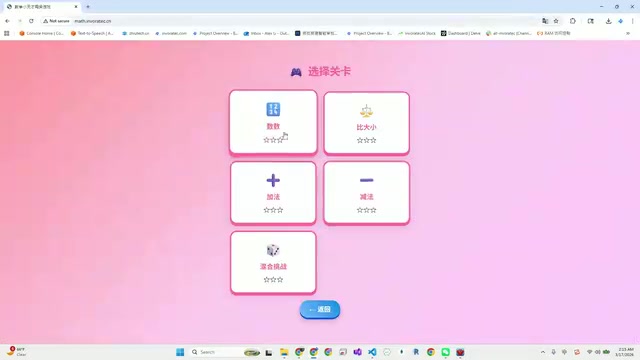
The author mentioned that he let his daughter try it out, and she ended up playing for an hour without wanting to stop. A dad's one-sentence request, and Tongyi Lingma AI helped him create a complete, publicly accessible game website.
What Does Zero-Code AI Website Building Mean?
From "Programmers Only" to "Accessible to Everyone"
The significance of this case goes far beyond a simple mini-game. It proves one thing: Anyone, regardless of whether they can write code, can turn their ideas into a real, online, publicly accessible web application simply by having a conversation with AI.

Consider these real-world scenarios:
- Want to create a customer survey? Tell AI your requirements, live in five minutes
- Want to build a company product page? Tell AI your requirements, live in five minutes
- Want to make an internal data dashboard? Tell AI your requirements, live in five minutes
- Want to create a personal portfolio website? Tell AI your requirements, live in five minutes
The barrier to website building has shrunk from three days to five minutes, from requiring professional programming skills to simply being able to speak.
Tongyi Lingma: The Capability Boundaries of an AI Full-Stack Engineer
In this scenario, Tongyi Lingma AI essentially plays the role of an AI full-stack engineer. In traditional software teams, a "full-stack engineer" refers to someone who masters both front-end and back-end development technologies and can independently complete the entire workflow from interface design to server deployment. Front-end engineers handle the user-facing interface and interactions, back-end engineers manage server logic and database operations, and DevOps engineers handle server configuration, deployment, and system monitoring. A full-stack engineer needs knowledge spanning all three domains—always a scarce and highly paid role in the job market. Tongyi Lingma AI uses the broad knowledge coverage of large language models to replace this cross-domain expertise that typically requires years of accumulation.
Its capabilities cover the complete website development pipeline:
| Capability Area | Specific Tasks |
|---|---|
| Front-end Development | Writing HTML structure, CSS styles, JavaScript interaction logic |
| Cloud Deployment | Configuring Alibaba Cloud OSS, uploading files, setting up static hosting |
| Operations Management | Binding domains, configuring DNS resolution, managing hosting rules |
These three areas traditionally require separate front-end engineers, back-end engineers, and DevOps engineers, but now Tongyi Lingma handles everything as a single AI tool.
A Realistic Perspective: Where Are the Limitations of AI Website Building?
Of course, we need to rationally assess the boundaries of AI website building capabilities. Currently, Tongyi Lingma AI's fully automated deployment is better suited for the following types of projects:
- Static websites and simple interactive pages: Product pages, personal homepages, online surveys, etc.
- Lightweight tools and mini-games: Like the math challenge game in this article
- Rapid prototype validation: Quickly verifying whether a product idea is feasible before formal development
It's important to understand the fundamental difference between static and dynamic websites. A static website means all page content is pre-generated on the server—when a user makes a request, fixed HTML files are returned directly, and every user sees identical content. Dynamic websites require server-side programs (such as Python, Java, PHP, etc.) to process user requests in real-time, reading data from databases to dynamically generate page content. For example, an e-commerce site displays different shopping cart contents based on login status, and social media platforms recommend different content feeds based on algorithms. Dynamic websites require continuously running back-end servers and persistent database connections, with architectural complexity and operational costs far exceeding static websites.
This explains why AI website building currently excels at static websites—it doesn't need to handle complex back-end logic like user authentication, data persistence, or concurrency control. For complex enterprise-level applications, back-end systems involving database read/write operations, and high-concurrency, high-traffic scenarios, professional development teams are still needed. However, it's undeniable that AI is expanding the boundaries of automated development at an astonishing pace—what can't be done today might be achievable tomorrow.
Conclusion: AI Website Building Is Redefining the Development Barrier
From "six months of learning to code + three days of deployment struggles" to "one sentence + five minutes of waiting," AI website building tools like Tongyi Lingma are redefining what it means to "build a website." The combination of fully automated coding and Alibaba Cloud deployment empowers ordinary people to quickly turn ideas in their heads into accessible online websites.
This isn't just an improvement in efficiency—it's a liberation of creativity. When technology is no longer the bottleneck, the only thing that truly matters is your idea itself.
Related articles
 Tutorials
ChatGPT Plus Subscription Guide: Are GPT-5.5, image-2, and Codex Worth the Upgrade?
A detailed look at ChatGPT Plus features — GPT-5.5, image-2, and Codex — with a Plus vs Pro comparison and a complete step-by-step subscription guide for users outside the US.
 Tutorials
Harness AI Engineering in Practice: Using Claude Code to Master Enterprise-Level E-Commerce Development
Deep dive into Harness AI Engineering: master enterprise e-commerce development with Claude Code using the Rules, Skills, Wiki, and Changes framework.
 Tutorials
Cursor + Codex Dual-IDE Collaboration: A Practical Methodology for Open-Source Project Customization
A complete methodology for open-source project customization based on real-world experience, detailing the Cursor+Codex dual-IDE workflow, seven-stage process, MVP validation, and AI source code reading techniques.