TRACE: A Private Communication Assistant That Teaches Language Models to "Read the Room"

TRACE steers a frozen LLM with three relationship feature layers for private email replies—better overall but style gains not significant.
This article interprets a study on personalization in one-to-many private communications. The TRACE system splits an author's linguistic features into author-level vocabulary habits, contact-specific phrasing, and temporal expression estimation, injecting each into a frozen LLM and using feedback-driven revision as real replies appear. On the Enron dataset (8 users, 216 test emails), TRACE's four configurations beat Base LLM and Base RAG on BLEU, ROUGE-L, and BERTScore with lower Reply Style MSE. But after multiple comparison correction, style gains were not statistically significant, ablations were mixed, and better state prediction didn't stably improve generation. The authors call the findings exploratory.
Why One-Size-Fits-All AI Writes Poor Personal Emails
Replying to your boss and messaging an old friend involve completely different word choices, tones, and rhythms. Yet current large language models tend to apply the same set of expression habits to every contact when generating replies, lacking any awareness of the "relationship." A study titled Personalized Language Models for One-to-Many Private Communications targets exactly this overlooked scenario: one-to-many private communications.
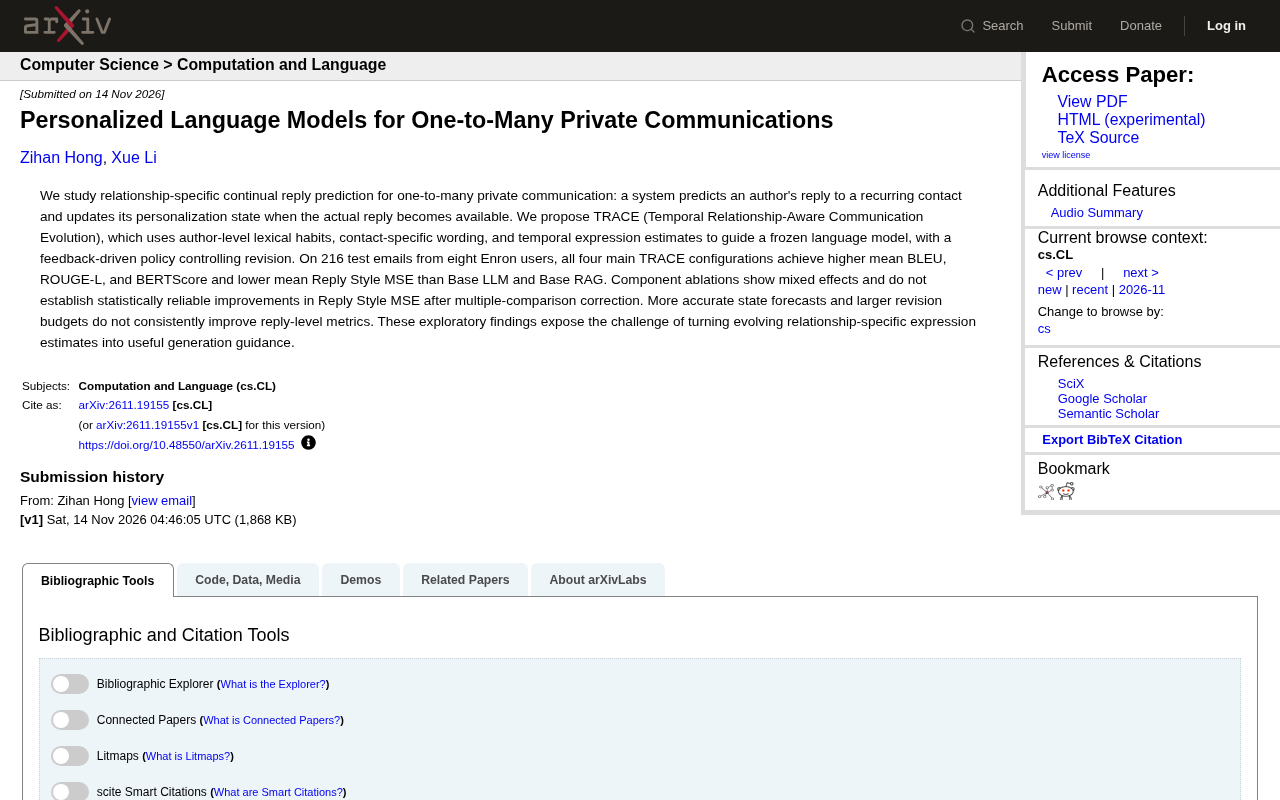
The researchers propose the TRACE (Temporal Relationship-Aware Communication Evolution) system, which aims to predict an author's reply to a frequently contacted person within an ongoing email exchange, continuously updating the personalized state as real replies appear. In effect, it lets the model remember "how you usually talk to this person," rather than broadly imitating your overall writing style.
TRACE's Three Layers of "Relationship Memory"
The core idea of TRACE is to decompose the author's linguistic characteristics into three granularities and feed each into a frozen language model.
Author-Level Vocabulary Habits
The first layer captures the author's own lexical preferences—the words and sentence patterns this person always favors regardless of whom they are writing to. This forms the foundation of personalization.
Author-level vocabulary habits are typically modeled via word frequency distributions or embedding vectors from the author's historical emails, forming a reusable "linguistic fingerprint." In TRACE, these features are concatenated as prefixes or soft prompts and fed into the frozen language model. Since the model parameters remain unchanged, all personalization information must be injected as external signals, so the design quality of the features directly determines the steering effectiveness.
Contact-Specific Phrasing
The second layer targets specific recipients. The same person may use wildly different phrasing with colleague A versus client B. TRACE captures "the distinctive expressions used when speaking to this person."
Contact-specific phrasing differs from author-level habits in its conditionality: the vocabulary differences a single author shows across different contacts may exceed the differences between different authors addressing the same contact. TRACE maintains an independent state representation for each frequent contact and updates it through interaction history with that author. This resembles user-item interaction modeling in recommender systems, except that here the "item" is the recipient and the feedback signal is the text of real replies.
Temporal Expression Estimation
The third layer involves the time dimension. Relationships evolve and reply styles drift over time, so the system attempts to estimate the expression state at the current point in time.
On top of these three layers, a feedback-driven policy controls the final generation: once a real reply appears, the system uses it to revise the personalized state. Throughout the process the language model itself remains frozen, and personalization is achieved entirely through external steering.
Temporal expression estimation addresses non-stationarity: linguistic style in interpersonal relationships shifts with events, seasons, or relationship stages. Ignoring the time dimension, the model might reply to a current email using the tone of several years ago. TRACE attempts to estimate the expression state at "the current moment," possibly using time-decay weighting or sequence models. However, the paper notes that more accurate state prediction did not stably improve generation metrics, indicating a remaining gap between temporal calibration and generative steering.
Experimental Performance: Overall Better Than Baselines, But Details Questionable
The study tested on eight users from the Enron email dataset, involving a total of 216 test emails. Evaluation metrics included BLEU, ROUGE-L, BERTScore, and Reply Style MSE (lower is better).
The results show that TRACE's four main configurations all outperformed the Base LLM and Base RAG baselines on average BLEU, ROUGE-L, and BERTScore, while also achieving lower average Reply Style MSE. Overall, introducing relationship-aware steering did bring improvements in generation quality.
But the researchers remained cautious. The component ablation experiments yielded "mixed" results, and after multiple comparison correction, the improvement in Reply Style MSE did not reach a statistically reliable level. In other words, the style similarity advantage could be noise.
Another counterintuitive finding: more accurate state prediction and larger revision budgets did not always stably improve reply-level metrics. This suggests a ceiling on the effectiveness of personalized steering—or that the current steering approach has yet to find the right lever.
Reply Style MSE is a metric measuring how close a generated reply is to a real reply in style. It is typically computed by mapping replies into a style feature space (e.g., word frequency, sentence length, sentiment polarity) and then taking the mean squared error. Lower values indicate closer style. Unlike word-overlap-based metrics such as BLEU and ROUGE, it focuses more on "how it is said" than "what is said."
Multiple comparison correction is a standard statistical practice: when testing multiple hypotheses simultaneously, the false positive rate accumulates, so the significance threshold for each individual test must be lowered (e.g., Bonferroni or Benjamini-Hochberg methods). The use of this correction in the paper indicates that the researchers performed significance tests on multiple metrics or configurations separately, and after correction the improvement in Reply Style MSE was no longer significant, meaning the advantage may be due to random fluctuation.
What This Research Reveals
The authors position their conclusions as "exploratory findings" and candidly state the core challenge: how to translate evolving relationship-specific expression estimates into genuinely useful generative steering.
Behind this lies a more general problem. Research on personalized language models has mostly focused on the single-user level—making the model like you. But the essence of private communication is relational: the same person presents different linguistic facades in different relationships. TRACE attempts to make "relationship" a first-class citizen of personalization. The direction is valuable, but the experimental results show that this path is far more complex than anticipated.
From an engineering perspective, the frozen-model-plus-external-steering approach has its appeal: no fine-tuning required, controllable deployment costs, and personalized states that can be maintained independently per contact. But how to design the feedback-driven revision policy and how to calibrate temporal estimation remain open questions.
For developers focused on deploying AI applications, this research offers a reminder: in private communication scenarios, generic writing assistants are hard to satisfy. True personalization requires modeling relationships, and the difficulty of relationship modeling is evident from TRACE's mixed ablation results.
Limitations and Outlook
The experimental scale is limited—eight users and just over two hundred emails—raising questions about sample representativeness. The mixed ablation results also indicate that the contributions of the three feature layers are unclear, and some components may be dragging down performance. The researchers did not shy away from these issues but explicitly flagged them as directions requiring further validation.
Why did more accurate state prediction not lead to better generation? It could be a disconnect between prediction accuracy and generation usability, or the revision budget allocation strategy may not be smart enough. The answers to these questions will determine whether relationship-aware personalization can move from exploration to practical application.
One-line Summary
TRACE uses three layers of relationship features to steer a frozen language model in generating private email replies, outperforming baselines overall but with no significant style improvement.
Paragraph Summary
This article interprets a study on personalization in one-to-many private communications. The researchers propose the TRACE system, which decomposes the author's linguistic characteristics into three granularities—author-level vocabulary habits, contact-specific phrasing, and temporal expression estimation—injects each into a frozen language model, and uses a feedback-driven policy to revise the personalized state as real replies appear. On the Enron dataset with eight users and 216 test emails, TRACE's four configurations outperformed Base LLM and Base RAG on BLEU, ROUGE-L, and BERTScore, with lower Reply Style MSE as well. However, after multiple comparison correction, the style metric improvement was not statistically significant; component ablations yielded mixed results; and more accurate state prediction and larger revision budgets did not stably improve generation quality. The authors position their conclusions as exploratory findings and note that practical relationship-aware personalization remains to be validated.
Related articles

Inside Honey Trap Training: Emotional Dissociation and Anchoring Techniques
How are spies trained for honey trap missions? A trainee reveals emotional dissociation, perfume and keyword anchoring, and target photo binding—psychological techniques that condition reflexes for intelligence work.

Frontier AI Risk Management: Full-Pipeline Practices from Training to Deployment
OpenAI outlines a frontier AI risk management framework: from training-stage model alignment to deployment-stage sandboxing and blocking safeguards, plus post-deployment monitoring—a layered risk control system across the model lifecycle.
DaisyRose-27B: 1,200-Task RL Boosts Qwen3.8 from 5.6% to 12% on Terminal-Bench 4.1
DaisyRose-27B uses RL training on 1,200 tasks to boost Qwen3.8's Terminal-Bench 4.1 score from 5.6% to 12%, showing lightweight RL can more than double terminal task performance.