TradingAgents-Astock: In-Depth Analysis of an Open-Source Multi-Agent Investment Research Framework for China's A-Share Market

TradingAgents-Astock is an open-source multi-Agent investment research framework deeply adapted for China's A-shares.
TradingAgents-Astock is a deep overhaul of the 65K-star GitHub project TradingAgents, delivering a fully open-source, zero-cost multi-Agent investment research framework for China's A-share market. Compared to the original and CN versions, it features zero-API-Key data source integration, 7 AI analysts (adding Policy, Hot Money, and Lock-up Expiry roles unique to A-shares), a quality gate mechanism, and a free Web UI with continuous open-source updates.
Project Background: From a 65K Star Popular Project to Deep A-Share Adaptation
TradingAgents is a popular multi-Agent investment research and analysis project on GitHub with 65K Stars. Multi-Agent System (MAS) is an important research direction in the field of artificial intelligence, referring to a system where multiple AI agents with autonomous decision-making capabilities work collaboratively. In investment research scenarios, each Agent is assigned a specific role and domain expertise, simulating the collective decision-making process of a real research team through information sharing and debate mechanisms — different Agents focus on different analytical dimensions, and a comprehensive conclusion is reached through structured information aggregation mechanisms. This approach offers stronger interpretability and robustness compared to a single large model directly outputting conclusions.
However, the original project primarily targets overseas markets, with virtually zero support for A-share trading rules, policy environments, and data sources.
Based on this pain point, developer 3101212 performed a deep overhaul of the original version and released TradingAgents-Astock — a fully open-source, free, and out-of-the-box multi-Agent investment research analysis framework for China's A-share market. This article provides a detailed breakdown of the project's core modifications and technical architecture.
Disclaimer: This article is based solely on research and technical analysis of the open-source project, intended for learning, exchange, and technical demonstration purposes only. It does not constitute any investment advice.
Horizontal Comparison of Three Versions: Original, CN, and Astock
Currently, there are three main Chinese versions based on TradingAgents: the Original, CN version, and Astock version. The differences between them are worth careful comparison.
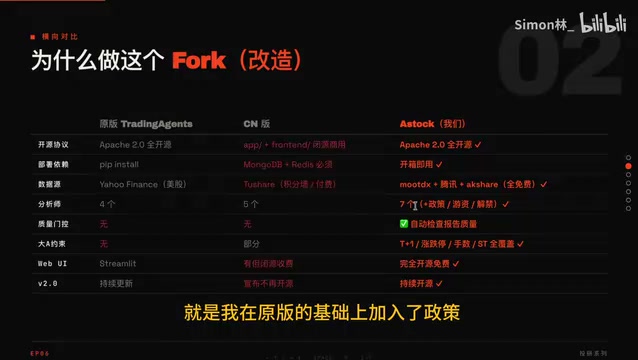
Open-Source License & Feature Completeness Comparison
| Dimension | Original | CN Version | Astock Version |
|---|---|---|---|
| Open-source license | Fully open-source | Closed-source commercial | Fully open-source, commercially usable |
| Data sources | Not very user-friendly | - | Out-of-the-box, zero cost |
| Number of analysts | 4 | 5 | 7 |
| Quality gate | None | None | Yes |
| A-share rule constraints | None | Partial | Complete |
| Web UI | Yes | Yes (paid) | Yes (free & open-source) |
| Continuous updates | Yes | Open-source discontinued | Continuously open-source |
From the comparison, we can see that the Astock version has clear advantages in terms of openness, feature completeness, and A-share adaptation. The CN version has announced it will no longer be open-sourced, while Astock is committed to continuous open-source updates — a key deciding factor for community developers.
Core Modification 1: Zero-Cost Data Source System
The original TradingAgents' data sources are not friendly to domestic Chinese users, often requiring API Keys or facing credit wall limitations. The Astock version integrates multiple high-quality data sources previously validated in the series into the multi-Agent system, achieving truly zero-cost, no API Key required, out-of-the-box functionality.
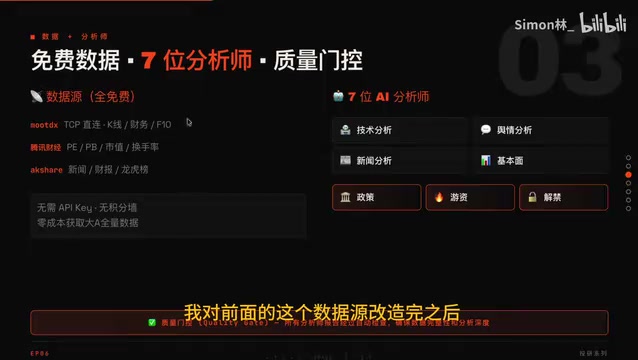
After cloning the project, users can access A-share market data, financial data, capital flow information, and other key data without any additional configuration, significantly lowering the barrier to entry.
Core Modification 2: Seven AI Analysts + Quality Gate Mechanism
Analyst Roles Expanded to Seven
The original version provides 4 analyst roles. Astock adds 3 new analytical dimensions with distinct A-share characteristics.
China's A-share market has a unique ecosystem that is significantly different from mature markets: It is heavily policy-driven, where regulatory bodies' industrial and monetary policies often directly influence sector trends; hot money (short-term speculative capital) is highly active, and the Dragon & Tiger List system gives large capital flows strong signal significance; restricted share unlocking is a supply shock mechanism unique to A-shares, where expectations of major shareholder sell-offs create systematic pressure on stock prices. These three dimensions have virtually no corresponding analytical frameworks in overseas mature markets, which is the fundamental reason why the original TradingAgents cannot be directly adapted for A-shares.
Targeting this ecosystem, the three new analyst roles added by Astock are:
- Policy Analyst: Focuses on interpreting and analyzing the impact of domestic macro policies and industry policies — critically important in A-share investment research
- Hot Money Analyst: Tracks the Dragon & Tiger List, hot money movements, and other market behaviors unique to A-shares
- Lock-up Expiry Analyst: Analyzes the potential impact of restricted share unlocking on individual stocks
These three new dimensions precisely target the unique ecosystem of the A-share market — areas that overseas investment research frameworks simply cannot cover.
Quality Gate: Ensuring Analysis Report Reliability
This is one of the most innovative modifications in the Astock version. The Quality Gate concept originates from continuous integration practices in software engineering, referring to mandatory quality checks set at critical process nodes that block subsequent processes if standards are not met. Introducing this into LLM multi-Agent workflows is significant: large language models suffer from "hallucination" issues, potentially generating analysis content that appears reasonable but is actually incorrect. If foundational analysis reports contain data errors or logical flaws, subsequent bull-bear debates and risk control assessments will operate on false premises, creating a "garbage in, garbage out" problem.
Related articles
Deep Dive into AI Agent Skill Design: …
Deep Dive into AI Agent Skill Design: Engineering Practices from Anthropic and Perplexity
A deep dive into Skill design philosophy from Anthropic's Claude Code team and Perplexity's Agent team, covering the Tax Test, Gotchas Flywheel, progressive disclosure, and Eval-First practices for building high-quality AI Agent skill systems.
Deep Dive into OpenAI's Official GPT-5…
Deep Dive into OpenAI's Official GPT-5.6 Prompting Guide: The Shift from Manual to Automatic
A deep dive into OpenAI's official GPT-5.6 Sol prompting guide: conciseness-first, outcome-oriented design, autonomy boundaries, tool routing, and reasoning intensity tuning.
 Deep Dives
Deep Dive into How OpenClaw (Open-Source Crayfish) AI Agent Works
Deep analysis of OpenClaw AI Agent internals: System Prompt, tool calling, SubAgents, Skill system, memory, and Context Engineering explained.