Traditional RAG vs. Context Graphs: How Do You Decide Which Wins?
Neither traditional RAG nor context graphs is inherently better—the choice depends on query complexity, data structure, and engineering cost.
The article addresses how to judge whether traditional RAG or context graphs are better. Traditional RAG recalls isolated chunks via vector search—simple and suited to single-point factual queries—while context graphs build entity-relationship networks and excel at multi-hop reasoning. The author proposes three criteria: query complexity and interrelatedness, the natural form of the data structure, and the choice of evaluation metrics. It emphasizes A/B testing on real business query sets rather than public benchmarks, and notes that graph maintenance costs are often underestimated. The conclusion: hybrid approaches (vector recall plus graph-based relationship expansion) are often more practical than choosing one, and selection should balance business complexity against engineering cost.
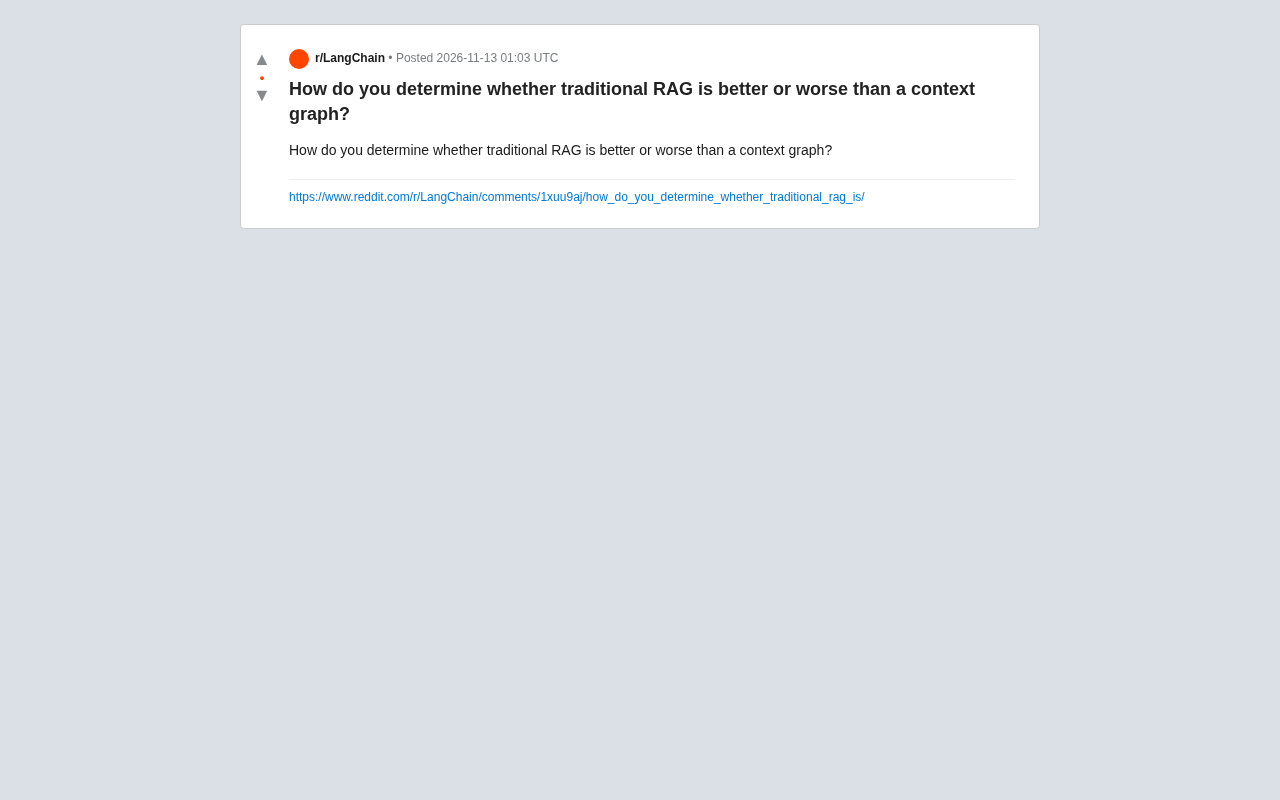
When building knowledge applications on top of large language models, retrieval-augmented generation (RAG) has become the mainstream paradigm. But recently, an approach called "Context Graph" has entered the discussion. A developer on Reddit raised a pointed question: How do you determine whether traditional RAG is better or worse than a context graph? Behind this question lies widespread confusion over the criteria for choosing between the two technical approaches.
The fundamental difference between the two approaches
The core logic of traditional RAG is "retrieve–concatenate–generate": vectorize the user query, recall the most similar text chunks from an external knowledge base, concatenate them into a prompt, and hand it to the model to generate an answer. Its advantages are simple implementation and a mature ecosystem, and it is notably effective for factual question answering.
Context graphs go further. Rather than merely retrieving isolated chunks, they attempt to build a network of relationships between entities—similar to a knowledge graph, but with more emphasis on dynamically organizing context at inference time. When a question involves multi-hop relationships (for example, "Which competitors does company B—funded by A's founder—have?"), a graph structure can provide more coherent context, whereas traditional RAG may recall a pile of unrelated documents.
The original Reddit poster did not provide a specific scenario, but the question itself hints at a key point: there is no absolute better or worse, only whether it matches the task requirements.
Retrieval-Augmented Generation (RAG) is a technical paradigm that combines external knowledge retrieval with large language model generation. Its typical pipeline has three steps: first, the user query is converted into a vector via an embedding model (such as text-embedding-3); second, an approximate nearest neighbor search is performed in a vector database to recall the document chunks most semantically similar to the query; finally, these chunks are concatenated into the prompt as context, and the large language model generates the final answer. The core value of RAG lies in mitigating model hallucination, overcoming the timeliness limitations of training data, and allowing the system to access private knowledge without retraining the model.
A knowledge graph is a data model that organizes knowledge in a graph structure, where nodes represent entities (such as people, companies, products) and edges represent relationships between entities (such as "founder" or "competitor"). Unlike vector retrieval, knowledge graphs emphasize explicit structured associations and support multi-hop queries and relational reasoning. A context graph can be seen as a dynamic application of knowledge graphs in reasoning scenarios: it not only stores static relationships but also dynamically prunes and organizes subgraphs based on the query when generating answers, thereby providing the model with more coherent and logically consistent context.
Criterion one: query complexity and interrelatedness
If your application mainly handles single-point factual queries ("How long is the warranty period for a product?"), traditional RAG is usually sufficient and more economical. Vector similarity retrieval can quickly hit the answer chunk, and the extra overhead of graph construction is not worthwhile.
But when queries require reasoning across documents and entities, the advantages of context graphs become apparent. In medical diagnosis assistance, for example, the associations among symptoms, medications, and medical history are crucial; in financial risk control, corporate equity networks and transaction chains need to be considered simultaneously. In such scenarios, traditional RAG easily loses key relationships because recalled chunks are fragmented.
A practical way to decide is: measure the proportion of user queries that involve associations among multiple entities. If the proportion is high, it is worth evaluating a graph approach.
Multi-hop relational reasoning refers to queries that require traversing multiple entities and relationships to answer. For example, "Which competitors does company B—funded by A's founder—have?" requires first finding A's founder, then finding company B that this founder invested in, and finally retrieving B's competitors—involving at least three relationship hops. Traditional RAG recalls based on vector similarity, computing relevance for each chunk independently, so it is difficult to ensure that entities along a multi-hop path are recalled simultaneously and correctly connected. Context graphs explicitly preserve edges between entities through the graph structure, allowing reasoning to traverse along paths, thereby handling such queries more reliably. This difference is one of the key bases for judging the applicability of the two approaches.
Criterion two: the natural form of the data structure
Traditional RAG is friendly to unstructured text; documents, web pages, and chat logs can all be directly chunked and indexed. Context graphs, by contrast, require data from which entities and relationships can be extracted—this usually requires an additional information extraction pipeline, and the extraction quality directly affects the final results.
If your data is itself highly structured (database tables, JSON returned by APIs), the cost of building a graph is much lower; conversely, if the data is a large amount of free text with fuzzy entity boundaries, the investment in building a graph may not pay off. Some developers in the Reddit discussion also pointed out that the maintenance cost of graphs is often underestimated—entity disambiguation and relationship updates are ongoing engineering burdens.
Information extraction is the process of automatically identifying entities, relationships, and attributes from unstructured text, with common tasks including named entity recognition (NER) and relation extraction (RE). Building a context graph usually requires first performing information extraction on the original documents to transform free text into "entity–relationship–entity" triples. Extraction quality directly determines the usability of the graph: fuzzy entity boundaries, incorrect coreference resolution, or unclear definitions of relationship types all lead to the accumulation of graph noise. In addition, entity disambiguation (determining whether "Apple" refers to the company or the fruit) and relationship updates (synchronizing the graph when corporate equity changes) are ongoing maintenance work whose engineering costs are often underestimated in the early stages of a project. Therefore, whether the data itself has a clear entity-relationship structure is an important prerequisite for evaluating the feasibility of a graph approach.
Criterion three: the choice of evaluation metrics
To answer "which is better," you must define how "better" is measured. Traditional RAG commonly uses metrics such as hit rate and answer faithfulness; context graphs require additional evaluation of relationship coverage and multi-hop reasoning accuracy.
It is recommended to run A/B comparisons on real business query sets rather than relying on public benchmarks. This is because the benefits of graphs depend heavily on the association density of domain data—in domains with sparse associations, graphs may actually be inferior to simple retrieval.
Hybrid approaches are often the best solution
Many practitioners favor a compromise: use traditional RAG for the first layer of recall, then use a lightweight graph for relationship expansion. This preserves the efficiency and coverage of vector retrieval while introducing structured associations when needed. Although the original Reddit post did not elaborate on specific implementations, the question itself reflects the community's reflection on "either-or" thinking—the end goal of selection is not to pick a side, but to find the balance point that matches business complexity.
Ultimately, judging the merits of traditional RAG versus context graphs comes back to three questions: How complex are the queries? How structured is the data? How much engineering cost are you willing to pay for relational reasoning? The answers vary by scenario, and that is precisely why this question is worth discussing.
Related articles

Nvidia CEO Removal Saga: Trump Intervenes Over the Weekend, Jensen Huang Reinstated Monday
Vergecast podcast reveals Nvidia CEO drama: earnings call said he wouldn't return and a new CEO was being sought; Trump intervened over the weekend, with J.D. Vance brokering a security guarantee to the board; Jensen Huang reinstated at 9 a.m. Monday.
Semantic Caching Explained: Reusing the Same Answer for Similar Questions
Semantic caching uses embeddings to judge whether queries are similar in meaning and reuses cached results for similar prompts. This article explains how it works, the difficulty of threshold tuning (such as the risk of misjudging negations), and its applicable boundaries.

How Did Trump Personally Turn Nvidia into the "Twelfth Board Member"?
A YouTube political commentary offers a sharp view: behind Nvidia's market cap milestone, Trump's deep involvement earns him the title of "twelfth board member." The article breaks down the commentator's logic on stock market achievements, the break from small-government tradition, and power display.