Trae AI Coding Tool: Download, Installation & Configuration Guide (2025 Latest)

Trae is ByteDance's free AI-native code editor, ideal for Python and AI development beginners.
Trae is an AI-native code editor from ByteDance with built-in LLMs including Doubao and DeepSeek, supporting Chinese conversations and natural language code generation. It's directly accessible in China, completely free for personal use, and compatible with the VS Code plugin ecosystem, with over 6 million registered users. This article covers Trae's download and installation, login configuration, Python environment setup, and hands-on AI-assisted coding workflows.
What is Trae AI Coding Tool
Trae is an AI-native code editor launched by ByteDance, with built-in large language models including Doubao, DeepSeekAd, GPT, and more. Unlike traditional code editors, Trae not only helps developers with code completion but also understands natural language descriptions to directly generate runnable code, explain complex logic, and even automatically fix bugs.
It's worth noting that the fundamental difference between an AI-native code editor and a traditional one is that AI capabilities aren't "attached" as plugins—they're deeply integrated into the editor's core architecture. Traditional editors like VS Code implement AI completion through plugins like GitHub Copilot, whereas AI-native editors embed LLM reasoning capabilities into underlying processes such as code parsing, context understanding, and project-level awareness. This enables cross-file code structure understanding, rather than merely completing code at the current cursor position.
For Python beginners and AI developers, Trae provides a low-barrier, high-efficiency programming environment that's particularly well-suited for learning and building projects with AI frameworks like LangChain.
Three Core Advantages of Trae
Direct Access in China, Free with Chinese Language Support
Trae's biggest advantage is direct accessibility within China without any special network configuration. It natively supports Chinese conversations, allowing users to describe programming needs in natural Chinese—even those unfamiliar with English can smoothly leverage AI coding capabilities.
More importantly, Trae's personal edition is completely free, with built-in LLMs like Doubao and DeepSeek available at no cost. This is highly competitive among similar AI coding tools. LLMs like Doubao, DeepSeek, and GPT are essentially pre-trained on massive code corpora (such as GitHub open-source code and technical documentation) for code generation scenarios, learning programming language syntax rules, common design patterns, and API calling conventions. When users input natural language descriptions, the model understands requirements through its context window and outputs in code form. DeepSeek performs exceptionally well on code tasks—its specialized model DeepSeek-Coder achieves internationally leading results across multiple programming benchmarks, which is a key reason Trae includes it as one of its core models.
Perfect Compatibility with the VS Code Plugin Ecosystem
Trae is compatible with the VS Code plugin ecosystem, supporting all existing mainstream plugins. If you previously used VS Code, migrating to Trae involves virtually no learning curve—your existing plugins and workflows transfer seamlessly.
VS Code was released by Microsoft in 2015 and has become the world's most popular code editor, holding the top position for multiple consecutive years in the Stack Overflow 2024 Developer Survey with over 70% market share. Its plugin marketplace offers more than 50,000 extensions, covering nearly every development scenario from language support and code formatting to database management. Trae's choice to be compatible with the VS Code plugin ecosystem means developers don't need to abandon their existing toolchain investments—frequently used plugins like Python, Pylance, and GitLens can all run directly in Trae. This is a key strategy for reducing migration costs.
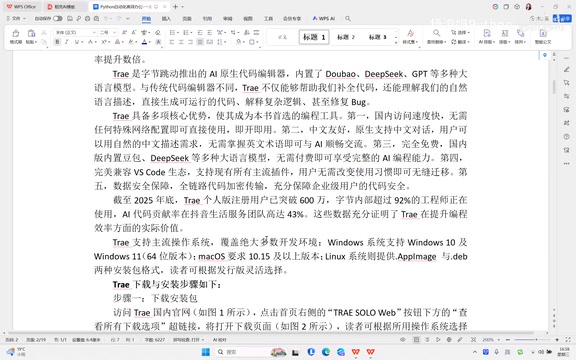
Trae supports Windows, macOS, and Linux—the three major operating systems—covering the vast majority of developer use cases.
User Scale Validates Product Strength
As of late 2025, Trae's personal edition has surpassed 6 million registered users, with over 92% of engineers within ByteDance using it in their daily work. In Douyin's life services team, the AI code contribution rate reaches as high as 43%. These figures clearly demonstrate Trae's practical value in improving programming efficiency.
Trae Download and Installation Steps
Step 1: Download the Installer
Visit the Trae official website (trae.com.cn), where you'll see a green download button on the right side of the page. Click "View all download options" below it, then select the appropriate version for your operating system.
Step 2: Run the Installation
After downloading, double-click the installer to begin:
- On the agreement screen, select "I agree to this agreement" and click Next
- Choose the installation directory—a location with ample disk space is recommended
- Follow the installation wizard, clicking Next through each step, then click Finish

After installation, a "Trae CN" shortcut icon will appear on your desktop.
First Launch and Login Configuration
Double-click the Trae CN icon on your desktop to launch the program. The first launch requires completing the following configurations:
- Choose a theme: Select light or dark theme based on personal preference
- Preference settings: Use the default configuration
- Install command-line tools: Click "Install Trae CN command" to configure the CLI tool
- Select user type: Choose "Personal user"
- Register and log in: Register and log in using your phone number
After successful login, the editor interface is divided into three main areas: the Activity Bar on the far left (vertically arranged function icons), the code editing area in the middle, and the AI chat window on the right.
Python Environment Configuration
Before writing Python code in Trae, you need to install the Python extension:
- Find the Extensions icon (four-square icon) in the left Activity Bar
- Type "Python" in the search box, find the Python extension, and click Install
- Restart the extension after installation
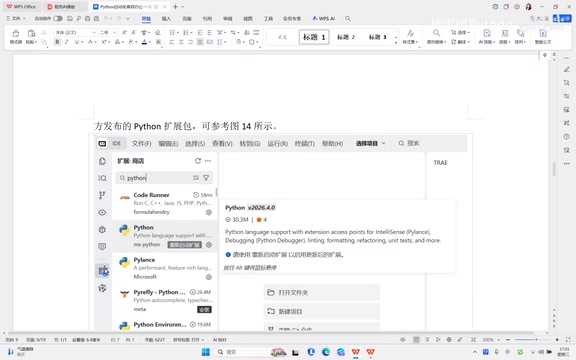
After installation, press Ctrl + Shift + P to open the Command Palette, type Python: Select Interpreter, and detect and select the Python interpreter version installed on your system.
The Python interpreter is the program that translates and executes Python source code line by line. A single computer may have multiple Python versions installed simultaneously (e.g., Python 3.9, 3.11, 3.12), and different projects may depend on different versions. The Python: Select Interpreter command tells the editor which Python environment the current project should use. In actual AI development, it's strongly recommended to create an independent virtual environment for each project (using python -m venv or conda) to avoid dependency version conflicts between projects—this is especially important when installing libraries with complex dependency trees like LangChain. This step ensures Trae can correctly identify and run Python code.
Hands-On: Writing Your First Python Program with AI
Once configuration is complete, you can start experiencing Trae's AI-assisted coding capabilities.
Create a File and Let AI Generate Code
- Right-click in the File Explorer, select "New File," and create a Python file with a
.pyextension - In the AI chat window on the right, describe your needs in natural language

For example, enter the following prompt:
Write a Python function that takes a name as a parameter and prints "Hello, welcome to learning
Related articles
 Tutorials
ChatGPT Plus Subscription Guide: Are GPT-5.5, image-2, and Codex Worth the Upgrade?
A detailed look at ChatGPT Plus features — GPT-5.5, image-2, and Codex — with a Plus vs Pro comparison and a complete step-by-step subscription guide for users outside the US.
 Tutorials
Harness AI Engineering in Practice: Using Claude Code to Master Enterprise-Level E-Commerce Development
Deep dive into Harness AI Engineering: master enterprise e-commerce development with Claude Code using the Rules, Skills, Wiki, and Changes framework.
 Tutorials
Cursor + Codex Dual-IDE Collaboration: A Practical Methodology for Open-Source Project Customization
A complete methodology for open-source project customization based on real-world experience, detailing the Cursor+Codex dual-IDE workflow, seven-stage process, MVP validation, and AI source code reading techniques.