Train a 436M-Parameter Model Easily on a MacBook, Outperforming Jev

A developer fine-tuned a 436M-parameter small model on an M4 MacBook in half an hour, surpassing Jev with just 1,000 samples.
A developer used only a MacBook with an M4 chip to fine-tune a 436-million-parameter small model on about 1,000 samples in roughly half an hour, yet it outperformed the well-known model Jev in multiple scenarios. This practice challenges the common belief that "bigger is better" and shows that for vertical scenarios, fine-tuning a small model with a small amount of high-quality data can yield efficient and accurate results. Consumer-grade hardware is sufficient for such training, offering individual developers and small teams a new way to rapidly iterate AI applications at low cost, though the generalizability of the conclusion still needs more verification.
In the AI field, massive models with hundreds of billions of parameters seem to grab all the spotlight. However, one developer's practice shows that small-scale, highly customized models can also deliver surprises. Using just a MacBook with an M4 chip, he trained a 436-million-parameter model that outperforms the well-known model Jev in multiple scenarios.

The Big Power of Small Models: How 436M Parameters Beat Jev
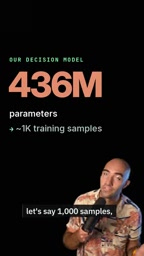
In a video, the developer shared his core finding: by fine-tuning a pretrained 436-million-parameter (436M) small model on a very small amount of data, you can achieve significant performance gains. He mentioned that the training data requires only about one thousand samples.
"You can take a small fine-tuned model, like a 436-million-parameter model, train it on a very small training set, like a thousand samples, and then you can beat Jev in every scenario I've encountered so far," he said in the video.
This conclusion challenges the common belief that "bigger is better." For many specific tasks, a carefully fine-tuned small model may be more efficient and accurate than a general-purpose large model.
Fine-tuning refers to the technique of continuing to train an already pretrained model with a small-scale dataset for a specific task, adapting the model to downstream scenarios. Compared with training from scratch, fine-tuning costs very little, usually requiring only a small number of labeled samples and a short amount of time. The "thousand-sample fine-tuning" in this article falls into this category: the pretrained model already possesses general language capabilities, and fine-tuning only needs to adjust some parameters to bias it toward a specific task distribution. Common variants include full-parameter fine-tuning and parameter-efficient fine-tuning (such as LoRA), the latter further reducing memory and compute requirements. Fine-tuning results depend heavily on the quality of the pretrained model and task relevance, so choosing an appropriate base model is a key prerequisite.
A Training Miracle on Consumer-Grade Hardware
Even more impressive is the hardware required for training. All training was done on his personal M4-chip MacBook, with no need for expensive GPU clusters. Training time is also quite short—about half an hour to train a model.
This means individual developers and small teams can quickly iterate and deploy AI models for specific tasks at extremely low cost. This opens new doors for democratizing AI applications.
The M4 chip is Apple's in-house system-on-chip (SoC) that uses a Unified Memory Architecture, where the CPU, GPU, and neural engine share the same high-bandwidth memory. This design avoids the overhead of repeatedly copying data between CPU and GPU memory in traditional PCs, which is especially beneficial for training small models. The M4's neural engine is optimized for matrix operations and, combined with frameworks such as Metal Performance Shaders, can directly execute model training on a MacBook. However, unified memory capacity is limited (typically up to tens of GB), so it is more suitable for models with parameter counts in the hundreds of millions or below; hundred-billion-parameter models still require multi-GPU clusters.
Implications for Developers
This practical case offers several important takeaways:
- Data quality beats quantity: Fine-tuning with a small number of high-quality samples can yield good results.
- Small models + fine-tuning is a viable path: For vertical scenarios, there is no need to blindly pursue large models.
- Consumer-grade hardware is sufficient: The compute power of M-series chips can already meet the needs of small-model training.
Of course, the scope of this conclusion still needs more verification. But it does provide a new approach for developing AI applications efficiently and at low cost.
(Note: The specific referent of Jev is not clearly stated in the original material and may be a particular model or system.)
Vertical scenarios refer to specific application domains with clear requirements and relatively concentrated data distributions, such as legal document review, medical Q&A, and customer service ticket classification. Although general-purpose large models have broad coverage, they often perform mediocrely in vertical scenarios due to a lack of domain knowledge; small models fine-tuned on domain data can capture task features more precisely, while offering lower inference costs, faster responses, and easier private deployment. Note that the quality of sample annotation in vertical scenarios directly affects fine-tuning results, and small models still lag behind large models on open tasks that require extensive world knowledge. Therefore, "small models + fine-tuning" is better suited to implementation scenarios with clear task boundaries and accessible data.
Related articles

Nothing CMF Buds 2A Drops to $17.89 on Black Friday: A New Low for ANC Earbuds
Nothing CMF Buds 2A wireless earbuds Black Friday deal: just $17.89 on Amazon, about $11 off retail and a record low. ANC earbuds at an entry-level price.

When AI Creation Gets Accused of "Spitting": Hacker News Heats Up Over the Glaude Controversy
A Hacker News post, "Spitting in the Face of Glaude," sparks debate on AI creation transparency and attribution ethics. This analysis examines the blurred creator identity behind the controversy and offers practical advice for AI content production.

Akai Embraces Custom Firmware: MPC Sample 1.4 Lets Users AI-Program Their Sampler
Akai embraces the modding community with MPC Sample 1.4 firmware, supporting vibe-coded custom firmware and effects. We analyze the impact of this open strategy on music hardware and AI-assisted programming.